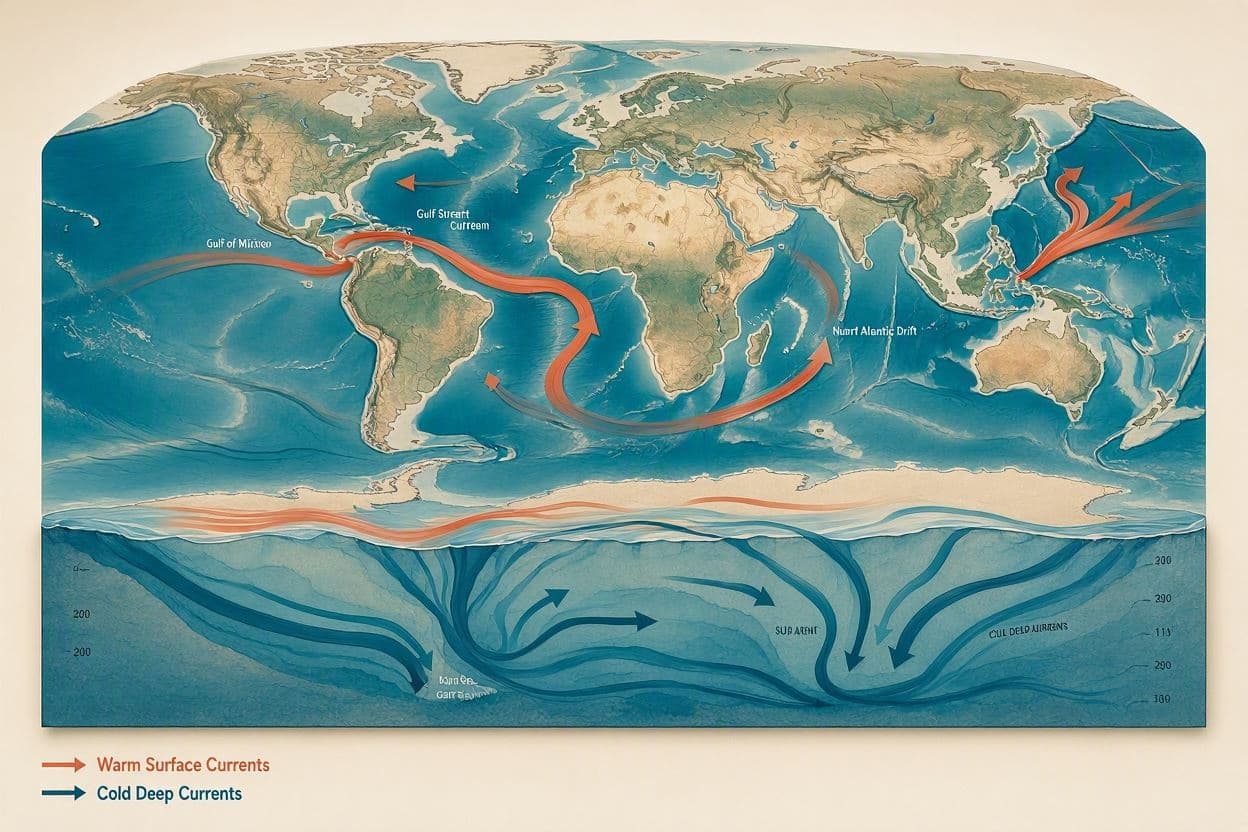
Deep beneath the waves of the Atlantic Ocean, a massive conveyor belt of water moves heat from the tropics to the north, regulating the climate of Europe and beyond. This system, known as the Atlantic Meridional Overturning Circulation (AMOC), has long been a subject of intense scientific study. Recently, however, climate models have begun to diverge in their predictions, raising questions about the stability of this crucial current and the timeline for any potential collapse.
The AMOC works by transporting warm, salty water northward, where it cools, becomes denser, and sinks, driving a deep return flow south. This process helps keep northern Europe warmer than it would otherwise be at such high latitudes. But as global temperatures rise and ice sheets melt, fresh water is pouring into the North Atlantic, potentially diluting the saltiness and weakening the sinking mechanism. The concern is that this could slow down or even stop the circulation entirely.
Recent modeling efforts have produced a range of outcomes. Some models suggest a gradual weakening over the coming century, while others hint at a more abrupt tipping point that could occur sooner than previously thought. This discrepancy has sparked debate within the scientific community about which models are most reliable and how to interpret the conflicting data. The uncertainty is not a sign of failure but rather a reflection of the complexity of the Earth’s climate system.
Researchers are working to refine these models by incorporating more detailed observations of ocean salinity, temperature, and current speeds. Satellite data and deep-ocean sensors provide real-time information that helps validate and adjust theoretical predictions. By comparing model outputs with actual measurements, scientists can identify biases and improve the accuracy of future projections. This iterative process is essential for building confidence in climate forecasts.
The stakes are high. A significant slowdown or collapse of the AMOC could lead to dramatic cooling in Europe, altered rainfall patterns in the tropics, and rising sea levels along the US East Coast. Such changes would have profound impacts on agriculture, ecosystems, and human settlements. Understanding the likelihood and timing of these scenarios is crucial for effective adaptation planning.
Despite the uncertainties, there is consensus that the AMOC is weakening. The question is no longer if it is changing, but how fast and how far it will go. Policymakers are urged to consider worst-case scenarios in their long-term strategies, ensuring resilience against potential climate shocks. Preparedness is key to mitigating the risks associated with such a major systemic shift.
As the science evolves, so too does our understanding of the planet’s delicate balance. The ongoing refinement of AMOC models highlights the importance of continued research and international cooperation. In the face of climate change, knowledge is our best tool for navigating the uncertain waters ahead.
AI Image Disclaimer: The visual content in this article is AI-generated to depict the concepts of ocean circulation and climate modeling.
Sources: Nature Communications, IPCC Reports, Yale Climate Connections
Published by Banx Network. This article is part of the Banx decentralized media programme, powered by the BXE token on the XRP Ledger.