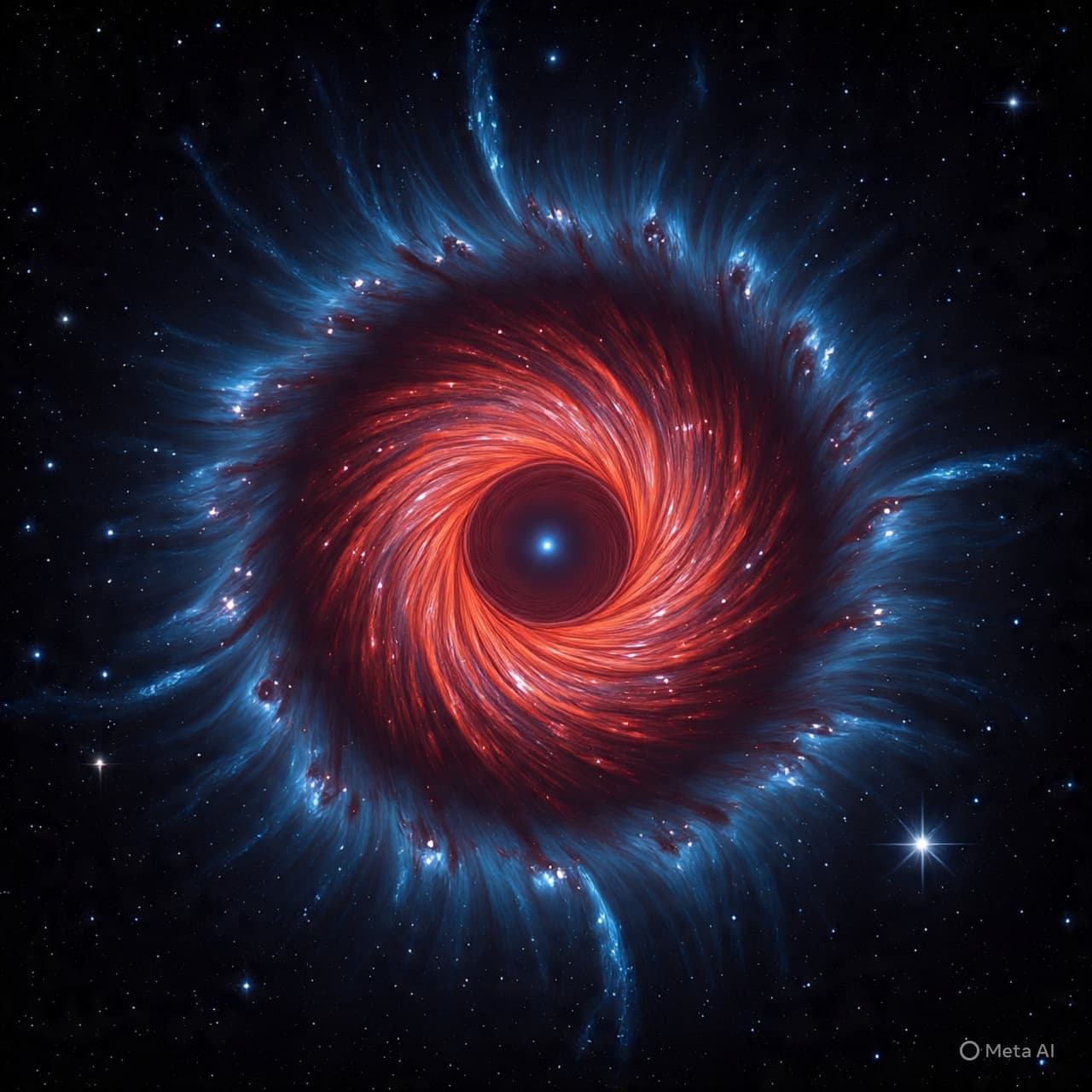
There is something humbling about a star in its later years. Swollen, luminous, and steady in its glow, a red giant appears serene from a distance — as though time itself has softened its edges. Yet beneath that calm radiance, motion persists. Deep currents swirl, unseen, reshaping the star from within.
Now, using powerful supercomputer simulations, researchers have found that rotation plays a decisive role in driving chemical mixing inside these aging stars. The finding offers a quiet but meaningful answer to a question that has lingered in astrophysics for decades: why do the chemical signatures on a red giant’s surface shift in ways earlier models struggled to explain?
Red giants represent a late phase in stellar evolution. After exhausting hydrogen in their cores, stars like our Sun expand dramatically, their outer layers cooling even as internal processes grow more complex. Astronomers have long observed that certain elements — particularly isotopes of carbon and nitrogen — appear in unexpected ratios at the surface of these stars. The puzzle was not that change occurred, but how efficiently it seemed to happen.
The new research suggests that the answer lies in spin.
Through high-resolution, three-dimensional hydrodynamical simulations run on advanced supercomputing systems, scientists modeled how rotation influences internal stellar flows. What emerged was a portrait of motion far more dynamic than traditional, non-rotating models predicted. As a red giant rotates, even slowly, it induces instabilities and circulation patterns that transport material from deeper layers upward. Elements forged or altered in the star’s interior are gradually carried toward the surface.
This rotational mixing appears to be significantly more effective than earlier assumptions allowed.
It is not a violent upheaval but a steady stirring — a cosmic blending that unfolds over immense spans of time. Yet its effects are measurable. Surface abundances change. Spectral fingerprints shift. Observations that once seemed anomalous now align more naturally with theoretical predictions.
Supercomputers made this clarity possible. Stellar interiors cannot be sampled directly; they must be understood through models that solve complex equations governing fluid motion, thermodynamics, and nuclear processes. The computational demands are immense. By simulating full three-dimensional stellar behavior, rather than relying solely on simplified approximations, researchers could capture subtle instabilities that emerge only when rotation is fully considered.
The implications extend beyond red giants alone.
Improved understanding of chemical transport refines broader models of stellar evolution, influencing how scientists estimate stellar ages and reconstruct galactic chemical histories. Because stars manufacture and redistribute elements throughout the cosmos, even incremental adjustments to mixing mechanisms ripple outward into our understanding of galaxies and planetary systems.
There is also a quiet relevance closer to home. Billions of years from now, our own Sun will enter its red giant phase. While humanity will not witness that transformation, studying present-day red giants offers a preview of that distant future. The same physical principles — gravity, rotation, convection — will govern its evolution.
What makes this discovery resonate is not only its technical sophistication, but its reminder that even seemingly placid stars are animated by motion within. Rotation, once considered a secondary detail in some stellar models, now appears to be a guiding force in shaping chemical identity.
In astronomy, answers often emerge not from a single revelation, but from refinement — from improving resolution, adding complexity, and allowing nature’s subtleties to surface. The new simulations do not overturn stellar theory. Rather, they gently adjust it, bringing models into closer harmony with observation.
Researchers continue to analyze the results and compare them with observational data from telescopes studying evolved stars across the galaxy. Further computational studies may explore how rotation interacts with magnetic fields and other instabilities.
For now, the finding offers a steady advance in understanding: as red giants turn, they stir themselves from within. And in that slow, dignified rotation, the chemistry of the cosmos quietly rearranges.
AI Image Disclaimer Graphics are AI-generated and intended for representation, not reality. There is something humbling about a star in its later years. Swollen, luminous, and steady in its glow, a red giant appears serene from a distance — as though time itself has softened its edges. Yet beneath that calm radiance, motion persists. Deep currents swirl, unseen, reshaping the star from within.
Now, using powerful supercomputer simulations, researchers have found that rotation plays a decisive role in driving chemical mixing inside these aging stars. The finding offers a quiet but meaningful answer to a question that has lingered in astrophysics for decades: why do the chemical signatures on a red giant’s surface shift in ways earlier models struggled to explain?
Red giants represent a late phase in stellar evolution. After exhausting hydrogen in their cores, stars like our Sun expand dramatically, their outer layers cooling even as internal processes grow more complex. Astronomers have long observed that certain elements — particularly isotopes of carbon and nitrogen — appear in unexpected ratios at the surface of these stars. The puzzle was not that change occurred, but how efficiently it seemed to happen.
The new research suggests that the answer lies in spin.
Through high-resolution, three-dimensional hydrodynamical simulations run on advanced supercomputing systems, scientists modeled how rotation influences internal stellar flows. What emerged was a portrait of motion far more dynamic than traditional, non-rotating models predicted. As a red giant rotates, even slowly, it induces instabilities and circulation patterns that transport material from deeper layers upward. Elements forged or altered in the star’s interior are gradually carried toward the surface.
This rotational mixing appears to be significantly more effective than earlier assumptions allowed.
It is not a violent upheaval but a steady stirring — a cosmic blending that unfolds over immense spans of time. Yet its effects are measurable. Surface abundances change. Spectral fingerprints shift. Observations that once seemed anomalous now align more naturally with theoretical predictions.
Supercomputers made this clarity possible. Stellar interiors cannot be sampled directly; they must be understood through models that solve complex equations governing fluid motion, thermodynamics, and nuclear processes. The computational demands are immense. By simulating full three-dimensional stellar behavior, rather than relying solely on simplified approximations, researchers could capture subtle instabilities that emerge only when rotation is fully considered.
The implications extend beyond red giants alone.
Improved understanding of chemical transport refines broader models of stellar evolution, influencing how scientists estimate stellar ages and reconstruct galactic chemical histories. Because stars manufacture and redistribute elements throughout the cosmos, even incremental adjustments to mixing mechanisms ripple outward into our understanding of galaxies and planetary systems.
There is also a quiet relevance closer to home. Billions of years from now, our own Sun will enter its red giant phase. While humanity will not witness that transformation, studying present-day red giants offers a preview of that distant future. The same physical principles — gravity, rotation, convection — will govern its evolution.
What makes this discovery resonate is not only its technical sophistication, but its reminder that even seemingly placid stars are animated by motion within. Rotation, once considered a secondary detail in some stellar models, now appears to be a guiding force in shaping chemical identity.
In astronomy, answers often emerge not from a single revelation, but from refinement — from improving resolution, adding complexity, and allowing nature’s subtleties to surface. The new simulations do not overturn stellar theory. Rather, they gently adjust it, bringing models into closer harmony with observation.
Researchers continue to analyze the results and compare them with observational data from telescopes studying evolved stars across the galaxy. Further computational studies may explore how rotation interacts with magnetic fields and other instabilities.
For now, the finding offers a steady advance in understanding: as red giants turn, they stir themselves from within. And in that slow, dignified rotation, the chemistry of the cosmos quietly rearranges.
AI Image Disclaimer Graphics are AI-generated and intended for representation, not reality.
Source Check
Credible coverage of this research appears in:
Phys.org EurekAlert! Interesting Engineering Science Magazine Space.com
Published by Banx Network. This article is part of the Banx decentralized media programme, powered by the BXE token on the XRP Ledger.