There is a particular kind of question that animates evolutionary biology: when two lineages arrive at similar solutions, did they inherit the answer from a common ancestor, or did they find it twice? Flight is one of those solutions, a capability so demanding that it has appeared only four times in the history of animals—in insects, pterosaurs, birds, and bats. But among the dinosaurs most closely related to birds, the record is messier, filled with feathered creatures that could glide, or flap, or perhaps do something in between. A new fossil from China suggests that the apparatus for flight was assembled not once but independently, in a lineage that never became birds.
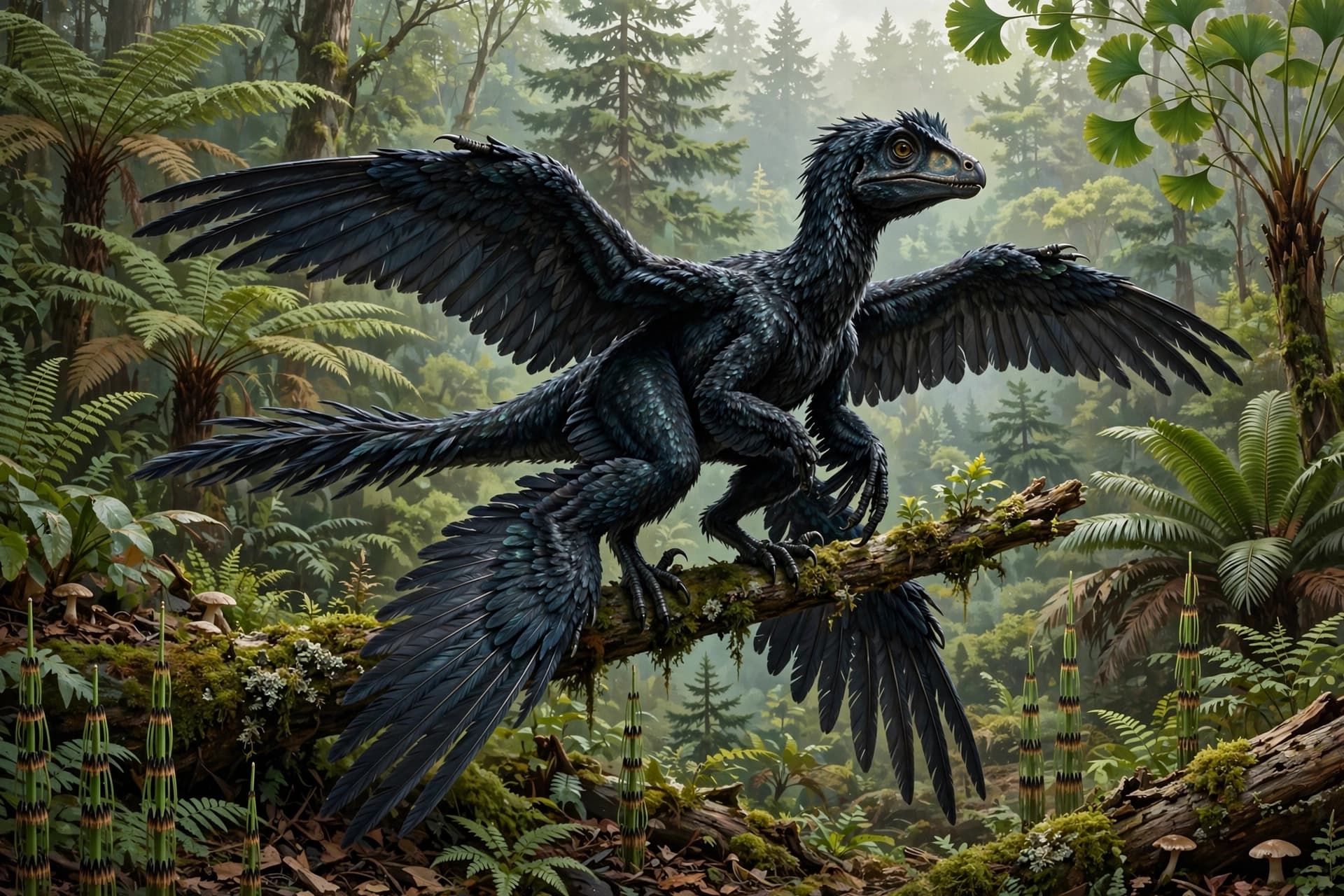
The specimen is a new species called Norellraptor barsboldi, a microraptorine dinosaur found in the Lower Cretaceous Jiufotang Formation of Liaoning, China . The fossil is exceptionally well-preserved: a complete skeleton measuring 57 centimeters, with parts of its plumage intact. Analysis indicates it was at least three years old when it died . Microraptorines were small, bird-like predatory dinosaurs with feathers on both forelimbs and hindlimbs, and they are among the closest non-bird relatives of modern birds.
What makes the fossil significant is not its preservation alone but what it reveals when placed in an evolutionary context. Researchers led by Andrea Cau compared the specimen's anatomy across an evolutionary tree and found that approximately 30 percent of the anatomical changes identified across microraptorine evolution also evolved in the bird lineage—but in a different order . This finding challenges the idea that microraptorines and birds inherited either a common flight apparatus or a shared developmental process that drove its evolution.
The argument turns on timing. In living birds, there is a trade-off between the growth rates of the front limbs and the hind limbs. The hind limbs become usable first, while the wings take longer to mature . But microscopic analysis of bone structure suggests that in microraptorines, there was no such difference—or in some cases, the reverse was true, with forelimbs developing relatively early . This hints that the developmental pathway toward flight was assembled differently in the two lineages, shaped by different selective pressures rather than inherited from a common ancestor.
The debate is not new. A 2020 paper in Current Biology concluded that powered flight might have originated independently in three other paravian lineages: Unenlagiinae, Microraptorinae, and Anchiornithinae . That claim was contested the following year by researchers who argued that the parameters used—wing loading and specific lift—cannot distinguish between powered flight and passive gliding. Gliding vertebrates like flying squirrels and flying fish have wing loading values lower than the proposed threshold, and some birds that glide long distances have values indistinguishable from those that flap . The question of whether microraptorines truly achieved powered flight, or something less, remains unresolved.
What the new fossil adds is not a definitive answer but a clearer picture of the process. The authors conclude that different selective pressures probably shaped the flight-related features of each lineage, and that further fossil and bone-growth evidence will be needed to test how widespread this pattern was among bird-like dinosaurs . The microraptorines, in other words, may have been experimenting with the same physical problem—how to move through air—but arriving at solutions through their own evolutionary paths, not by inheriting a blueprint.
The broader lesson is about the nature of evolutionary innovation. Flight is often imagined as a singular achievement, a threshold crossed once and then refined. The fossil record of bird-like dinosaurs suggests something more plural: multiple lineages, each assembling the prerequisites for aerial locomotion in their own way, some succeeding, some failing, and only one giving rise to the birds that survive today. Norellraptor barsboldi is a reminder that the path to the sky was not a single road but a branching network of experiments, most of which ended in extinction.
AI Image Disclaimer: The images in this article were generated by artificial intelligence and are not photographs of the actual fossil specimen.
Sources: IFLScience, Nature Communications, Scimex, Current Biology, EurekAlert
Published by Banx Network. This article is part of the Banx decentralized media programme, powered by the BXE token on the XRP Ledger.