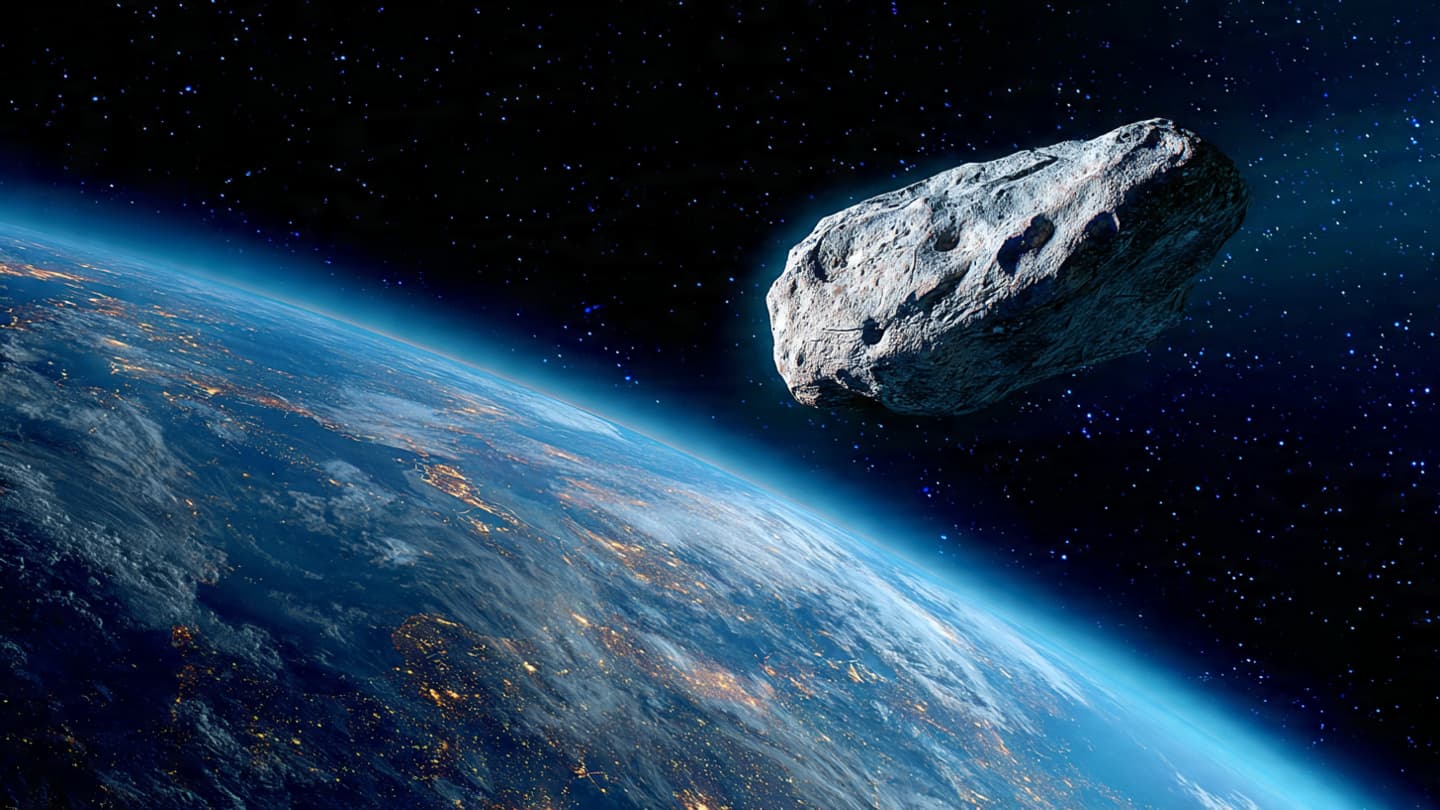
The night sky has always carried the quiet movement of countless objects, from distant stars to wandering asteroids. Modern astronomy has transformed these distant travelers from mysterious lights into carefully monitored neighbors. NASA recently tracked an airplane-sized asteroid passing near Earth, adding another entry to the growing catalog of near-Earth objects observed by scientists.
Near-Earth asteroids are rocky bodies whose orbits bring them relatively close to our planet. Thousands have been identified, and new discoveries occur regularly as telescope technology improves. Most of these objects pose no threat and simply continue their paths around the Sun.
According to NASA's tracking data, the recently observed asteroid passed Earth at a safe distance. Although described as a close approach in astronomical terms, the object remained far from creating any danger to people or infrastructure.
Planetary defense programs monitor these events continuously. Ground-based observatories and space-based instruments work together to calculate asteroid trajectories and refine predictions about future movements. The collected information helps scientists maintain accurate long-term records.
Studying asteroids provides more than safety benefits. Many are considered remnants from the early Solar System and preserve clues about the conditions that existed billions of years ago. Their composition may help researchers understand how planets formed and evolved.
NASA and other space agencies have also developed projects to test asteroid deflection technologies. Experimental missions demonstrate methods that could one day alter the path of a potentially hazardous object, should the need ever arise.
Public interest in asteroid flybys often increases with media coverage, but scientists encourage people to view these events within their proper scientific context. Close approaches are common, and careful monitoring provides reliable information about potential risks.
International cooperation strengthens asteroid research. Observatories and scientific institutions around the world exchange data to improve tracking accuracy and support planetary defense initiatives.
The latest asteroid flyby offers another reminder that Earth travels through an active cosmic environment. Through observation and research, scientists continue to deepen understanding of the Solar System while helping safeguard the future.
AI Image Disclaimer: The illustration accompanying this article was generated using AI for visual interpretation.
Sources: NASA, Reuters, Live Science, European Space Agency
Published by Banx Network. This article is part of the Banx decentralized media programme, powered by the BXE token on the XRP Ledger.