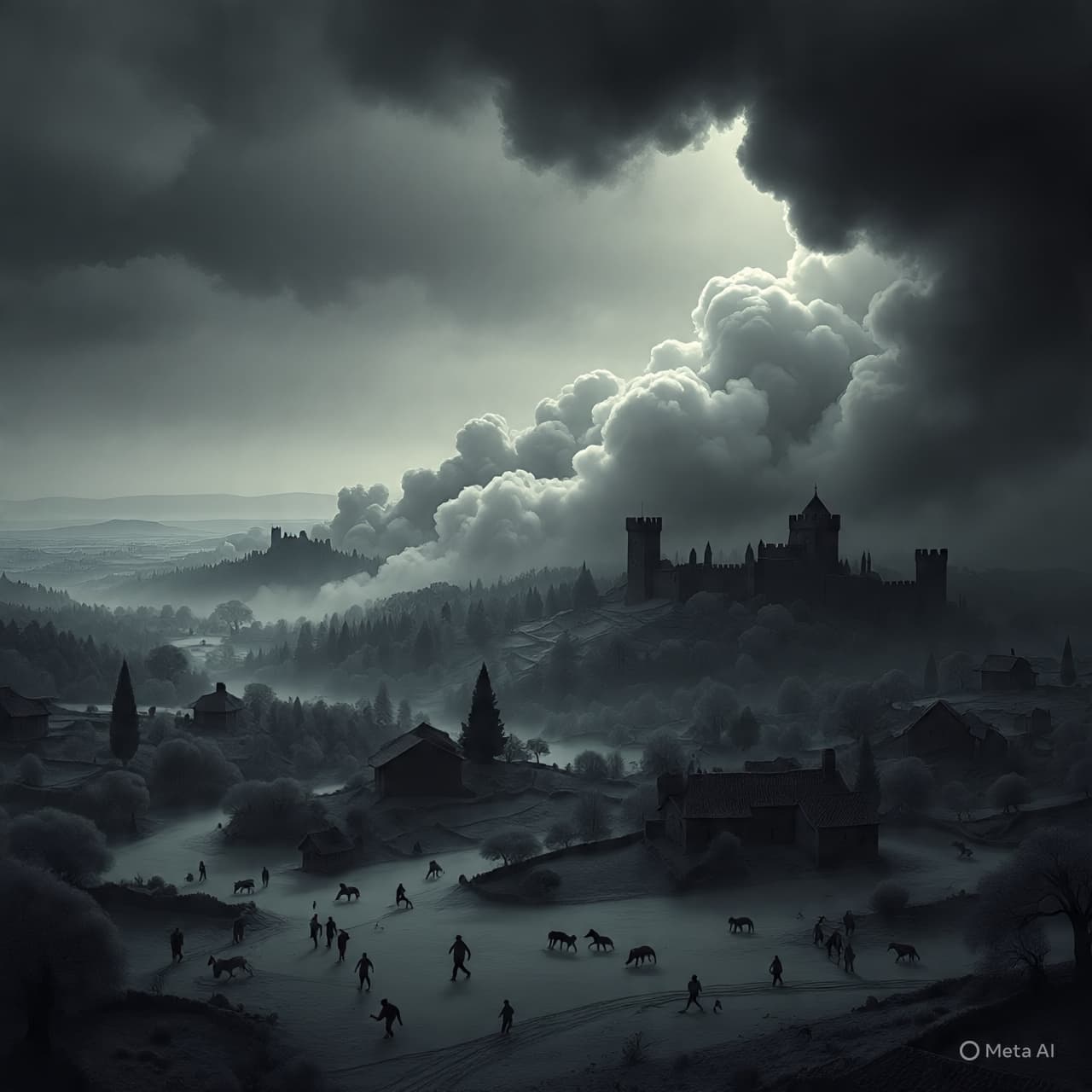
From a sky heavy with ash — dust carried far beyond any horizon — came an unseen cloud that would wash over Europe’s fields and cities. That haze, born of fire and brimstone far from medieval shores, may have faintly drawn the first brushstroke of one of history’s darkest canvases. The flame of a distant volcano — or perhaps several — might have ignited a chain of events that culminated in the sweeping devastation of the Black Death.
Imagine a Mediterranean summer gone wrong: sun dimmed, air chilled, rain more frequent, and crops failing beneath a stubborn gray sky. According to new research, around the year 1345, a volcanic eruption (or cluster of eruptions) — likely from the tropics — spewed sulfur and ash high into the atmosphere. This aerosol veil reduced sunlight, cooled the climate for several years, and led to anomalous cold, wet summers across southern Europe.
That climatic downturn didn’t just bite into the seasons — it hollowed out granaries. Fields that once yielded grain, grapes, and other staples faltered. Famine threatened many communities. According to the study authors, to stave off starvation, maritime city‑states such as Venice, Genoa, and others turned to distant suppliers around the Black Sea and imported large quantities of grain.
But the grain came with a fatal stowaway: the bacterium Yersinia pestis — carried by fleas and rats that had hitched a ride on the ships. Once in port cities, the conditions were ripe for plague transmission: crowded, unsanitary, and vulnerable after famine and hardship. From those harbors the plague spread rapidly, engulfing towns and countryside alike.
In this light, the Black Death was not simply a matter of disease biology — it was a perfect storm of environment, climate, commerce, and human desperation. The volcanic eruption set off a domino effect: ash → climate cooling → harvest failure → famine → grain imports → plague introduction → pandemic. Any one of those links might have blunted the crisis, but together they unleashed catastrophe.
Still, many questions remain unanswered. The exact volcano (or volcanoes) remains unidentified. While the climate and trade‑based theory makes sense of why the timeline of the plague matches the 1340s, the earlier paths of Y. pestis — how it moved from Central Asia to the Black Sea — are still obscure.
Looking back now, centuries removed, the new findings remind us how fragile human societies can be when nature’s forces align against them. They also hint at a deeper truth: when environment, economy, and human networks intertwine — a spark anywhere can become a conflagration everywhere.
In factual terms: a recently published interdisciplinary study argues that volcanic eruptions around 1345 triggered climate cooling and subsequent famine, pushing medieval European city‑states to import grain — a chain of events that may have enabled the plague that became the Black Death. This hypothesis reframes how historians and scientists understand the pandemic’s origins.
AI image disclaimer: “Graphics are AI-generated and intended for representation, not real photographs.”
Sources (media / outlets) National Geographic; Scientific American; The Washington Post; EurekAlert! / SciTechDaily; LiveScience
Published by Banx Network. This article is part of the Banx decentralized media programme, powered by the BXE token on the XRP Ledger.


.jpg&w=3840&q=75 "September 2026 Was the Second-Warmest on Record, With Global Temperatures Above 1.5°C for a Second Month")