There is a particular kind of mystery that emerges when the ordinary rules seem to be suspended, when something that should be inert behaves as though it has a will of its own. Two rocks pulled from the seafloor off the Pacific coast, brought to a laboratory and prepared for study, did something that rocks are not supposed to do: they began to smoke, then heat up, then burn. The temperature exceeded 100 degrees Celsius, and by the end, the original material had been completely oxidized, transformed by a reaction no one had asked it to perform .
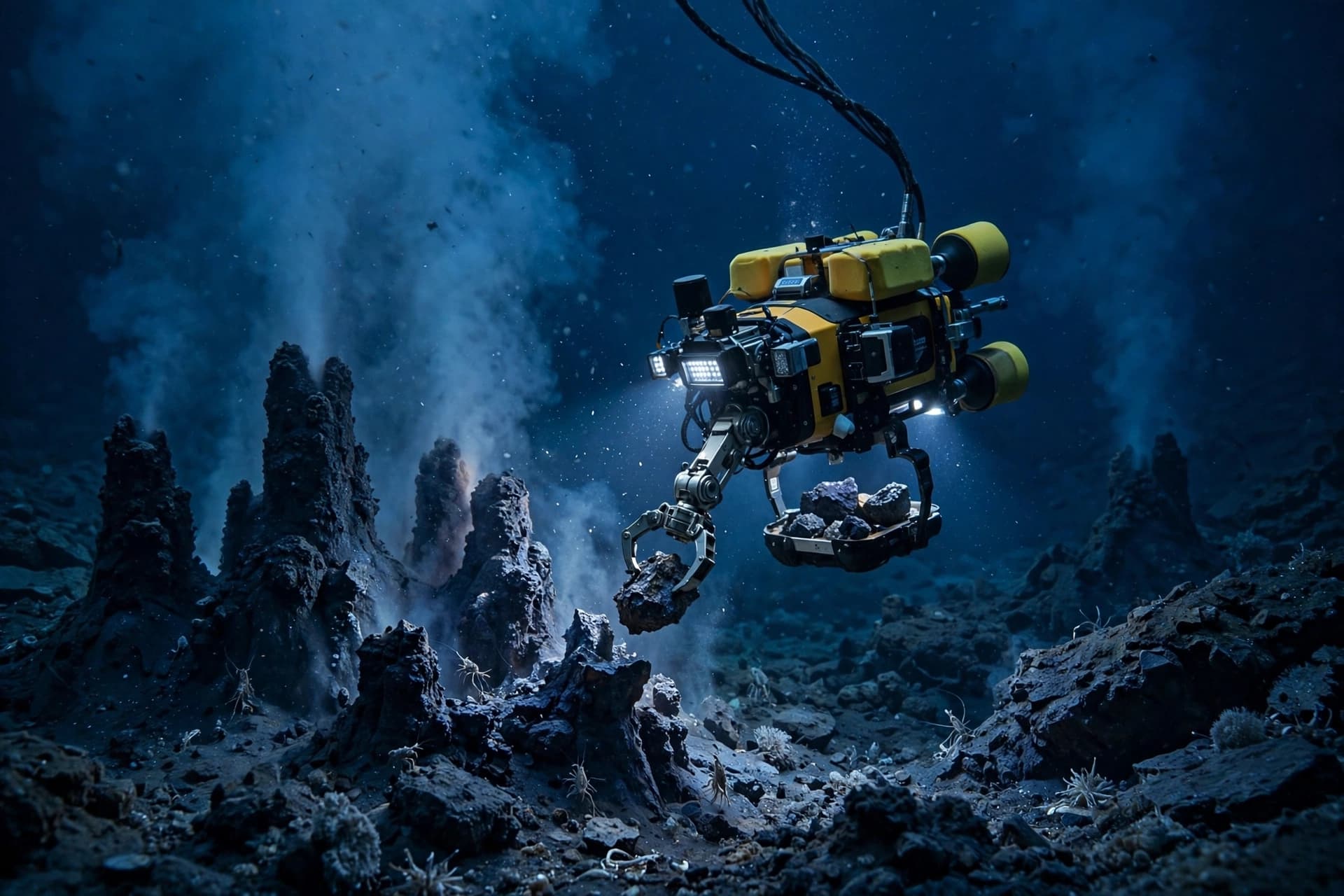
The rocks came from the Escanaba Trough, a volcanic zone at the southern end of the Gorda Ridge off the Oregon-California border, where the seafloor is slowly pulling apart . Researchers from the U.S. Geological Survey collected fifty-seven samples there in 2022 using a remotely operated vehicle, and most of them contained metal sulfides—compounds of metals and sulfur that form at hydrothermal vents . The samples were freeze-dried and prepared for analysis. When researchers broke two of them apart by hand, exposing fresh surfaces, the reaction began.
The culprit, according to a study in Scientific Reports, is a fragile form of iron sulfide called nanocrystalline marcasite . The crystals in these rocks measured only five to sixteen nanometers across—thousands of times thinner than a human hair. This extreme fineness gives oxygen an enormous amount of surface area to react with. The oxidation of iron sulfides releases heat, and when the heat builds faster than it can escape, the rock can keep warming itself until it burns .
On the seafloor, conditions were entirely different. The rocks sat in water of roughly two degrees Celsius, with relatively little oxygen, conditions that slowed the reaction and helped the unstable mineral survive . Pull the rock into warm, oxygen-rich air, and the chemistry changes. The mechanical action of breaking the rock apart may also have played a role, exposing fresh surfaces and triggering the reaction that the cold ocean had kept dormant .
The discovery has implications beyond the laboratory. Seafloor sulfide deposits, which can hold copper, zinc, and other valuable metals, are being explored as a potential source of minerals. The International Seabed Authority has granted exploration contracts for such deposits, covering parts of the Mid-Atlantic Ridge and the Indian Ocean . Yet no engineering controls exist for mining these deposits, and the authors warn that the chemistry could cause rapid-onset fires aboard ships, where the rocks would be exposed to air, temperature changes, and mechanical processing .
The study does not suggest that all deep-sea rocks are flammable, or that mining them is inherently dangerous. Only two of the forty-one sulfide-rich samples ignited, and both came from the same southern area of the trough . The researchers emphasize that the risk of spontaneous heating and combustion must be assessed for each site, and that safety measures used for onshore ore may not apply to deep-sea rocks . The cold, dark, high-pressure world where these rocks formed is very different from the one where they were opened.
For a rock that spent millennia in the quiet darkness of the deep ocean, the laboratory was a shock. It had been stable in its own world, its unstable mineral protected by cold and oxygen-poor water. Exposed to air, it revealed a chemistry that had been waiting all along. The question is not why it burned, but what else the deep sea holds that we do not yet understand.
AI Image Disclaimer: The visual content in this article was generated by artificial intelligence and is for illustrative purposes only.
Sources:
· Scientific Reports · U.S. Geological Survey · Techlicious · Scinexx
Published by Banx Network. This article is part of the Banx decentralized media programme, powered by the BXE token on the XRP Ledger.