There is a particular poetry in the idea of flight on a world where the air is barely there, a machine lifting itself against a sky that offers almost nothing to push against. NASA's Ingenuity helicopter proved it was possible, making history as the first powered aircraft to fly on another planet. But Ingenuity was a technology demonstration, a small craft with a camera and no science instruments, and its flights were measured in hundreds of meters rather than kilometers. The next generation is being designed to go farther.
Researchers at NASA's Ames Research Center, working with Imperial College London and Nagoya University in Japan, have developed a new rotor blade airfoil called roamx-0201. Using high-fidelity computer simulations and wind tunnel tests, they found that the redesigned blades could enable future Mars helicopters to expand the distance covered in a single uninterrupted flight from Ingenuity's 0.7 kilometers to as much as 18.7 kilometers while carrying scientific instruments . The findings were published in a journal of the American Institute of Aeronautics and Astronautics.
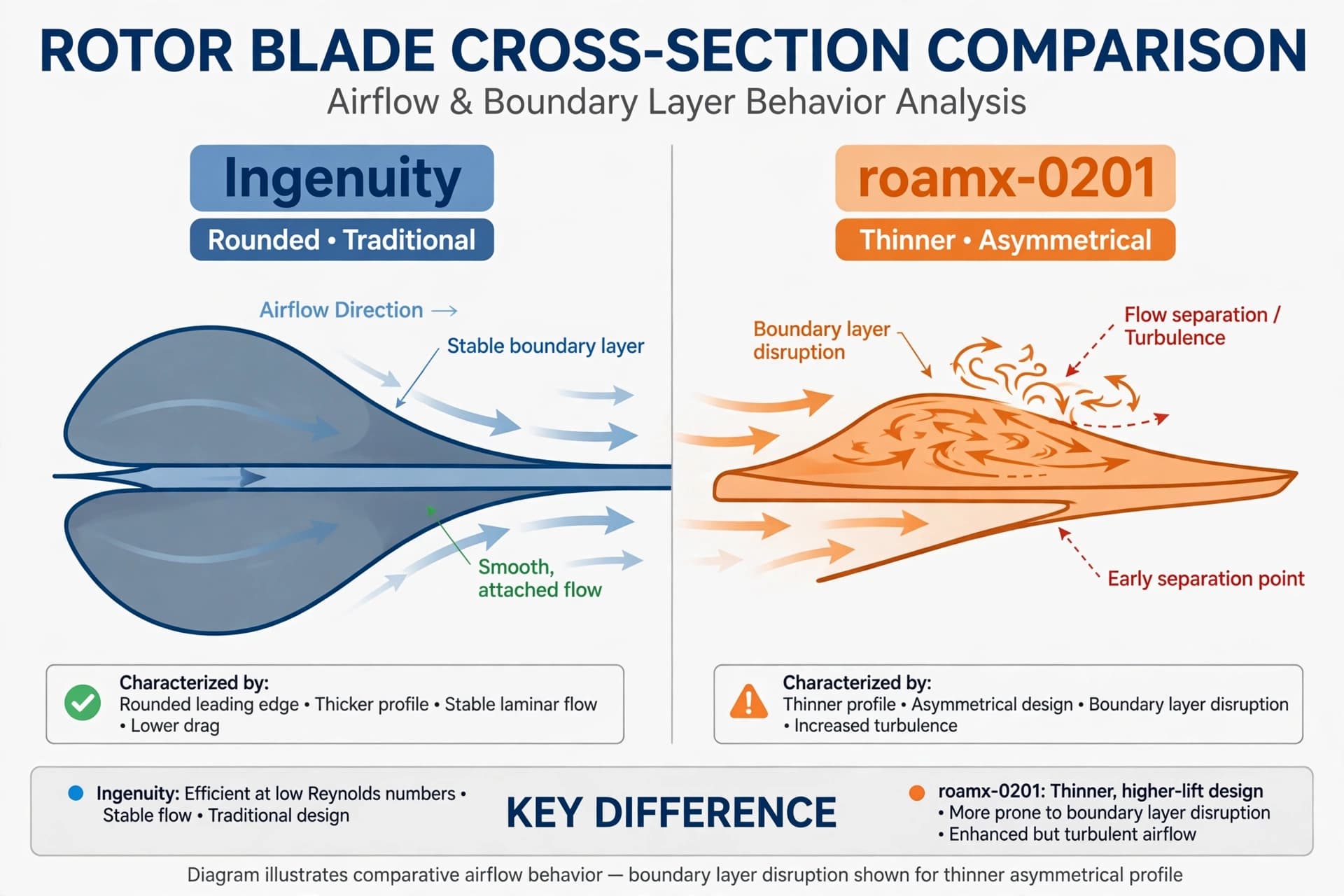
The design is counterintuitive in a way that reflects the strange physics of the Martian atmosphere. The new airfoil is thinner and sharper than Ingenuity's more traditional, rounded blade, and it intentionally disrupts the flow of the boundary layer—the thin region of air that forms as it flows over the blade—at the leading edge. This disturbance, counterintuitively, pulls the blade upward and helps lift the rotorcraft more effectively . The shape was arrived at through advanced simulations and algorithms tuned specifically to Mars conditions, not adapted from Earth designs.
The performance gains extend beyond simple lift. The roamx-0201 blades were able to operate longer at higher speeds before experiencing "drag divergence," the sudden drop in performance that occurs when rotors approach the speed of sound—which is lower on Mars than on Earth due to the thin, cold, carbon-dioxide-rich atmosphere . The new design also showed significantly improved behavior at stall, the aerodynamic condition where performance drops sharply and flight becomes unstable. Ingenuity's blades experienced steep degradation at stall; the new design could allow future helicopters to operate safely at a wider range of flight angles .
The context for this work is the SkyFall mission, scheduled for launch in 2028, which will send a trio of helicopters to Mars. Those aircraft will use a blade designed to operate in the thin atmosphere, distinct from Ingenuity's but not yet the full roamx-0201 design. The research is laying groundwork for missions after SkyFall, for helicopters that can fly higher, farther, and carry more . The technology is not yet ready for Mars, and tests are helping engineers understand discrepancies between computational predictions and real-world performance.
There is a quiet significance in the fact that this work is happening at all. Mars exploration has been dominated by rovers and orbiters, machines that move slowly or not at all. A helicopter capable of covering eighteen kilometers in a single flight would change the geometry of exploration, allowing scientists to survey terrain that rovers cannot reach and orbiters cannot see closely. The blade is a small thing, a cross-section of composite material. But it is the difference between a demonstration and a tool.
For now, the simulations and wind tunnel tests continue. The blades have not yet flown on Mars. But the numbers suggest that the next generation of Martian aircraft will not be limited to the short hops of its predecessor. The sky, thin as it is, is opening.
---
AI Image Disclaimer: The visuals in this article are generated by artificial intelligence and are intended for illustrative purposes only.
Sources: NASA, American Institute of Aeronautics and Astronautics
Published by Banx Network. This article is part of the Banx decentralized media programme, powered by the BXE token on the XRP Ledger.