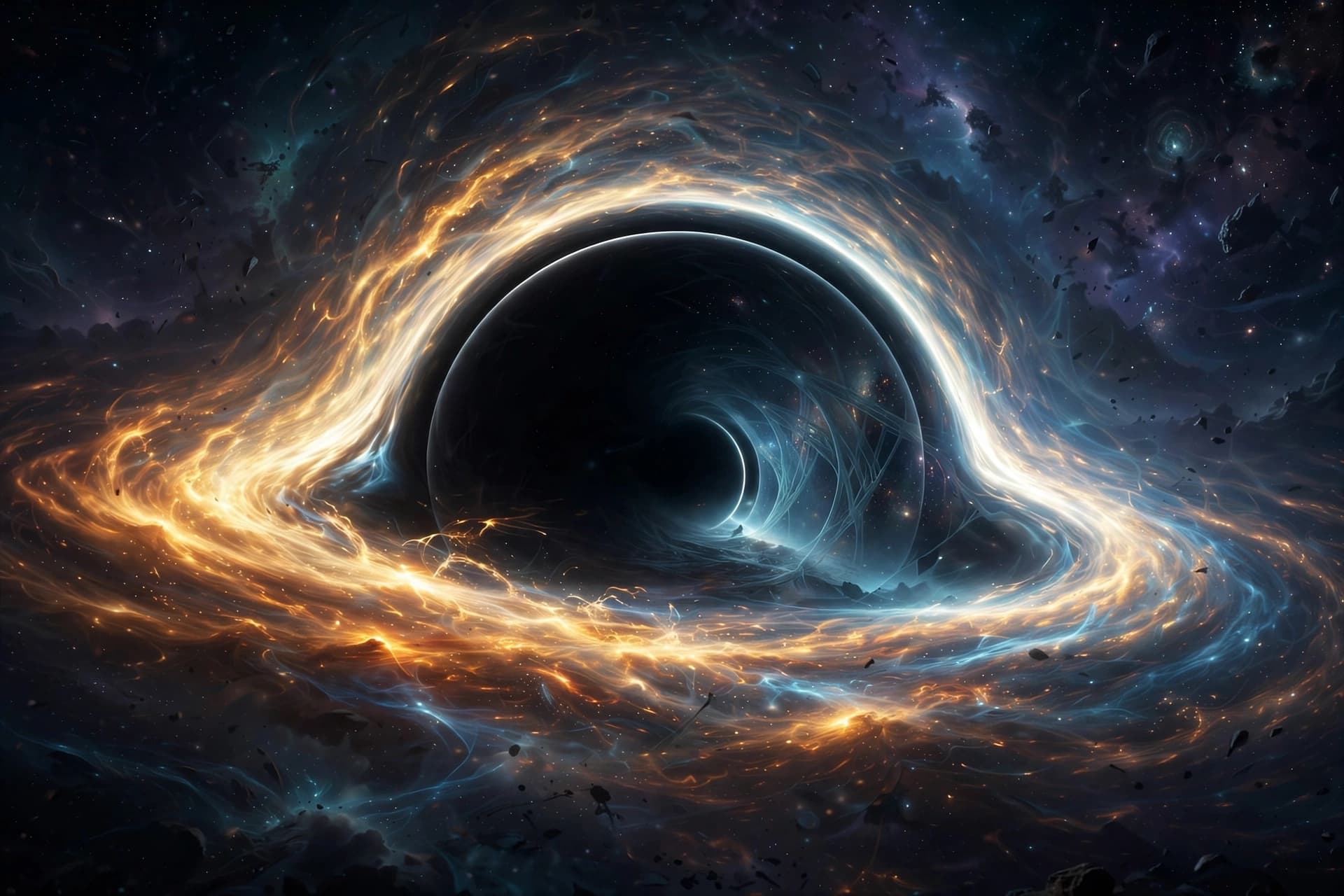
There is a particular stubbornness to a mystery that refuses to resolve itself, a question that has been asked for decades and answered only with possibilities. Black holes are among the most confirmed objects in astrophysics, their existence supported by gravitational waves, event horizon images, and the orbits of stars at the galactic center. Wormholes, the tunnels through spacetime that science fiction loves, remain entirely hypothetical—mathematically possible but never observed. Now, a new line of theoretical work suggests that the two may be harder to tell apart than anyone assumed, and that some of the objects we call black holes might be something else entirely.
The idea is not new. For years, physicists have noted that certain wormhole geometries can mimic the observational properties of black holes with remarkable fidelity. A paper by Thibault Damour and Sergey Solodukhin, cited in a recent Futura-Sciences report, argued that "many of the properties considered 'characteristic' of a black hole... can be faithfully imitated by a globally static wormhole" . This includes the apparent accretion of matter, the absence of distinctive "hair," and even quasi-normal mode oscillations—the vibrations of spacetime that black holes emit when perturbed.
Recent work has extended this mimicry to more specific observations. A 2025 study uploaded to arXiv and slated for publication in Physical Review D analyzed quasi-normal modes and found that wormholes could consistently replicate those of static black holes . Another line of research has examined the iron K-alpha line—a spectral feature produced by accretion disks around compact objects. The broad, skewed profile observed in black hole candidates could, in principle, also be produced by a wormhole's accretion disk, depending on the wormhole's spin and geometry . The differences are subtle, and current observations cannot yet rule out the possibility that some supermassive objects in galactic nuclei are wormholes rather than black holes.
The key limitation is observational. The only definitive way to distinguish a black hole from a wormhole, according to the Damour-Solodukhin argument, would be to detect Hawking radiation—the faint glow theorized to emanate from event horizons. But for astrophysical black holes, this radiation is far too weak to observe . Without it, the two objects can appear identical across a wide range of measurements.
This does not mean that wormholes are likely. The consensus remains that black holes are black holes, and that wormholes, if they exist at all, require exotic physics—negative energy, or modifications to general relativity—that have never been observed. The mimicry works mathematically, but mathematics allows many things that nature does not build. The value of the research is not that it proves wormholes exist, but that it sharpens the question of what evidence would be needed to tell the difference.
For now, the objects at the centers of galaxies remain what they have always been: black holes, by every measurement we can make. The wormhole hypothesis is a reminder that the universe is not obligated to make its strangest possibilities visible. It is obligated only to follow its own rules, and those rules, as far as we can tell, produce black holes that look like black holes. Whether some of them are something else is a question that will require instruments not yet built and theories not yet tested.
---
AI Image Disclaimer: The visuals in this article are generated by artificial intelligence and are intended for illustrative purposes only.
Sources: Futura-Sciences, Popular Mechanics, arXiv (via cited studies), Physical
Published by Banx Network. This article is part of the Banx decentralized media programme, powered by the BXE token on the XRP Ledger.