Before there were planets, before there was Earth, before the first rains fell on any world, there was a choice to be made. Not a conscious choice, of course, but a sorting—a quiet preference written into the physics of a young solar system still finding its shape. The ingredients were two: chondrules, tiny beads of rock forged in intense heat, and matrix, a cold, fine-grained dust rich in water ice and organic molecules. One represented fire, the other ice. According to a new study, the solar system made its preference clear from the very beginning, and it chose fire .
The research, led by Yale University and published in Nature Astronomy, provides the first geochemical evidence that within the first million years of the solar system's formation, the sorting of chondrules over matrix was already underway . This may sound like a technical distinction, but it speaks to something fundamental about how worlds are built. The earliest solid bodies in the outer solar system, the study found, were composed of 83 to 92 percent chondrules, with only a small fraction of the icy, volatile-rich dust that would dominate later-forming objects . The solar system, in its infancy, was already discriminating.
There is a difficulty in studying this earliest chapter. No preserved undifferentiated bodies survive from that first million years. The parent bodies of the oldest meteorites accumulated so much radioactive aluminum-26 that they melted completely, erasing the physical evidence of their original composition . It is as if the earliest drafts of a manuscript were written in disappearing ink, leaving only later copies to hint at what came before. The researchers found a way around this by examining iron meteorites from the outer solar system, searching for chemical tracers that could reconstruct the original recipe.
Two tracers proved particularly useful. Sulfur exists in concentrated form in matrix, and the oxidation state of iron reveals how much water ice and oxidized dust a body incorporated . Both independently pointed to the same conclusion: the early planetesimals were remarkably matrix-poor. The convergence of two separate lines of evidence is what gives the finding its weight. As the study's lead author put it, both tracers tell the same story, and that convergence is what makes the result robust .
Why would fire have won out so decisively? The answer appears to lie in aerodynamics. In the protoplanetary disk surrounding the young sun, materials of similar density tended to clump together. Chondrules, being denser and more compact, had a greater chance of colliding and sticking. The lighter, fluffier matrix material was more easily blown outward, eventually coalescing into later-forming bodies such as comets . The solar system was not making a deliberate choice, but its physics favored the sturdy over the delicate, the compact over the diffuse.
This finding helps explain a long-standing puzzle in the meteorite record: why chondrules from the earliest epoch are so scarce. They were incorporated into bodies that later melted, their physical traces erased by the very heat that had once created them . The chondrules themselves were not destroyed, but the evidence of their original context was. What survives in meteorites today is a later chapter, one in which matrix had begun to assert itself.
The implications extend beyond our own solar system. If the assembly of planets involves a selective process from the very start, then the compositions of rocky worlds elsewhere may follow patterns that are not entirely random. The building blocks of planets are sorted and chosen, not simply gathered. As the researchers noted, this assembly process was remarkably selective from the very beginning . That selectivity, written into the physics of dust and heat, may shape the kinds of worlds that emerge around other stars.
There is something quietly humbling in this narrative. The solar system did not begin as a chaotic jumble, but as a place with preferences, however impersonal those preferences may be. Fire over ice, rock over vapor, the dense over the diffuse. These early leanings set the stage for everything that followed: the formation of planets, the delivery of water to their surfaces, the emergence of conditions that could, in at least one case, support life. The choice was made long before anyone was there to observe it, in the silent, spinning disk of dust and heat that would become our home.
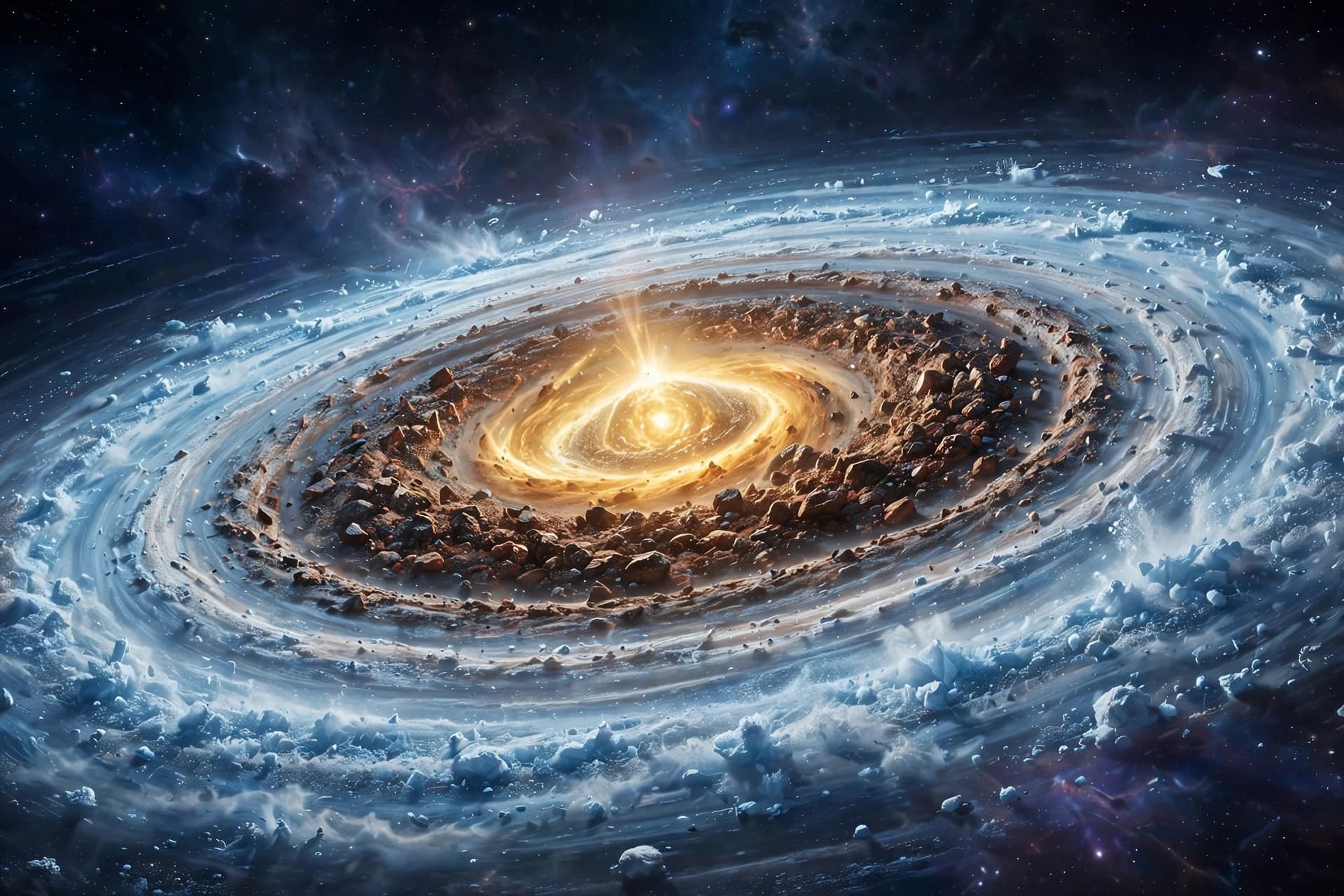
Image Disclaimer: This article's accompanying image is an AI-generated illustration, not a photograph of actual astronomical phenomena.
Sources: Nature Astronomy, Yale University, EurekAlert, ScienceAlert, Universe Today
Published by Banx Network. This article is part of the Banx decentralized media programme, powered by the BXE token on the XRP Ledger.