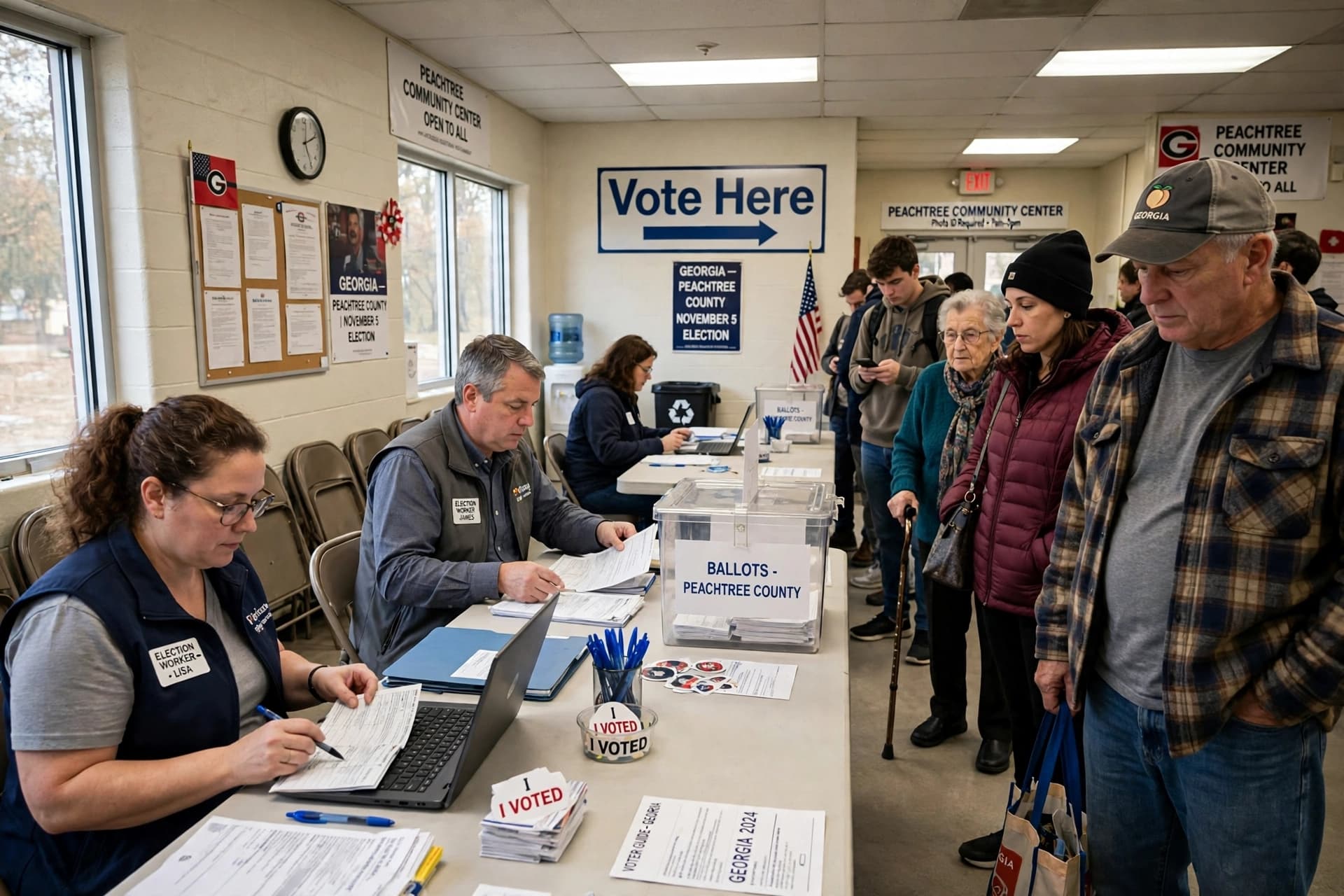
There is a particular kind of signal that arrives in the early numbers of an election, a message that is not yet a verdict but is more than noise. In Georgia, early voting began on October 13, and by noon on Tuesday, more than one million voters had cast ballots in person—a record for a midterm election. Including absentee ballots, the total surpassed 1,055,000 . The figure is not merely a statistic. It is a map of enthusiasm, a hint at which communities are paying attention, and a reminder that in a state that has decided national elections by razor-thin margins, every early ballot is a small act of anticipation.
The raw comparison is instructive. By the same point in the 2022 midterms, 894,412 voters had cast early in-person ballots. This year's total represents an increase of more than twelve percent . Secretary of State Brad Raffensperger, who has overseen Georgia's elections through cycles of scrutiny and accusation, described the turnout as evidence that voters trust the state's process . The statement is as political as it is factual, but the numbers behind it are not in dispute.
Where those voters live tells a more complicated story. An analysis by the Atlanta Journal-Constitution found that roughly 400,000 early voters came from areas that strongly supported Kamala Harris in 2024, compared with about 380,000 from communities where Donald Trump dominated. About twenty-one percent of voters in strong Harris areas have voted so far, compared with sixteen percent in deep-red Trump territory . Black voters, the Democratic Party's most loyal constituency, account for about thirty-five percent of the early vote. Women outnumber men by roughly ten percentage points .
But the picture is not one-sided. Turnout has jumped in Cherokee and Forsyth counties, two fast-growing conservative strongholds that have become linchpins of the GOP's statewide strategy. It is also climbing in parts of northwest Georgia, including Whitfield County, where Trump rallied supporters and urged them to "pretend" he was on the ballot . The surge in Republican-leaning areas suggests that the Democratic advantage in raw numbers may not translate directly into a Democratic advantage at the polls.
There is a caution embedded in all of this. The early vote tells us who is voting, not how they are voting. Georgia does not register voters by party, and with a significant number of split-ticket voters expected, a big turnout in Trump country does not mean every ballot is Republican, just as a spike in Democratic territory does not mean every vote is blue . About ninety-five percent of early voters also cast ballots in 2024, a reminder that the first wave is dominated by regular voters, not newcomers. The flood of early votes does not necessarily mean higher overall turnout; some voters may simply be voting now rather than waiting until November 3.
For both parties, the numbers offer reasons for hope and reasons for anxiety. Democrats can point to the enthusiasm in metro Atlanta and among their core constituencies. Republicans can point to the surge in their strongholds and the historical pattern of early voters skewing older, a demographic that leans Republican. What neither side can do is claim certainty. The election will be decided by those who have not yet voted, and by the choices they make when they do.
---
AI Image Disclaimer: The visuals in this article are generated by artificial intelligence and are for illustrative purposes only.
Sources: Capitol Beat, Atlanta Journal-Constitution, WTOC
Published by Banx Network. This article is part of the Banx decentralized media programme, powered by the BXE token on the XRP Ledger.