1. The Hidden Materials Behind the Modern World
The global economy depends on materials that most consumers rarely think about. Smartphones, electric vehicles, wind turbines, advanced medical equipment and military technologies all rely on specialised minerals that are difficult to replace.
Among the most strategically important are rare earth elements, a group of 17 metallic elements with distinctive magnetic, electrical, optical and chemical properties. Despite their name, they are not necessarily rare in the Earth's crust. The challenge is finding economically viable deposits and separating the elements from one another at the purity required for industrial use.[1]
Their importance has grown alongside the expansion of electrification, renewable energy, artificial intelligence infrastructure and advanced defence systems.
Yet the world has a major vulnerability: mining is only one part of the supply chain. Processing, refining and manufacturing high-performance magnets require specialised technology, equipment, investment and expertise. China has spent decades developing these capabilities, creating a position that competitors cannot easily replicate.
This has transformed rare earths from an industrial commodity into a strategic resource at the centre of international competition.
2. Why China Dominates the Rare Earth Industry
China's position did not emerge overnight. The country developed an extensive rare earth industry through decades of investment, industrial policy, technical expertise and a large domestic manufacturing base.
According to the International Energy Agency's 2025 analysis, China accounted for approximately 60% of global mined rare earth production and 91% of refined output in 2024. Its position in permanent magnet manufacturing is similarly dominant.[2]
These figures reveal the deeper problem facing competitors. Opening a mine elsewhere does not automatically create an independent supply chain. The material must still be separated, refined into usable products, converted into metals and alloys, and manufactured into components.
China's established industrial ecosystem gives its manufacturers advantages in cost, scale, processing knowledge and access to downstream customers.
The country also has a large domestic market for electric vehicles, electronics and renewable energy equipment. This creates demand that supports investment throughout the supply chain.
For competing countries, the challenge is therefore not simply to discover new deposits. It is to reproduce an entire industrial system that China has developed over many years.
3. What Makes Rare Earths So Valuable?
Rare earth elements are useful because their physical and chemical properties enable technologies to perform in ways that alternative materials may struggle to match.
Four elements are particularly important in high-performance permanent magnets:
Neodymium: A major ingredient in powerful magnets used in electric motors, generators and electronics.
Praseodymium: Commonly used alongside neodymium to produce high-performance magnetic materials.
Dysprosium: Helps certain magnets retain their magnetic performance at high temperatures.
Terbium: Used in specialised magnets and other advanced applications where particular magnetic properties are required.
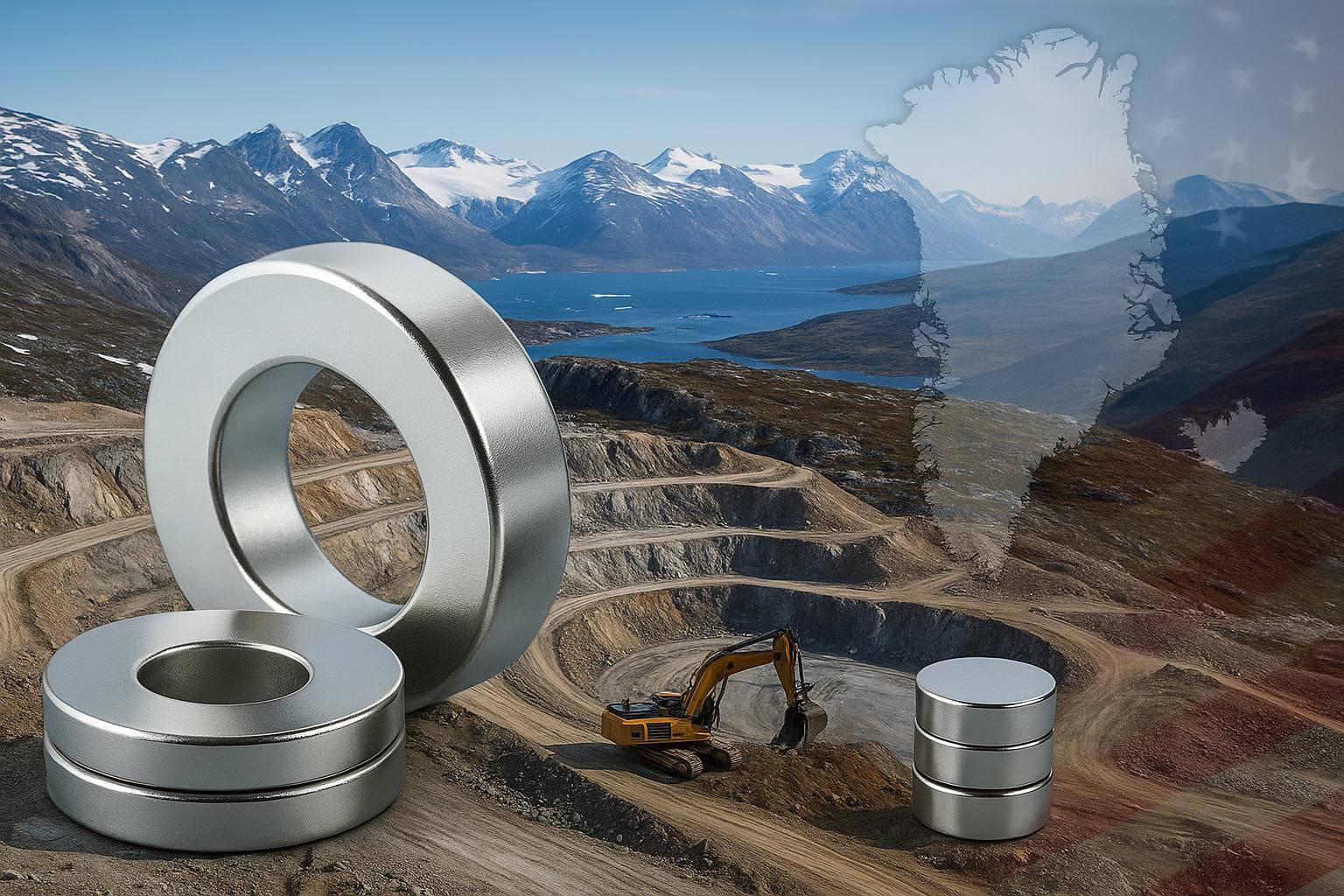
Neodymium-iron-boron magnets are especially important because they can deliver substantial magnetic strength in relatively compact components. This makes them useful in applications where weight, space and efficiency matter.[3]
An electric vehicle may use these magnets in its traction motor. Wind turbines can use them in generators, depending on the design. Industrial robots, precision machinery and some defence systems also depend on high-performance magnetic materials.
Rare earths have other applications too, including catalysts, optical technologies, specialised alloys and certain medical and scientific devices.
The important distinction is that the 17 elements are not interchangeable. Each has different properties, supply conditions and industrial uses. A shortage of one specialised element can create problems even when other rare earths remain readily available.
4. The Export Control Shock That Exposed the Risk
The vulnerability of concentrated supply chains became particularly clear in 2025, when China introduced export controls affecting several rare earth elements and related products.
In April 2025, Beijing imposed controls on specified items involving seven rare earth elements: samarium, gadolinium, terbium, dysprosium, lutetium, scandium and yttrium. Exporters were required to obtain licences for covered products.[4]
China subsequently announced a wider package of controls in October 2025, covering additional rare earths, related technologies and equipment. Some of those expanded measures were later suspended following trade negotiations with the United States.
However, the suspension did not eliminate all rare earth export controls. The existing licensing requirements continued to matter, leaving manufacturers exposed to delays, uncertainty and uneven access to strategically important materials.
The International Energy Agency reported in its 2026 critical minerals outlook that the 2025 restrictions had already disrupted downstream industries, with some automakers reducing production or temporarily halting operations because of shortages.[1]
The lesson was clear: a material can represent a relatively small portion of a finished product's cost while still being essential to manufacturing the entire product.
When access to that material becomes uncertain, the financial consequences can extend far beyond the mining industry.
5. Why the Rare Earth Battle Could Cost Trillions
Rare earth supply chains support enormous amounts of economic activity. The value of the products that depend on them is much greater than the value of the raw materials themselves.
The IEA's 2026 outlook estimated that, if China's expanded October 2025 restrictions were fully implemented, as much as $6.5 trillion per year in downstream production outside China could be put at risk across automotive, high-tech, defence and energy sectors.[1]
This figure represents production potentially exposed to disruption, not a prediction that $6.5 trillion would necessarily be lost.
Nevertheless, it illustrates the scale of the problem. A shortage of specialised magnets or processed materials could interfere with production lines making cars, aircraft components, industrial equipment and energy infrastructure.
Manufacturers might respond by paying more for available supplies, drawing down inventories, redesigning products or temporarily suspending production.
Smaller businesses could face particular difficulties because they may have less bargaining power with suppliers and fewer resources to stockpile expensive materials.
The effects could also spread across borders. A factory in Europe or North America might depend on a component manufactured in another country, which in turn relies on rare earths processed in China.
This creates a supply chain in which a disruption at one specialised stage can affect businesses thousands of miles away.
6. Electric Vehicles and the Green Energy Transition
The energy transition is one of the main reasons rare earths have become strategically important.
Many electric vehicles use permanent magnets in their motors. These magnets can help deliver high power and efficiency, although not every electric vehicle uses a rare-earth-based motor. Some manufacturers use alternative designs, including induction motors or other magnet technologies.
Wind energy presents a similar picture. Certain wind turbines use permanent-magnet generators, while other designs rely on different generator systems.
The implications are significant because governments are attempting to expand clean energy capacity while reducing dependence on fossil fuels.
If rare earth supplies become more expensive or less predictable, manufacturers may face higher costs, longer project timelines and pressure to redesign equipment. These effects could complicate the expansion of electric vehicles, renewable energy and related infrastructure.
However, rare earth restrictions would not automatically stop the energy transition. Manufacturers can diversify suppliers, improve recycling, reduce the amount of material used per product or adopt alternative technologies where practical.
The real danger is that supply disruptions could make the transition more expensive and less predictable at precisely the moment when governments and businesses are trying to scale up investment.
7. The Defence Industry's Strategic Vulnerability
Rare earths are also important to national security.
High-performance magnets and other rare earth applications can be found in precision guidance systems, radar equipment, aircraft components, communications technologies and various advanced military platforms.
The exact materials and quantities differ by system, and not every defence technology depends on rare earths in the same way. Nevertheless, the difficulty of replacing certain specialised components makes supply security an important concern for defence planners.
A prolonged shortage could delay maintenance, restrict manufacturing or increase the cost of producing advanced equipment.
This creates a strategic problem for countries that rely on foreign suppliers for materials used in military systems. Even if a government can afford to pay higher prices, access may still depend on export licences, processing capacity and the willingness of suppliers to fulfil orders.
The United States and its allies have consequently treated rare earth supply chains as part of a broader effort to strengthen industrial resilience and reduce exposure to potential geopolitical pressure.[5]
The issue is not only whether a country possesses mineral deposits. It is whether it can reliably turn those deposits into finished components during a crisis.
8. Can the United States Break China's Dominance?
The United States is attempting to rebuild parts of its rare earth supply chain through domestic production, processing facilities and magnet manufacturing.
In June 2026, the US Department of Commerce announced a final award for USA Rare Earth involving up to $277 million in federal incentives and a loan agreement of up to $1.3 billion. The programme supports a proposed mine-to-magnet strategy, including mining and processing facilities and expanded metal and magnet production.[6]
The goal is to create a more integrated domestic supply chain rather than relying on raw material extraction alone.
However, funding announcements are not the same as completed factories or sustained commercial output. Building mines and processing facilities requires time, technical expertise, environmental approvals, infrastructure and dependable customers.
New producers must also compete with established suppliers on price and quality. If rare earth prices fall sharply, projects developed under high-price conditions could become less commercially attractive.
The United States can reduce its dependence on China, but creating a competitive industry will require consistent investment across several stages of production.
9. Australia, Malaysia and the Search for Alternatives
Other countries are also seeking to expand their role in the rare earth industry.
Australia has important deposits and established mining expertise. Lynas Rare Earths, an Australian company, operates an integrated supply chain involving its Mount Weld mine in Western Australia and processing facilities in Australia and Malaysia.[7]
Malaysia is also seeking to develop more domestic processing capability. On 27 October 2026, Reuters reported that the Malaysian government had permitted DTEC Mineral and Metal Technology to export up to 700 metric tonnes of rare earth carbonate to the United States for research. An initial shipment of approximately 30 tonnes was expected to support work on separation and refining technologies.[8]
The project illustrates a wider shift: governments and businesses are exploring how to develop alternatives to Chinese processing rather than merely finding new mineral deposits.
Other countries, including Canada and several European states, are also exploring ways to strengthen their critical minerals industries.
However, diversification is not the same as independence. New producers may still depend on Chinese equipment, specialist chemicals, technical expertise or customers.
The most resilient supply chain is likely to be one that connects several countries, with enough alternative capacity to prevent a single supplier from becoming an unavoidable bottleneck.
10. The Environmental Cost of Mining Rare Earths
Reducing dependence on China will not automatically make rare earth supply chains sustainable.
Mining and processing rare earths can create substantial environmental challenges, depending on the deposit and the methods used. These can include high energy and water consumption, chemical waste, land disturbance and the management of radioactive by-products associated with certain ores.
Poorly regulated operations can cause serious damage to nearby communities and ecosystems.
Building new facilities in the United States, Australia, Europe or elsewhere therefore requires more than financial investment. Projects must also meet environmental standards, manage waste safely and secure the trust of local communities.
These requirements can increase costs and extend development timelines, but ignoring them risks creating new environmental problems while attempting to solve a geopolitical one.
Governments face a difficult balance: they want reliable supplies of strategic materials, but they also need to ensure that domestic production does not transfer environmental costs onto vulnerable communities.
Long-term resilience will depend on responsible production, transparent supply chains and credible environmental oversight.
11. Could Recycling Reduce Dependence on China?
Recycling offers another potential solution, particularly as electric vehicles, wind turbines and electronic equipment reach the end of their useful lives.
Rare earths can sometimes be recovered from discarded permanent magnets and industrial waste. Recovered materials could then be processed and reused, reducing the need for new mining.
Yet the industry remains underdeveloped relative to its potential. The European Commission reported in 2025 that less than 1% of rare earth elements were being recycled in the European Union.[9]
There are several reasons for this gap. Rare earths are often embedded in complex products, making collection and separation difficult. The quantities contained in individual consumer devices can be small, while recovery processes require specialised facilities and sufficient volumes of material to operate economically.
Recycling infrastructure also needs dependable sources of scrap. Much of the equipment manufactured during the current expansion of electric vehicles and renewable energy has not yet reached the end of its working life.
For these reasons, recycling is unlikely to replace mining in the near future. Its greater value may be in complementing primary production, recovering valuable materials and reducing long-term dependence on a narrow group of suppliers.
12. Can Manufacturers Replace Rare Earths?
Diversification does not necessarily require every manufacturer to use the same materials indefinitely.
Companies can explore alternative motor designs, improve material efficiency, redesign components and develop magnets that use smaller quantities of constrained elements.
Some electric vehicles already use motors that do not require rare earth permanent magnets. Other applications may be able to reduce their dependence on particular elements, although performance, weight, efficiency and manufacturing costs can limit the available options.
Substitution is more difficult in highly specialised applications, where a material's properties may be difficult to replicate.
Research into new magnetic materials, improved recycling methods and more efficient industrial designs could gradually reduce demand for certain rare earths.
However, technological progress should not be confused with an immediate solution. Replacing a material in a consumer product can require years of testing, redesign and qualification. The barriers are even higher for aerospace, medical and defence equipment, where reliability and safety requirements are stringent.
The likely outcome is not the complete disappearance of rare earth demand, but a gradual reduction in some dependencies as technology improves.
13. The Investment Opportunity—and the Risk
The rare earth supply-chain challenge is attracting attention from governments, manufacturers and investors.
Potential beneficiaries include mining companies, specialist refiners, magnet manufacturers, recycling businesses and suppliers of processing equipment. Companies that successfully develop commercially viable alternatives to concentrated supply chains could become strategically important.
Public investment and government support may help some projects overcome the high initial costs associated with building new facilities.
But investors should approach the sector carefully.
Rare earth companies can be exposed to volatile commodity prices, project delays, financing requirements, regulatory risks and uncertain customer demand. A deposit's geological value does not guarantee that it can be mined profitably, and a mining project does not guarantee access to the processing technology needed to produce saleable materials.
Government support can also change as political priorities shift. Projects that depend heavily on subsidies or favourable trade conditions may face difficulties if those conditions change.
Investors should distinguish between announced capacity, facilities under construction and production that is already operating commercially. They should also examine a company's processing capabilities, customer contracts, financing position and exposure to individual elements.
The strategic importance of rare earths may create opportunities, but it does not guarantee that every company in the industry will be profitable.
14. What This Means for Britain and Europe
Britain and the European Union face many of the same supply-chain challenges as the United States.
European manufacturers need reliable access to critical materials for automotive production, clean energy, aerospace, electronics and defence. If supplies become more expensive or difficult to obtain, the consequences could affect industrial competitiveness and investment decisions.
The EU's Critical Raw Materials Act aims to strengthen domestic extraction, processing and recycling while reducing excessive dependence on individual external suppliers.[10]
For the UK, the issue is connected to industrial strategy, energy security, defence procurement and the future of domestic manufacturing. Even when materials are imported indirectly through finished components, disruptions elsewhere in the supply chain can still affect British businesses.
A more resilient approach would combine diversified international partnerships with domestic processing where commercially and environmentally practical. It would also encourage recycling, material efficiency and better visibility into suppliers several stages removed from the final manufacturer.
The challenge is financial as well as technical. Alternative supply chains must be reliable enough to justify investment without making manufacturers permanently uncompetitive.
For Britain and Europe, the goal should not necessarily be complete self-sufficiency. It should be the ability to maintain essential production when a particular supplier or trade route becomes unavailable.
15. Three Possible Futures for the Rare Earth Industry
The future of rare earth supply chains will depend on investment, technological progress and relations between major economies.
Scenario One: China Retains Its Dominant Position
New projects outside China struggle to compete with established producers on price and scale. Governments continue to rely heavily on Chinese processing while maintaining strategic stockpiles and alternative suppliers for selected materials.
In this scenario, supply remains relatively efficient during normal conditions, but geopolitical tensions continue to create risks for manufacturers.
Scenario Two: The World Builds a More Diversified Supply Chain
The United States, Australia, Malaysia, Europe and other producers expand mining, refining and magnet manufacturing. Recycling becomes more commercially viable, and manufacturers reduce their dependence on the most constrained elements.
China remains a major industry participant, but its ability to disrupt global manufacturing through a single supply-chain bottleneck declines.
This scenario would require sustained investment, international cooperation and sufficient customer demand to support new facilities.
Scenario Three: Trade Restrictions Trigger a Wider Industrial Shock
Export controls tighten, licensing delays increase or diplomatic relations deteriorate. Manufacturers struggle to secure essential materials, forcing some to pay higher prices, reduce production or delay projects.
Governments accelerate emergency investment, but new facilities cannot come online quickly enough to resolve the immediate shortages.
This scenario would demonstrate the cost of allowing a critical supply chain to remain highly concentrated for too long.
These outcomes are not mutually exclusive. The industry could move towards diversification over time while still experiencing periodic disruptions and price spikes.
16. The Real Battle Is Over Processing Power
Rare earths reveal a broader truth about the modern economy: control over a relatively small quantity of specialised materials can influence industries worth vastly more.
China's position reflects decades of investment and industrial development, not simply an abundance of mineral deposits. Competing countries must build processing expertise, manufacturing capacity, infrastructure and reliable commercial relationships if they want to reduce their dependence.
The solution will not come from mining alone. It will require a combination of diversified supply, recycling, technological innovation, responsible production and long-term industrial investment.
For governments, the challenge is to strengthen economic security without creating unnecessarily expensive or environmentally damaging supply chains. For manufacturers, it is to reduce the risk of relying on a single source for essential components. For investors, it is to separate genuine commercial progress from political promises.
Rare earths may be hidden inside the technologies people use every day, but the power struggle surrounding them is becoming impossible to ignore. The countries that can secure, process and manufacture these materials reliably will have an important advantage in the next phase of industrial competition.
Sources
[1] International Energy Agency (IEA) — Global Critical Minerals Outlook 2026: Executive Summary https://www.iea.org/reports/global-critical-minerals-outlook-2026/executive-summary
[2] International Energy Agency (IEA) — Global Critical Minerals Outlook 2025 https://www.iea.org/reports/global-critical-minerals-outlook-2025/executive-summary
[3] U.S. Department of Energy — Achieving American Leadership in the Rare Earth Magnets Supply Chain https://www.energy.gov/sites/default/files/2024-12/Neodymium%20Magnets%20Supply%20Chain%20Fact%20Sheet%20Final%5B1%5D.pdf
[4] Reuters — Factbox: What to Know About China’s Rare Earth Export Controls https://www.investing.com/news/commodities-news/factboxwhat-to-know-about-chinas-rare-earth-export-controls-4079938
[5] Congressional Research Service — Rare Earth Elements and U.S. Supply Chains https://www.everycrsreport.com/reports/IF13171.html
[6] National Institute of Standards and Technology (NIST) — Department of Commerce Finalizes Agreement With USA Rare Earth for Up to $1.6 Billion https://www.nist.gov/news-events/news/2026/06/department-commerces-chips-program-finalizes-definitive-agreement-usa-rare
[7] Lynas Rare Earths — About Lynas Rare Earths https://lynasrareearths.com/about-us/about-lynas-rare-earths/
[8] Reuters — DTEC Granted Permit to Ship Raw Rare Earths From Malaysia to US for Research https://www.reuters.com/world/asia-pacific/dtec-granted-permit-ship-raw-rare-earths-malaysia-to-us-research-ceo-says-2026-10-27/
[9] European Commission — Critical Raw Materials: Strengthening the EU’s Resilience and Circularity https://eur-lex.europa.eu/legal-content/EN/TXT/?uri=celex%3A52025DC0945
[10] European Commission — European Critical Raw Materials Act https://commission.europa.eu/topics/competitiveness/green-deal-industrial-plan/european-critical-raw-materials-act_en
Published by Banx Network. This article is part of the Banx decentralized media programme, powered by the BXE token on the XRP Ledger.