There is a particular kind of faith that attaches to the search for Noah's Ark—a faith that has survived not only the millennia since the biblical flood but the decades of failed expeditions, the geological dismissals, and the quiet skepticism of the scientific mainstream. For nearly eighty years, a boat-shaped formation in eastern Turkey has drawn researchers who believe it is the fossilized remains of the vessel described in Genesis. Now, a team drilling into the site says it is "inching towards" confirmation, and that the evidence is challenging the long-held theory that the formation is simply a natural rock anomaly.
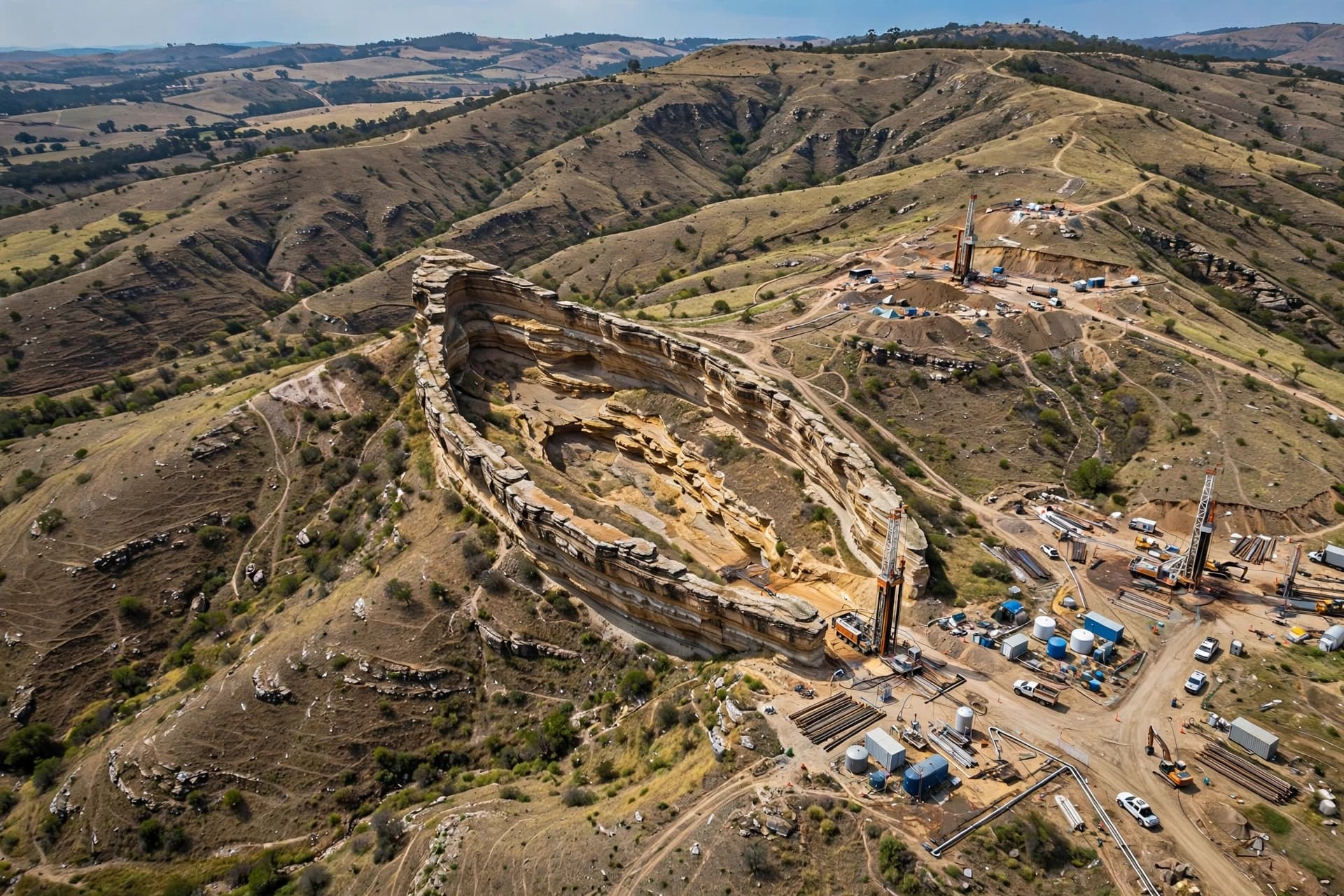
The Durupınar formation sits about eighteen miles south of Mount Ararat, in a landscape of rolling hills and volcanic clay. It was first identified in 1959 by a Turkish Army captain who photographed it from the air. The shape—roughly 515 feet long, 85 feet wide, and 52 feet high—matches the dimensions of the Ark as described in the Bible: 300 cubits long, 50 cubits wide, and 30 cubits high. For decades, geologists have dismissed it as a natural syncline, a boat-shaped ridge of limestone sculpted by erosion. But the team from Noah's Ark Scans believes that explanation is no longer tenable.
Using ground-penetrating radar and electrical resistivity tomography, researchers say they have detected organized structures beneath the surface—straight lines, right-angle intersections, and large spaces that could be corridors or chambers. Andrew Jones, founder of Noah's Ark Scans, told NewsNation that the radar data showed "organized structure below the surface without even digging". Dr. Khosrow Bakhtar, a scientist who previously worked for the Department of Defense, brought his own subsurface scanner to the site and reported detecting "massive underground corridors and chambers" running through the formation. "This is the most significant finding for 40 years of my career," he said. "I have never seen this kind of anomaly before".
The drilling, which began in September, represents the first physical sampling of the site's interior. The team, led by archaeologist Dr. Cenker Atila of Sivas Cumhuriyet University, has collected around 1,000 soil samples from 150 locations and is analyzing the material for signs of organic matter or wooden structure. The project is authorized by the Turkish government and involves a team of international archaeologists and geologists. A specially designed underground robot called Gopher—originally built to explore wombat burrows in Australia—has been repurposed to navigate the spaces beneath the formation and collect high-resolution footage and samples.
Not everyone is convinced. Geologists maintain that the formation is a natural geological feature, and no peer-reviewed study has yet confirmed that the underground features are man-made. Critics have noted that the project's fundraising and publicity have been driven in part by creationist activists, including Lauren Witzke, a former Senate candidate who has said the findings will "dismantle" Darwinism and require textbooks to be rewritten. For their part, the researchers say they remain open-minded about what they will find. Dr. Bakhtar, for instance, said he is "a hundred per cent sure" the anomalies come from "the same original object" but remains open about what that object is. The drilling will continue until winter freezes the ground. The lab results, when they come, will determine whether the Durupınar formation is finally confirmed as the resting place of the Ark—or whether it remains what it has always been: a mystery shaped like a ship, waiting for someone to prove it is more.
AI Image Disclaimer: The images accompanying this article were generated by artificial intelligence and are for illustrative purposes only.
Sources: Daily Mail, New York Post, NewsNation, Geo.tv, Express, The National
Published by Banx Network. This article is part of the Banx decentralized media programme, powered by the BXE token on the XRP Ledger.