In the quiet theatre of the night sky, Saturn stands like a regal dancer, once adorned with a crown of ice and rock. But every so often, that crown seems to vanish, as if the planet were deliberately removing its most majestic accessory. It is not magic, nor some cosmic theft — merely a shift in perspective, played out across vast distances.
At the heart of this gentle vanishing act is geometry. Saturn’s axis is tilted by about 26.7 degrees, and as it travels around the Sun in its roughly 29.5-year orbit, the angle of its rings relative to Earth changes. Twice in that long orbit, the rings swing to an “edge-on” alignment — a moment called a ring-plane crossing. Because the rings are astonishingly thin compared to how wide they are, when viewed from the side they reflect almost no light. The result? To observers on Earth, Saturn’s glorious rings all but vanish, leaving only a thin line or even no sign at all.
This phenomenon is not rare in cosmic terms — it happens roughly every 13 to 15 years. In March 2025, for instance, Saturn went through precisely this alignment, and for about 44 days, the rings were almost invisible from our vantage point. It’s a moment of subtlety, not spectacle: a gentle reminder that even the most dramatic celestial features can hide in plain sight.
Yet this is not just a beautiful illusion. For scientists, these ring-plane crossings offer a rare and valuable window. With the rings’ glare greatly reduced, astronomers can peer more easily at faint moons and outer rings. Observations during past crossings have even led to the discovery of new moons around Saturn.
Still, beneath the poetic charm of the disappearing rings lies another, quieter truth: they are slowly being lost. Tiny particles of ice and dust in the ring system are falling into Saturn, a process sometimes called “ring rain.” Over the course of millions of years, this will gradually erode the rings. But from our vantage point — over human lifetimes — it remains a gentle, transient illusion: Saturn’s rings don’t disappear because they’re gone, but because of how the sky aligns.
In the end, the “disappearing” rings of Saturn are a quiet ballet of light and shadow, a cosmic moment when geometry outshines material. For a brief time, we are given a more delicate portrait of the ringed world — one that emphasizes fragility and perspective over grandeur. And when the alignment shifts, the rings return, as if Saturn softly smiles and reclaims its crown.
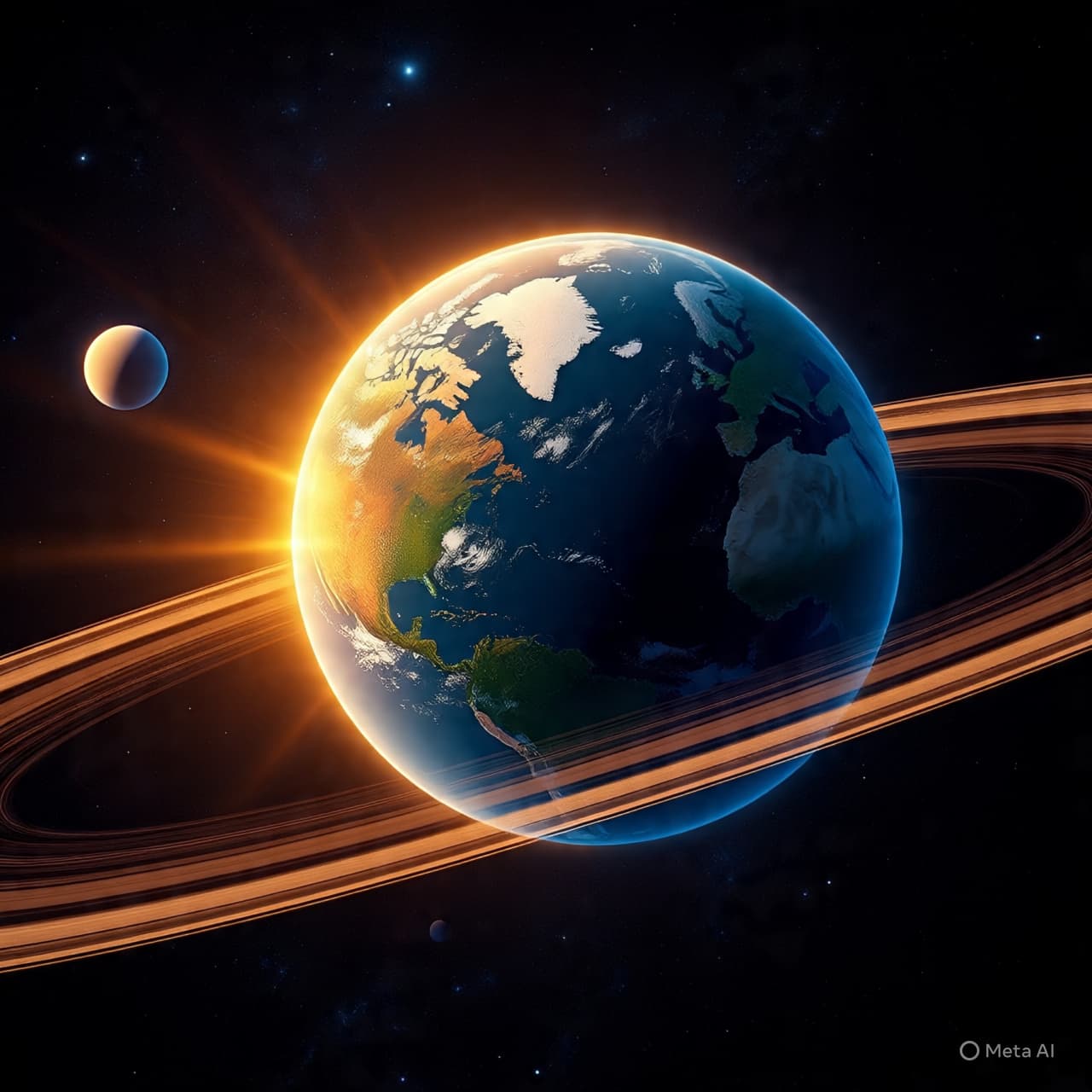
AI Image Disclaimer Images in this article are generated by AI and meant for conceptual representation only.
Sources: NASA / Jet Propulsion Laboratory Smithsonian Magazine Space & Telescope magazine Astronex (astronomy-niche) Kompas (Indonesian science news)
Published by Banx Network. This article is part of the Banx decentralized media programme, powered by the BXE token on the XRP Ledger.