There is a symmetry that feels almost intuitive about black holes: they merge, they grow, they become larger and more voracious with every collision. The universe, after all, tends toward disorder, toward the spreading out of things, and a black hole swallowing another seems to fit that pattern. But what about the reverse? Can a black hole, like a cell dividing or a drop of water breaking on a hot surface, split into two smaller ones?
A new theoretical study published in Physical Review D has taken that question seriously, and its answer is a qualified maybe—under conditions so extreme that they may exist only at the edges of what physics allows . The paper, titled "When Black Holes Admit Pair-of-Pants Topologies," was authored by Giacomo Cacciapaglia, Manuel Del Piano, Francesco Sannino, and Vania Vellucci, and it examines the thermodynamic and kinematic barriers that normally prevent such a split .
The central obstacle is entropy. For an ordinary, non-rotating black hole, splitting into two smaller ones would reduce the total entropy of the system, and thermodynamics forbids processes that decrease entropy . A black hole's entropy is proportional to the area of its event horizon, and two smaller black holes have less combined horizon area than one large one. The math is unforgiving: the split cannot happen because the universe would become, in a small way, more ordered rather than less.
But rapidly rotating black holes offer a possible loophole. In a spinning black hole, the rotational energy changes the entropy calculus, and under certain conditions, the total entropy of the fragments could exceed that of the original . Even then, a second barrier appears: the two resulting black holes must be able to separate rather than immediately falling back together. When the researchers included that requirement, the window for splitting narrowed to black holes rotating at nearly their maximum possible rate—a state that is theoretically possible but may be rare in nature .
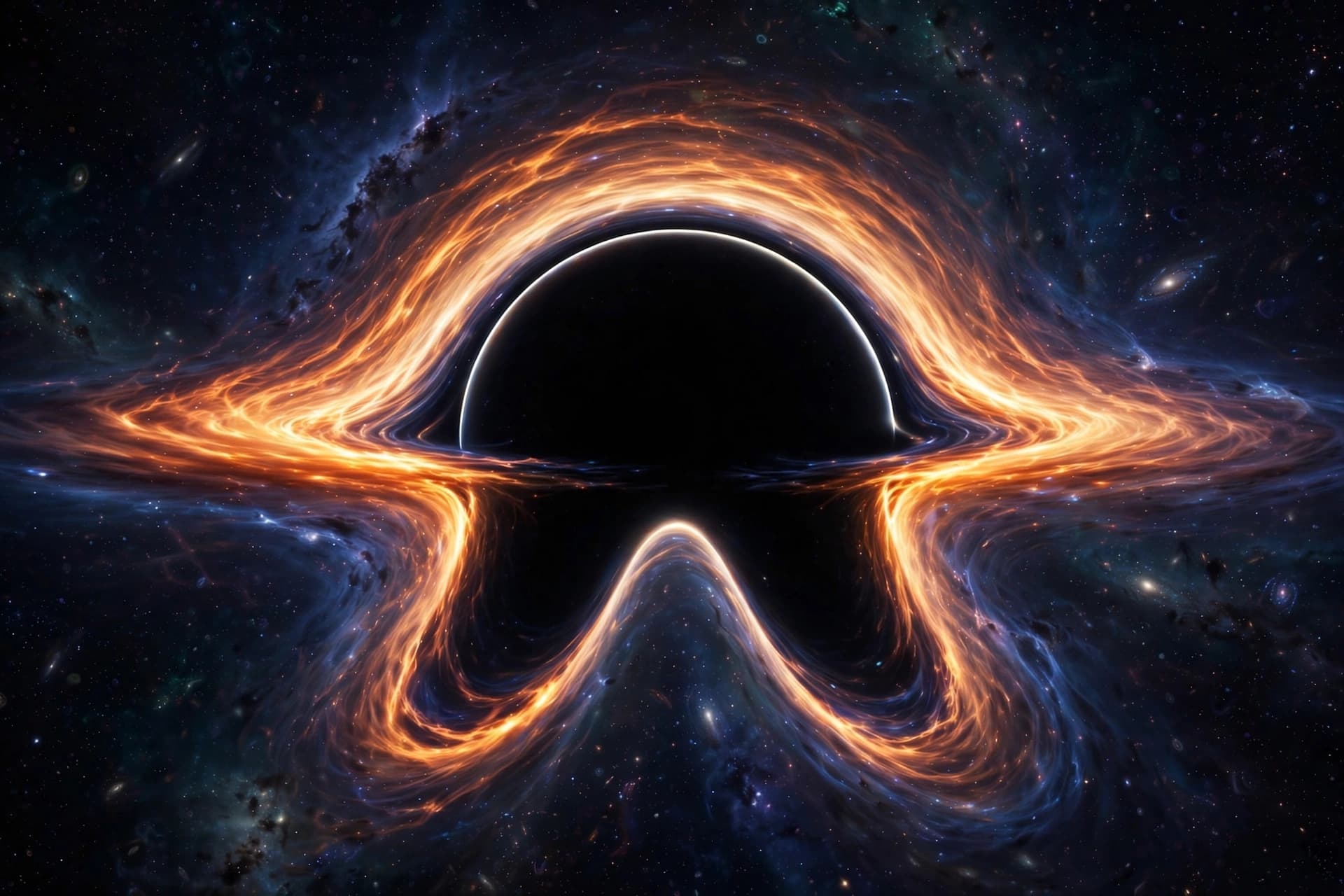
If such a split did occur, the event horizon would trace a shape through time that physicists call "pair-of-pants topology"—a single tube dividing into two, like a pair of trousers . The image is whimsical, but the physics is not. The study also explores more exotic scenarios, including theories with extra dimensions where black-hole-like objects can become unstable and fragment, and the possibility that small primordial black holes—remnants from the early universe—might be more prone to splitting than the massive astrophysical black holes that form from collapsed stars .
Francesco Sannino, one of the authors, was careful to note that the study does not offer a probability for splitting. "It depends on how gravity behaves beyond Einstein's theory, and we are working to quantify this," he said. He suggested that gamma-ray telescopes like Fermi-LAT might one day detect indirect evidence of a split, in the form of signals from tiny fragments produced during black hole mergers .
For now, the answer to the question is not a simple yes or no. It is a map of the theoretical landscape where the impossible becomes merely improbable, and where the universe's most extreme objects might, under the rarest of conditions, do something that resembles division.
Image Disclaimer: The visuals accompanying this article were created by artificial intelligence and are illustrative in nature.
Sources: EurekAlert!, Physical Review D, University of Southern Denmark
Published by Banx Network. This article is part of the Banx decentralized media programme, powered by the BXE token on the XRP Ledger.