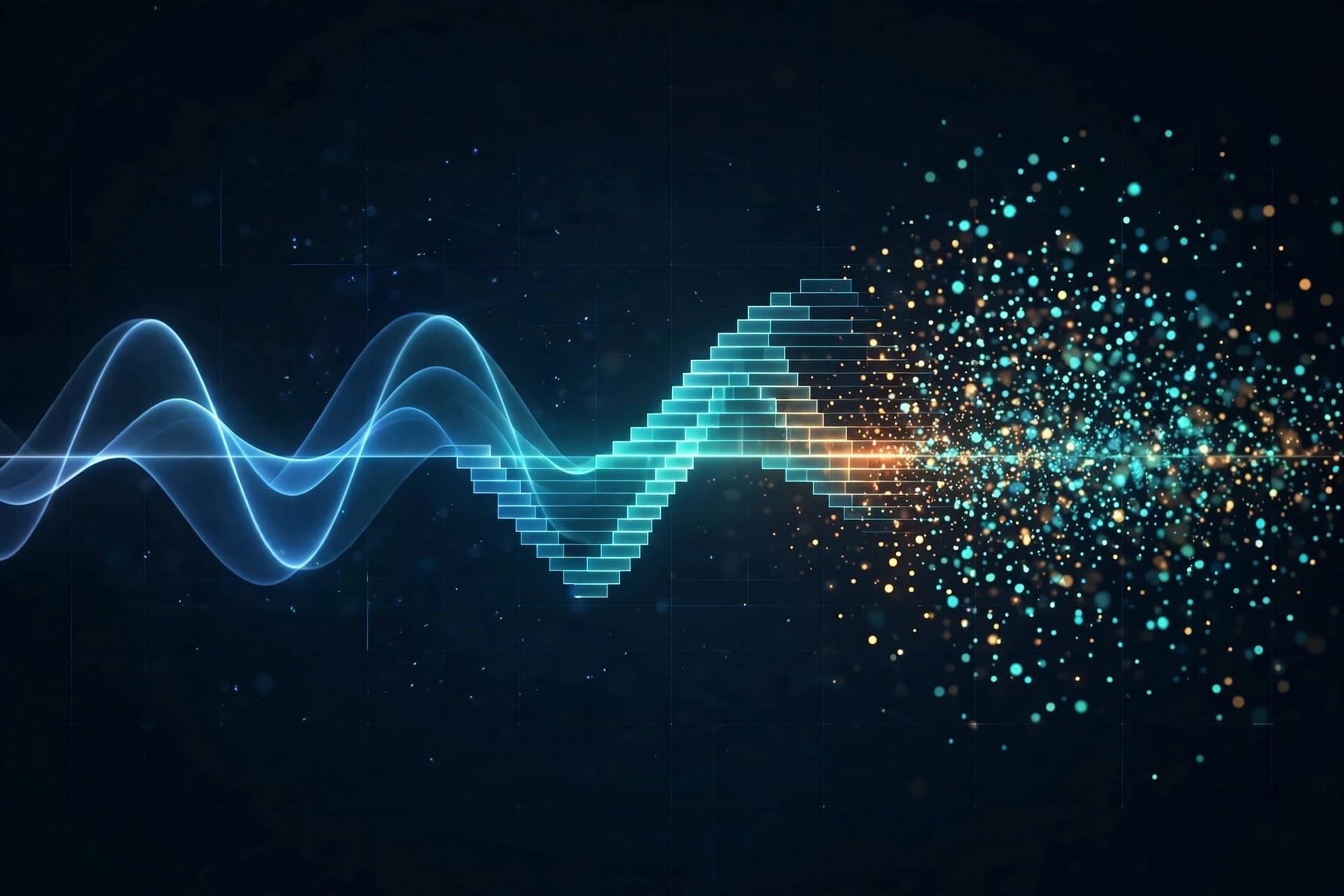
Sound is typically experienced as a continuous wave, a ripple moving through air or water. But in the strange and counterintuitive realm of quantum mechanics, even sound behaves differently. Recently, scientists achieved a groundbreaking milestone by observing sound jumping between discrete quantum states. This phenomenon, known as phonon quantization, reveals that acoustic energy is not smooth but granular, existing in specific packets. It is a discovery that bridges the gap between the audible world we know and the invisible rules that govern the smallest particles.
The experiment involved trapping sound waves in a microscopic mechanical resonator, cooling it to near absolute zero to minimize thermal noise. In this controlled environment, researchers were able to detect individual phonons, the quantum units of vibrational energy. Watching a phonon jump from one energy level to another is akin to seeing a ball leap between steps rather than rolling down a ramp. This observation confirms theoretical predictions made decades ago, providing empirical evidence for the quantum nature of sound.
This achievement has profound implications for the field of quantum information science. Just as photons are used in quantum computing and communication, phonons could serve as carriers of quantum information. Their ability to interact with various materials makes them versatile tools for building hybrid quantum systems. By controlling sound at the quantum level, scientists may develop new types of sensors, processors, and memory devices that operate with unprecedented precision.
The technical challenge of isolating and measuring single phonons is immense. It requires sophisticated equipment and a deep understanding of quantum mechanics. The success of this experiment highlights the advancements in nanotechnology and cryogenics that have made such observations possible. It is a testament to the ingenuity of researchers who push the boundaries of what can be measured and understood.
Beyond technology, this discovery enriches our fundamental understanding of physics. It demonstrates that quantum effects are not limited to light and electrons but extend to mechanical vibrations as well. This universality suggests that the quantum world is more pervasive than previously thought, influencing phenomena across different scales. It invites physicists to rethink the boundaries between classical and quantum domains.
For the public, the idea that sound has a quantum structure may seem abstract, but it underscores the mystery and beauty of the natural world. It reminds us that reality is often more complex than our senses perceive. By exploring these hidden layers, science expands our perspective, offering new ways to interpret the universe. It is a journey from the familiar to the extraordinary.
As research in this area continues, we can expect further innovations in quantum acoustics. The ability to manipulate sound at the quantum level could lead to breakthroughs in materials science and energy efficiency. It opens a new chapter in the story of human discovery, where the whisper of a particle holds the key to future technologies.
The observation of sound jumping between quantum states marks a significant advance in physics. It validates long-standing theories and opens new avenues for quantum technology. As scientists continue to explore this frontier, the boundary between the audible and the quantum becomes increasingly porous, revealing a world of intricate possibilities.
AI Image Disclaimer: Images accompanying this text are AI-generated artistic interpretations of quantum mechanics and acoustic waves, not actual laboratory photographs.
Sources: Science Magazine Phys.org MIT News
Published by Banx Network. This article is part of the Banx decentralized media programme, powered by the BXE token on the XRP Ledger.