A Different Kind of Computer
Almost every computer people use today — from smartphones and laptops to the world's most powerful supercomputers — is based on classical computing.
Classical computers process information using bits.
A bit has two possible states:
0 or 1.
Billions of these simple units can be combined to perform extraordinarily complicated calculations.
Quantum computers approach the problem differently.
Their basic unit of information is called a qubit.
A qubit can exist in a quantum combination of states known as superposition. Quantum systems can also exhibit entanglement, where the states of multiple qubits become correlated in ways that have no classical equivalent.
These properties allow quantum computers to process information according to fundamentally different rules.
But that does not mean a quantum computer is simply a much faster version of a laptop.
The real opportunity is much more specific.
Quantum computers could potentially solve certain classes of problems far more efficiently than classical machines.
Why Quantum Computing Matters
The most important question isn't whether quantum computers can replace conventional computers.
They probably won't.
Classical computers are extremely good at everyday tasks.
Running websites.
Playing games.
Processing spreadsheets.
Streaming video.
Managing databases.
Quantum computers are being developed for a different category of problems.
Scientists are particularly interested in applications involving complex simulations and optimisation.
These include:
Molecular simulation Drug discovery Materials science Chemical engineering Optimisation Financial modelling Cryptography Machine learning
The common theme is complexity.
Some problems become extraordinarily difficult for classical computers as the number of variables increases.
Quantum algorithms could potentially approach certain problems in fundamentally different ways.
The Chemistry Problem
One of the most promising areas is chemistry.
Nature itself operates according to quantum mechanics.
Molecules are quantum systems.
Simulating increasingly complicated molecules using classical computers can therefore become extremely computationally demanding.
A sufficiently capable quantum computer could potentially simulate molecular systems more naturally.
That could eventually help researchers investigate new medicines, catalysts, batteries and materials.
The potential economic impact is significant.
A better catalyst could make an industrial process cheaper.
A new material could improve batteries.
A better drug candidate could accelerate pharmaceutical research.
A new chemical process could reduce energy consumption.
Quantum computing could therefore become valuable not because consumers buy quantum computers, but because industries use them to solve problems that are currently difficult or expensive.
The Hardware Is Extremely Difficult
The theory is elegant.
The engineering is not.
Qubits are extraordinarily sensitive.
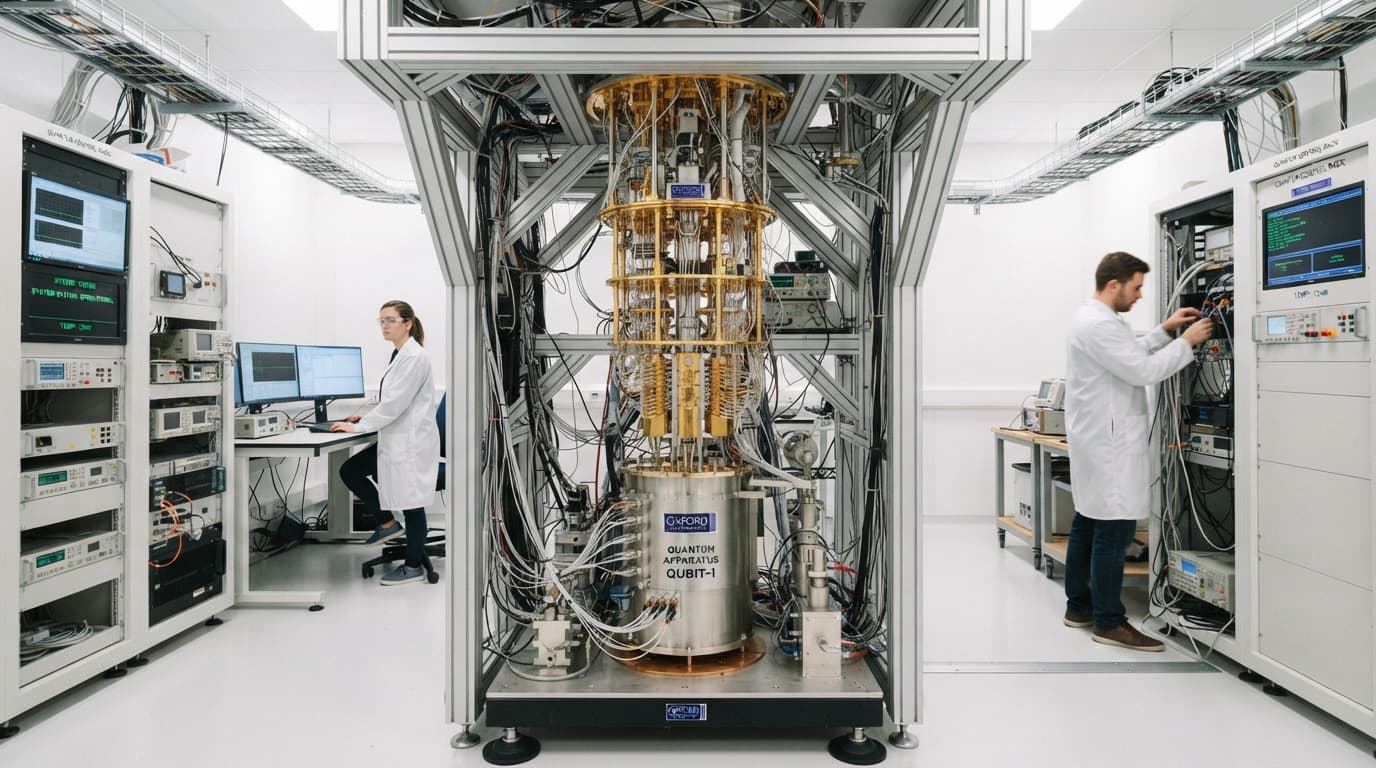
Interactions with the surrounding environment can cause quantum information to lose its useful state — a problem broadly referred to as decoherence.
Quantum computers therefore require highly controlled environments.
Different companies and research groups are pursuing different approaches.
Some use superconducting circuits.
Others are investigating trapped ions, neutral atoms, photonic systems and other physical platforms.
There is no universally accepted winner.
This makes the current quantum industry resemble the early stages of several previous technological revolutions.
Multiple approaches are being developed simultaneously.
Some will probably succeed.
Others may eventually disappear.
The Error-Correction Challenge
One of the biggest obstacles is quantum error correction.
Classical computers can copy and check information relatively easily.
Quantum information is much more delicate.
Researchers therefore need sophisticated techniques to protect quantum information from errors without destroying the quantum properties that make the system useful.
This has become one of the central goals of the industry.
Google reported in 2024 that its Willow quantum processor demonstrated a key milestone in quantum error correction, showing that increasing the number of physical qubits used for error correction could reduce the logical error rate rather than making it worse. (blog.google)
That does not mean fault-tolerant quantum computing has been solved.
It demonstrates progress toward one of the fundamental requirements for building large-scale quantum machines.
Google's Quantum Milestone
Google has been one of the major companies competing in quantum computing.
In December 2024, the company announced Willow, a 105-qubit quantum processor.
Google reported that Willow completed a particular benchmark computation in less than five minutes that the company estimated would take a leading classical supercomputer an extremely long time to reproduce using the same approach. (blog.google)
The result attracted considerable attention.
But there is an important qualification.
The benchmark was specifically designed to demonstrate quantum computational performance and was not a practical commercial problem.
It therefore should not be interpreted as meaning that quantum computers have suddenly become faster than classical computers for ordinary computing tasks.
The significance lies in demonstrating progress toward increasingly capable quantum systems.
IBM's Approach
IBM is pursuing its own large-scale quantum computing roadmap.
The company has described a roadmap focused on scaling quantum processors while developing increasingly sophisticated error-correction techniques.
IBM's quantum roadmap targets fault-tolerant quantum computing later this decade, while continuing to develop processors with increasingly large numbers of qubits. (ibm.com)
The competition between companies and research institutions is important.
Quantum computing is not a single technology.
Different hardware architectures have different advantages and engineering challenges.
The eventual industry could therefore look very different from today's market.
Quantum Computing and Cybersecurity
One of the most important consequences of sufficiently powerful quantum computers could involve cybersecurity.
Modern public-key cryptography relies on mathematical problems that are extremely difficult for conventional computers to solve.
A sufficiently capable quantum computer running Shor's algorithm could theoretically solve some of these problems much more efficiently.
That creates a long-term security concern.
Governments and organisations therefore have been developing post-quantum cryptography — cryptographic methods designed to resist attacks from both classical and quantum computers.
The U.S. National Institute of Standards and Technology finalised its first three post-quantum cryptographic standards in 2024 and has encouraged organisations to begin transitioning to them. (nist.gov)
This is an important point.
Quantum computing does not need to become commercially mature before it affects the economy.
The possibility of future quantum attacks is already influencing cybersecurity decisions today.
The Financial Industry Is Watching
Finance is another sector investigating quantum computing.
Banks, asset managers and financial technology companies deal with complex optimisation and modelling problems.
Potential applications could include portfolio optimisation, risk analysis, derivatives pricing and fraud detection.
However, most proposed financial applications remain research projects rather than proven commercial advantages.
That distinction matters.
The quantum industry has generated substantial interest, but investors and businesses still need to determine which applications can produce measurable advantages over classical computing.
The first commercially valuable quantum applications may therefore be relatively specialised.
Quantum Computing Won't Replace the Supercomputer
It is tempting to imagine a future where quantum computers replace data centres full of conventional machines.
That is unlikely.
Quantum computers are more likely to operate alongside classical computers.
A future computing system could look something like this:
Classical computer → Quantum processor → Classical computer
The classical system could manage the overall application.
A specialised quantum processor could handle a particular computational problem.
The classical computer could then process the resulting information.
This is sometimes described as hybrid quantum-classical computing.
The quantum processor would effectively become another specialised computational resource.
The Race for Quantum Advantage
The phrase quantum advantage is used to describe situations where a quantum computer can perform a useful task more efficiently than the best available classical approach.
This is one of the industry's major objectives.
But demonstrating a theoretical advantage is not enough.
A commercially useful quantum system must provide an advantage that matters economically.
It needs to be:
Reliable Scalable Affordable enough to use Programmable Better than classical alternatives for a meaningful task
That is a much higher standard.
The industry is therefore moving from a question of:
"Can we build a quantum computer?"
towards:
"Can we build one that solves commercially valuable problems?"
The Global Quantum Race
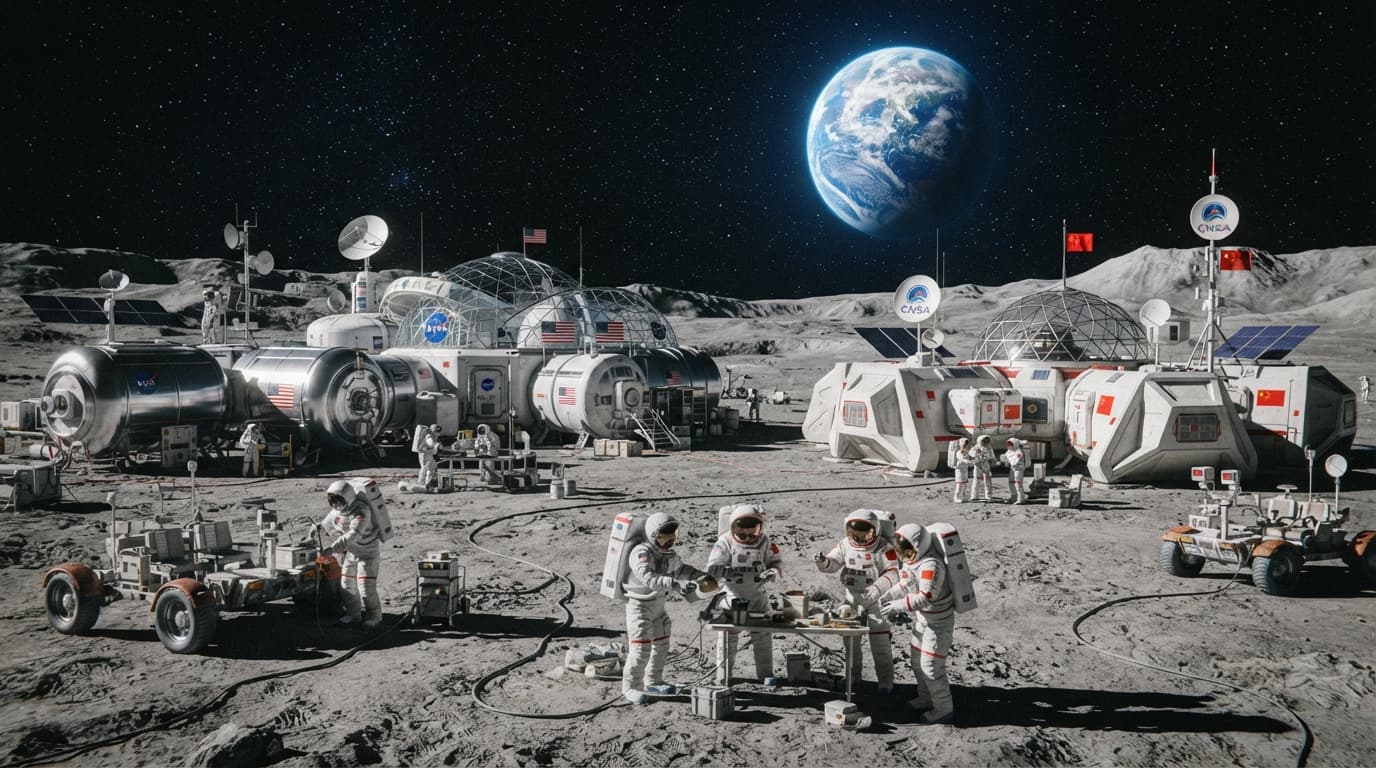
Quantum computing has also become a strategic technology.
The United States, China, Europe, Japan, the United Kingdom and other countries are investing heavily in quantum research.
Governments view quantum technology as potentially important to computing, cybersecurity, scientific research and advanced manufacturing.
The European Union, for example, has established the European Quantum Flagship, a long-term research and innovation initiative designed to support Europe's quantum technology ecosystem. (quantum-flagship.eu)
The United Kingdom has also published a National Quantum Strategy covering research, commercialisation, skills and infrastructure. (gov.uk)
This competition could become increasingly important as quantum technologies mature.
What Happens If Quantum Computing Works?
Imagine a future where fault-tolerant quantum computers become practical.
Scientists could potentially simulate increasingly complex molecules.
Pharmaceutical companies could investigate drug candidates using more sophisticated molecular models.
Materials scientists could search for new superconductors, catalysts and battery materials.
Financial institutions could experiment with new optimisation techniques.
Engineers could investigate complex systems that are currently difficult to model.
Cybersecurity systems would have to evolve.
Entire industries could potentially gain access to computational capabilities that previously required approximations or enormous classical computing resources.
The effects would not necessarily be visible to consumers.
You may never own a quantum computer.
But you could use a medicine, battery or financial service that was developed with one.
The 2030s Could Be Decisive
Predicting the exact timeline for quantum computing is difficult.
Some researchers and companies expect meaningful commercial applications before the end of this decade.
Others argue that the industry still faces substantial engineering challenges.
The key milestones to watch are not simply the number of qubits.
More qubits do not automatically mean a better quantum computer.
The quality of those qubits matters.
Error rates matter.
Connectivity matters.
Error correction matters.
And ultimately, useful algorithms matter.
A machine with fewer high-quality logical qubits could potentially be more useful than a machine advertising a much larger number of noisy physical qubits.
That is why the industry is gradually shifting its focus from qubit counts toward logical qubits and fault-tolerant performance.
A New Computing Layer
The quantum revolution may not replace the classical computing revolution.
It could extend it.
For more than half a century, humanity has continually expanded its ability to process information.
Transistors made modern computing possible.
Microprocessors put computing into personal devices.
Cloud computing turned computing into an on-demand service.
Artificial intelligence transformed how computers process information.
Quantum computing represents another possible expansion.
Instead of simply making conventional computers faster, it attempts to exploit the fundamental behaviour of nature itself.
That is an extraordinary proposition.
But it is also one that demands patience.
The technology remains under development, and many of the most exciting applications remain theoretical or experimental.
The Quantum Future
The quantum computing revolution is therefore not about replacing your laptop.
It is about developing a new type of computational capability for problems that classical machines may struggle to solve efficiently.
The technology still has significant obstacles to overcome.
Error correction remains difficult.
Hardware remains expensive and technically demanding.
Useful quantum algorithms are limited.
And the economic advantage of many proposed applications has yet to be demonstrated.
Yet the progress of recent years suggests that quantum computing has moved well beyond being purely theoretical.
Companies are building increasingly sophisticated processors.
Researchers are developing new error-correction techniques.
Governments are investing in national quantum strategies.
Industries are beginning to investigate potential applications.
The ultimate outcome remains uncertain.
But if scalable, fault-tolerant quantum computing becomes reality, its impact could extend far beyond the computing industry.
The biggest revolution may happen quietly — inside laboratories, pharmaceutical companies, financial institutions, materials research facilities and data centres.
And when the results begin appearing in the real world, people may not even realise that a quantum computer was behind them.
References
1. Google Quantum AI — Willow Quantum Chip Google's announcement and technical discussion of its Willow quantum processor and quantum error-correction results. Google Quantum AI — Willow 2. IBM — Quantum Computing Roadmap IBM's roadmap for scaling quantum processors and developing fault-tolerant quantum computing. IBM Quantum Roadmap 3. NIST — Post-Quantum Cryptography Standards Information on NIST's first three finalized post-quantum encryption standards. NIST — Post-Quantum Encryption Standards 4. European Quantum Flagship Information on the European Union's quantum research and innovation programme. European Quantum Flagship 5. UK Government — National Quantum Strategy The UK's strategy for quantum research, commercialisation, skills and infrastructure. UK National Quantum Strategy 6. IBM — What Is Quantum Computing? Background on qubits, quantum computing principles and potential applications. IBM Quantum Computing Overview
Published by Banx Network. This article is part of the Banx decentralized media programme, powered by the BXE token on the XRP Ledger.