Time, in the cosmic sense, is a concept that stretches the imagination. We speak of billions of years as if they were mere moments, yet these epochs define the lifecycle of stars and galaxies. For decades, the prevailing narrative held that our Milky Way and our neighbor, Andromeda, were destined for a dramatic collision, a celestial dance that would reshape both galaxies forever. However, new insights suggest that the future may be less certain than we once thought. A recent study introduces a note of ambiguity into this cosmic prophecy, reminding us that even the grandest predictions are subject to revision.
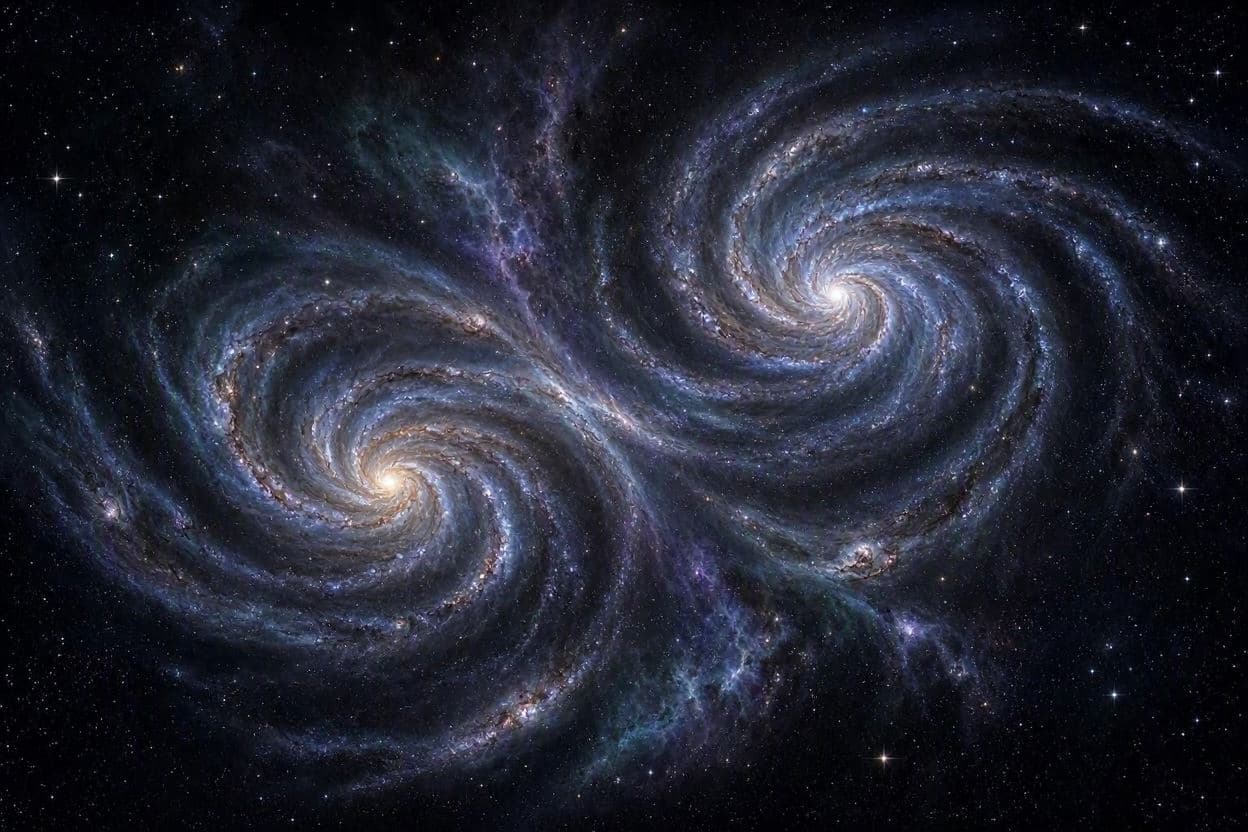
The traditional view of the Milky Way-Andromeda merger was based on earlier measurements of galactic motion. Astronomers believed that the two galaxies were on a direct collision course, driven by mutual gravitational attraction. This event, often referred to as Milkomeda, was expected to occur in approximately 4.5 billion years. It was a scenario that captured the public imagination, evoking images of swirling stars and chaotic gravitational interactions. Yet, science is a process of continuous refinement, and new data often leads to new conclusions.
The 2025 study published in Nature Astronomy leverages data from two of our most powerful observational tools: the Hubble Space Telescope and the Gaia mission. Gaia, in particular, has provided unprecedented precision in mapping the positions and movements of stars within our galaxy and beyond. By analyzing the proper motion and radial velocity of Andromeda with greater accuracy, researchers have recalculated the trajectory of the approaching galaxy. The results indicate that the likelihood of a direct merger within the next 10 billion years is only about fifty percent.
This uncertainty arises from the complex interplay of gravitational forces and the influence of dark matter. The mass distribution in both galaxies, particularly the invisible halo of dark matter surrounding them, plays a crucial role in determining their paths. Small variations in these measurements can lead to significantly different outcomes. Instead of a head-on collision, the galaxies might engage in a prolonged gravitational dance, passing near each other multiple times without fully merging. Alternatively, they could drift apart if the expansion of the universe exerts a stronger influence than anticipated.
The implications of this finding are profound for our understanding of galactic evolution. Mergers are key drivers of structural change in galaxies, triggering star formation and altering their shapes. If the Milky Way and Andromeda do not merge as expected, our galaxy’s future development may follow a different path. This could affect the distribution of stars, the rate of new star birth, and the overall dynamics of the Local Group of galaxies. It prompts astronomers to reconsider models of galactic interaction and the role of external forces.
Moreover, this study highlights the importance of precise measurement in astronomy. The difference between a certain collision and a probable miss lies in minute details of motion and mass. The collaboration between Hubble’s deep-field imaging and Gaia’s astrometric precision demonstrates the power of combining different observational techniques. It is a testament to the iterative nature of scientific inquiry, where each new dataset refines our picture of the universe. We are learning to see with greater clarity, even as the subject of our study remains vast and distant.
For the general public, this news may seem abstract, given the immense timescales involved. Human civilization, let alone individual lives, will not exist to witness these events. Yet, there is a philosophical comfort in knowing that our understanding is evolving. The universe is not a static script but a dynamic story, full of twists and turns. The possibility that Andromeda might not collide with us is a reminder that certainty is rare in science, and openness to new possibilities is essential.
As we look forward, further observations will be needed to narrow down the probabilities. Future missions and more advanced telescopes will provide even more detailed data on galactic motions. Until then, we hold this new perspective lightly, appreciating the nuance it brings to our cosmic narrative. The dance of the galaxies continues, whether it ends in a merger or a graceful pass, it remains a spectacle of gravitational artistry.
The revised probability of the Milky Way-Andromeda merger invites us to embrace uncertainty as part of the scientific journey. It reminds us that the cosmos is full of surprises, and our knowledge is always a work in progress. Let us remain curious and humble as we watch the skies.
AI Image Disclaimer: Visuals accompanying this text are AI-generated artistic renderings and do not represent actual photographic evidence of future galactic events.
Sources: Nature Astronomy ESA Gaia Mission NASA Hubble Site
Published by Banx Network. This article is part of the Banx decentralized media programme, powered by the BXE token on the XRP Ledger.