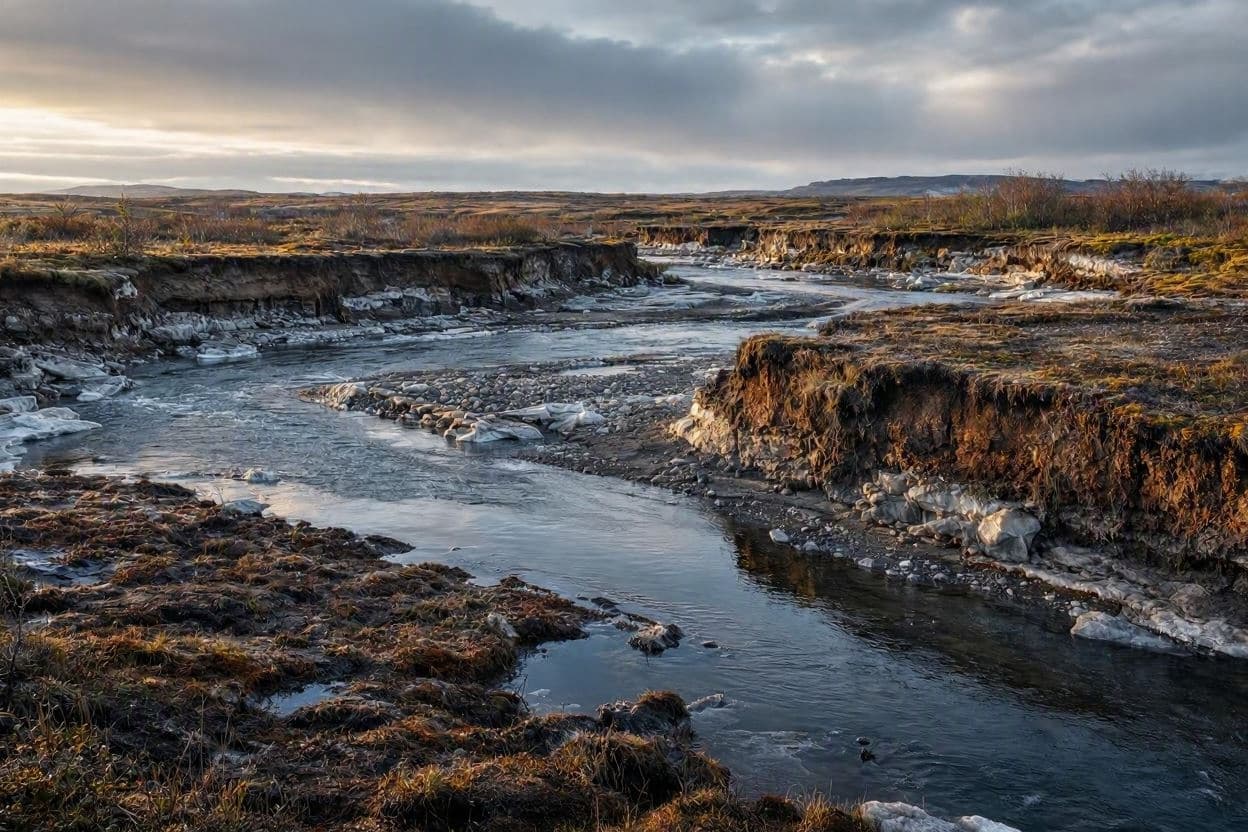
The Arctic is often viewed as a frozen, static landscape, a realm of ice and silence. However, beneath the surface, its rivers are dynamic agents of change, carving paths through the terrain with increasing intensity. Recent studies have revealed that Arctic rivers are eroding their banks at rates far higher than previously predicted, defying conventional models of geological processes in cold environments. This discovery highlights the rapid transformation of the region due to climate change.
Traditionally, scientists assumed that erosion in the Arctic was limited by the short summer season and the presence of permafrost, which binds soil together. However, as temperatures rise, the permafrost thaws, making the soil more susceptible to being washed away. The rivers, swollen with meltwater and rain, carry increased sediment loads, accelerating the erosion process. This feedback loop is reshaping the Arctic coastline and riverbeds at an alarming pace.
The implications of this accelerated erosion are significant. It affects local ecosystems, altering habitats for fish and wildlife that depend on stable riverbanks. Indigenous communities, who rely on these waterways for transportation and subsistence, face growing challenges as landscapes shift and infrastructure becomes unstable. The loss of land also releases stored carbon into the atmosphere, contributing further to global warming.
Researchers used satellite imagery and field measurements to track changes in river morphology over several years. The data showed that some rivers are widening and migrating laterally much faster than expected. These findings challenge existing climate models, which may have underestimated the rate of landscape change in the high latitudes. Updating these models is crucial for accurate predictions of future environmental impacts.
The study also highlights the role of extreme weather events. Heavy rainfall and heatwaves, becoming more frequent in the Arctic, trigger sudden spikes in erosion. These pulses of activity can cause more damage in a few days than gradual processes do in years. Understanding these episodic events is key to managing the risks associated with riverbank collapse and flooding.
As the Arctic warms at twice the global average, the resilience of its landscapes is being tested. The defying of scientific expectations serves as a warning that natural systems can respond to climate change in nonlinear and unpredictable ways. It underscores the need for adaptive management strategies and continued monitoring of these sensitive environments.
For the global community, the changes in the Arctic are a bellwether. What happens in this remote region has ripple effects worldwide, from sea-level rise to weather patterns. By studying these rivers, scientists gain valuable insights into the broader impacts of a warming planet, urging action to mitigate further changes.
Arctic rivers are eroding faster than anticipated, challenging previous scientific understanding and highlighting the urgent impacts of climate change. This accelerated transformation affects local communities and ecosystems, underscoring the need for updated models and adaptive strategies.
AI Image Disclaimer: Visual representations of this environmental phenomenon are generated by artificial intelligence for editorial context.
Sources: Nature Geoscience National Snow and Ice Data Center Science Daily
Published by Banx Network. This article is part of the Banx decentralized media programme, powered by the BXE token on the XRP Ledger.