There is a particular intimacy in a debate about water, a substance so ordinary that it is easy to forget how much depends on it, and so essential that the question of who controls it becomes a question about the kind of city Toronto wants to be. With less than a week before election day, Mayor Olivia Chow and her main challenger, Brad Bradford, have turned that question into the sharpest exchange of the campaign, a dispute that is not really about pipes and pumps but about trust, control, and the ghost of privatization.
Bradford's proposal, announced last month, would transform Toronto Water into a publicly owned utility company modeled on Toronto Hydro, which became a corporation in 1999. He argues that the current system collects far more in water fees than it needs to operate, with the surplus flowing into city reserves that are not spent for decades. By reducing those transfers, he says, the average homeowner could save about $300 a year on their water bill. The utility would be 100 percent owned by the city, with an independent board setting rates and private investment prohibited .
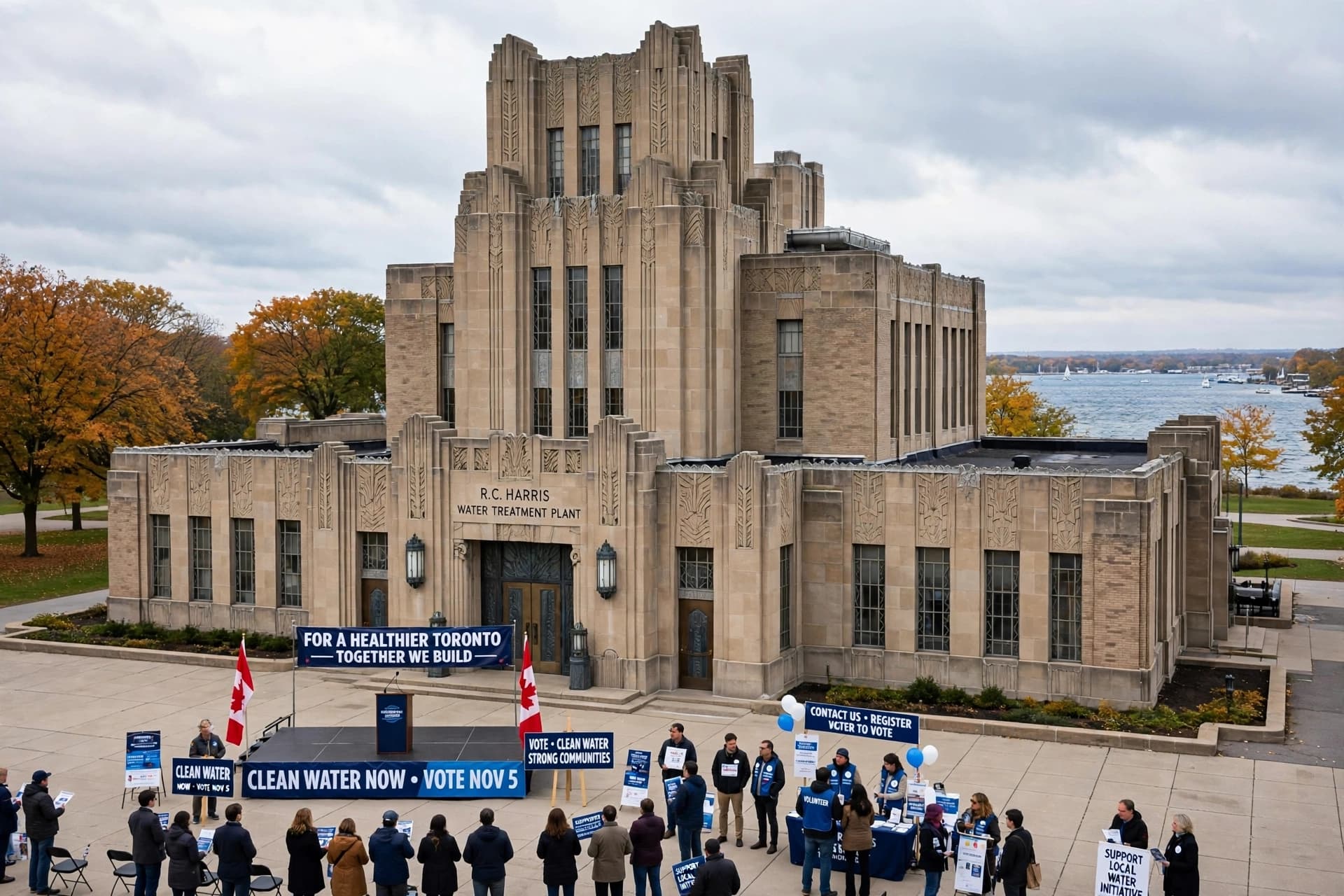
Chow has rejected the plan with a directness that has defined her campaign's closing argument. Speaking outside the R.C. Harris Water Treatment Plant on Wednesday, she accused Bradford of wanting to "hand control of Toronto's water to Doug Ford's government," opening the door to privatization. "This is the water our children drink, the water we cook with, the water we depend on every single day, and it belongs to the people of Toronto, which is why I will never give our water away" . Environmentalist David Suzuki stood beside her, echoing the warning.
The legal and institutional context is more complicated than either candidate's framing suggests. The Toronto Civic Employees Union, Local 416, which operates and maintains the water system and has endorsed Chow, obtained a legal opinion warning that under Ontario's Waste and Wastewater Public Corporations Act, the city could lose significant control. The opinion argues that a future provincial government could change the law to permit private investment, and that ministerial powers could override the city's intentions . Bradford counters that the legislation currently prohibits any shares from being held by anyone other than the city, province, or federal government, and that the union's strongest argument is simply that laws can change in the future—which is true of every law in Ontario. He points to Toronto Hydro as evidence that a city-owned corporation is not the same as privatization .
The political arithmetic adds weight to the dispute. A recent Nanos poll conducted for CTV News Toronto and CP24 found Chow's lead over Bradford had shrunk to 3.2 percent among decided voters, within the margin of error . The union's letter noted that fifteen city councillors oppose Bradford's plan, alongside Chow, suggesting that even if he wins, he would face a council resistant to the change. Myer Siemiatycki, a professor emeritus at Toronto Metropolitan University, told CBC that this raises the prospect of a mayor relying on strong mayor powers to push the plan through, a tactic that could prove unsustainable beyond a few key votes .
There is a larger question beneath the exchange that neither candidate has fully addressed. Toronto's water system is aging, and the infrastructure that delivers clean water to millions of people requires investment that the city has deferred for years. Bradford's argument is that the current model overcharges residents to build reserves that are not used, and that a utility structure would be more efficient. Chow's argument is that the current model works, that the water is safe, and that the risks of restructuring outweigh the savings promised. Both are making claims about the future that cannot be tested until after the votes are counted.
For now, the debate has crystallized the choice facing Toronto voters. One candidate offers a structural change with a promise of savings and a confidence that public ownership can be preserved within a new framework. The other offers continuity, a defense of the existing system, and a warning that the change is a door that, once opened, cannot be closed. The water itself will continue to flow, as it has since 1873, regardless of who wins on Monday.
AI Image Disclaimer: The images accompanying this article are generated by artificial intelligence and are intended for illustrative purposes only.
Sources: CTV News, CBC News, NOW Toronto, Nanos Research
Published by Banx Network. This article is part of the Banx decentralized media programme, powered by the BXE token on the XRP Ledger.