Some discoveries arrive with fanfare, announced by careful planning and deliberate aim. Others drift into view quietly, noticed only because someone happened to be looking elsewhere. The massive, starless cloud NASA recently identified belongs to the second kind—a presence revealed not by intention, but by attention.
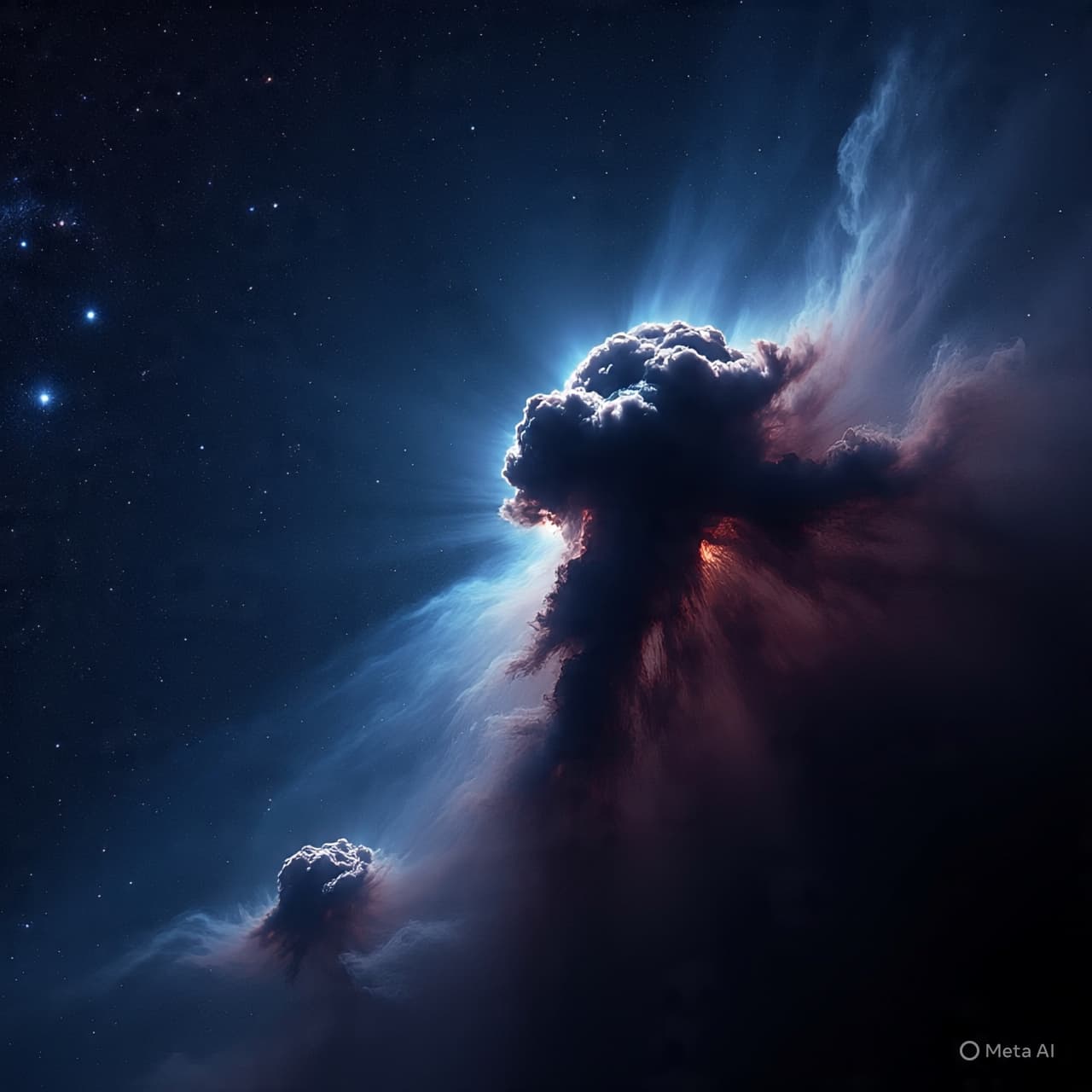
The cloud was uncovered as astronomers analyzed data collected for a different purpose, combing through deep-space observations meant to study distant cosmic structures. In the background of those measurements appeared something unexpected: a vast accumulation of cold gas and dust, dense enough to block light, yet curiously empty of stars. It was there all along, hidden not by distance, but by darkness.
Such clouds are not rare in principle. Molecular clouds are known as the raw material of stars, sprawling reservoirs of hydrogen and dust that eventually collapse into glowing constellations. What makes this one unusual is its scale and stillness. Despite its mass—large enough to form thousands of stars—it shows no clear signs of star formation. No newborn suns, no energetic outflows, no telltale infrared glow. It is heavy, cold, and silent.
Astronomers refer to structures like this as “starless” or “dark” clouds, but the terms can be misleading. They are not empty. They are crowded with particles, threaded with magnetic fields, and shaped by subtle forces. What they lack is ignition. Gravity has not yet won its slow argument with internal pressure and turbulence. Time, it seems, is still deciding.
The cloud’s discovery matters because it offers a rare glimpse of an early chapter in the stellar life cycle—one that is usually inferred rather than observed. By studying such a cloud, scientists can examine the conditions that exist before stars are born, when matter gathers but resists collapse. Temperature, density, magnetic alignment, and motion can all be measured without the disruptive influence of active star formation.
There is also a humbling implication in how the cloud was found. Modern astronomy is saturated with data, much of it collected automatically and archived for years. The universe may already be present in these records, waiting for the right question—or the right accident—to bring it into focus. Discovery, in this sense, becomes less about pointing telescopes and more about learning how to notice.
Eventually, this cloud may change. A shockwave from a nearby supernova, a slow accumulation of mass, or the quiet weakening of internal turbulence could tip it toward collapse. When that happens, light will follow. Stars will form, planets may gather, and the cloud’s anonymity will end. But for now, it remains suspended in a long cosmic pause.
In the darkness between stars, NASA found not emptiness, but potential—a reminder that much of the universe’s story unfolds before anything begins to shine.
AI Image Disclaimer
Visuals are AI-generated and serve as conceptual representations.
Sources
NASA Astrophysical Journal Nature Astronomy Science
Published by Banx Network. This article is part of the Banx decentralized media programme, powered by the BXE token on the XRP Ledger.