We often think of sunlight as instantaneous, a beam that travels the nine million miles from the sun to Earth in just eight minutes. But this final sprint is only the end of a much longer, more arduous journey. Before a photon ever escapes the sun’s surface, it may spend hundreds of thousands of years wandering through the star’s dense interior. It is a paradox of light: the fastest thing in the universe moving at a crawl, trapped in a stellar labyrinth.
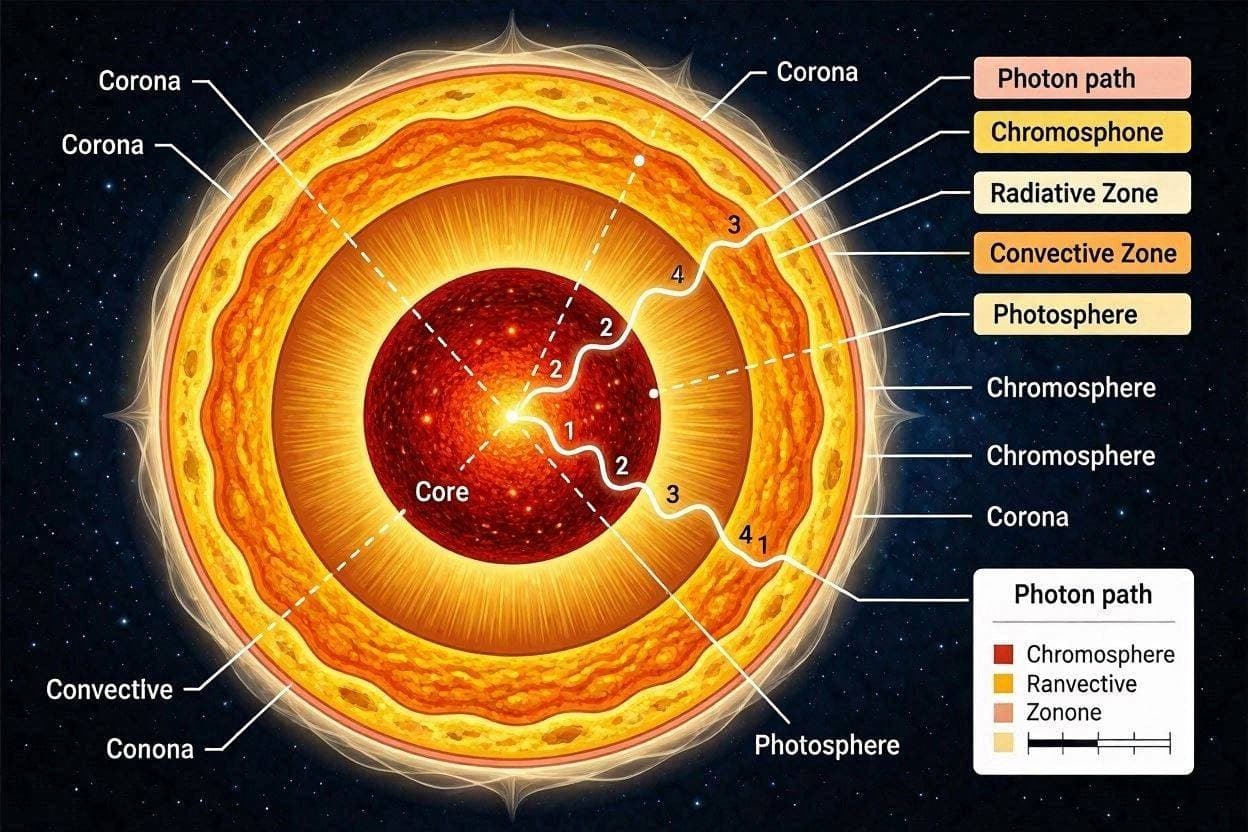
The journey begins in the sun’s core, where nuclear fusion converts hydrogen into helium, releasing immense energy in the form of gamma-ray photons. These high-energy particles are born into a plasma so dense that they cannot travel far before colliding with other particles. Each collision absorbs and re-emits the photon, changing its direction and reducing its energy. This process, known as the "random walk," means that progress outward is incredibly slow.
Imagine trying to exit a crowded room where every step you take results in being bumped into a new direction. This is the reality for a photon in the radiative zone of the sun. It may take tens of thousands to hundreds of thousands of years for a photon to traverse this region, moving only a few centimeters at a time before another interaction occurs. The distance is short, but the path is infinitely complex.
Once the photon reaches the convective zone, the transport mechanism changes. Here, hot plasma rises toward the surface, carrying energy with it like boiling water in a pot. This convection is faster than the random walk, but it still takes time. The photon, now degraded to lower-energy visible light, continues its ascent, riding the currents of superheated gas.
Finally, the photon reaches the photosphere, the sun’s visible surface. Here, the density drops significantly, allowing the light to escape into the vacuum of space. From this point, it travels unimpeded at the speed of light, reaching Earth in mere minutes. The contrast between the eons spent inside the sun and the minutes spent in transit is striking, highlighting the extreme conditions within our star.
This long internal journey is crucial for understanding stellar physics. It explains why the sun shines steadily rather than flashing unpredictably. The delay acts as a buffer, smoothing out variations in energy production from the core. If the sun’s energy output changed suddenly, we would not know about it for thousands of years, until the affected photons finally emerged.
Studying this process helps astronomers model the interiors of other stars as well. By understanding how energy moves through the sun, we can infer the structures and lifecycles of distant stars. It is a fundamental aspect of astrophysics that connects the microscopic behavior of particles to the macroscopic brightness of the cosmos.
The next time you feel the warmth of the sun on your skin, remember the ancient origin of that light. It began its journey long before humans walked the Earth, navigating a dense and chaotic interior to reach us. It is a testament to the enduring power of our star, and the patient, persistent nature of light itself.
AI Image Disclaimer: The visuals associated with this article are AI-generated conceptual illustrations of solar interiors and light paths, designed to represent the scientific theory of photon transport.
Sources: NASA Solar Physics Scientific American University of Oregon Astronomy Department Space.com
Published by Banx Network. This article is part of the Banx decentralized media programme, powered by the BXE token on the XRP Ledger.