The Moon, often seen as a silent companion to Earth, holds more than just reflected light. Beneath its stillness, especially at its poles, lie traces of time—frozen records that stretch far beyond human history. Recent findings suggest that ice has been accumulating there for at least 1.5 billion years.
This discovery builds upon decades of observation and exploration. Scientists have long suspected the presence of water ice in permanently shadowed regions of the Moon, where sunlight never reaches and temperatures remain extremely low.
Using advanced data analysis and modeling, researchers have now traced the accumulation process across geological timescales. The findings indicate that water molecules, delivered by comets, asteroids, or solar wind interactions, gradually settled and remained preserved in these cold traps.
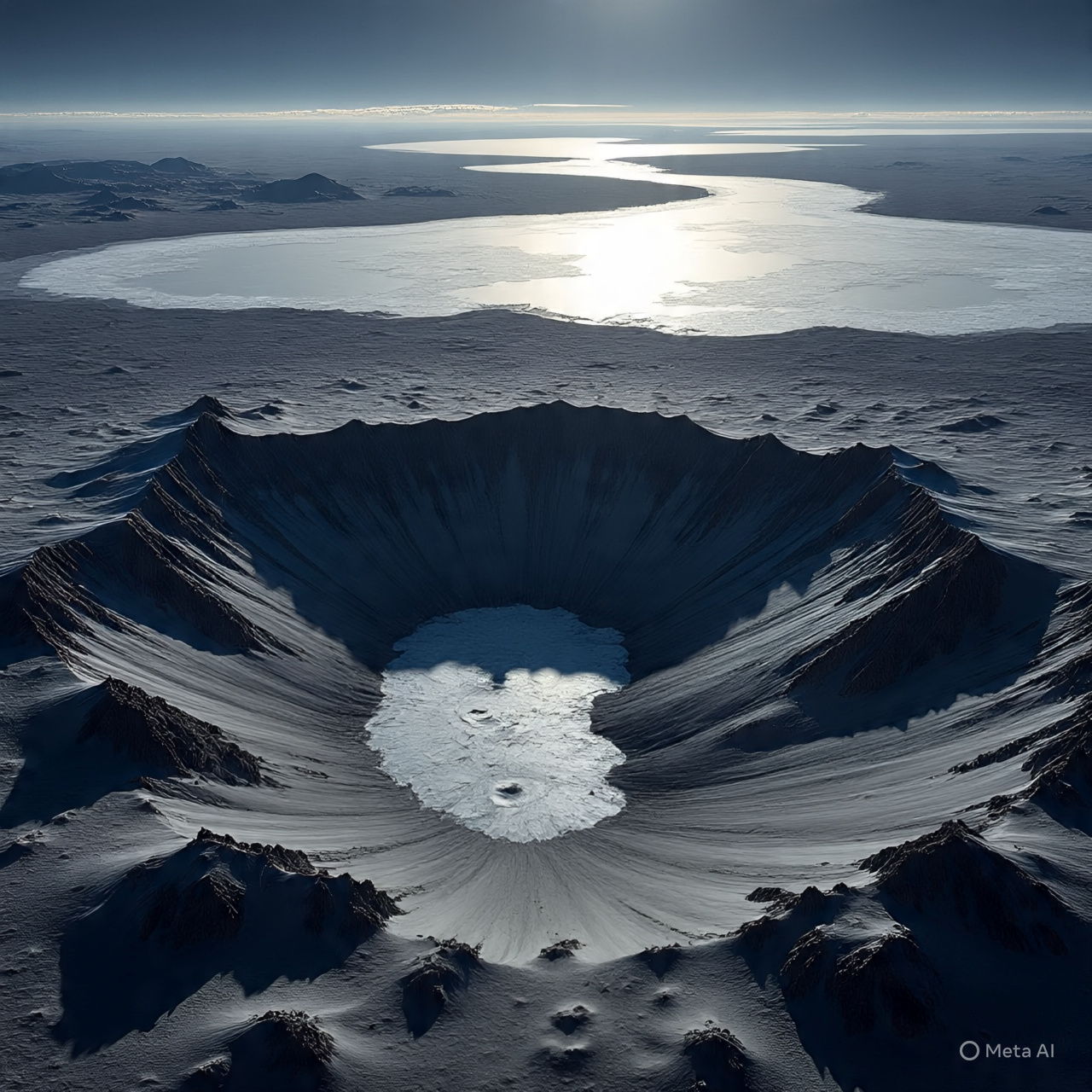
The Moon’s poles present unique conditions. Unlike its equatorial regions, which experience extreme temperature fluctuations, the shadowed craters at the poles maintain stability. This environment allows ice to persist without evaporating into space.
Understanding how long this ice has existed offers more than historical insight. It provides clues about the broader dynamics of the solar system, including how water has been distributed across planetary bodies.
For future space missions, particularly those involving human exploration, this discovery carries practical significance. Water ice could potentially be used for drinking, oxygen production, or even fuel, making it a valuable resource for sustained lunar presence.
Space agencies have already shown increased interest in polar regions. Missions under programs like lunar exploration initiatives aim to study these areas more closely, combining robotic and human efforts.
The research also raises questions about preservation. If ice can remain stable on the Moon for such long periods, similar mechanisms might exist elsewhere, including on Mars or icy moons orbiting distant planets.
At the same time, scientists emphasize the need for careful exploration. Disturbing these ancient deposits could alter valuable scientific records, making it essential to balance discovery with preservation.
In the quiet shadows of the Moon’s poles, the story of water continues to unfold—not loudly, but steadily, offering insights that bridge past and future exploration.
AI Image Disclaimer Illustrations were produced with AI and serve as conceptual depictions.
Source Check NASA Nature Science Magazine Reuters The New York Times
Published by Banx Network. This article is part of the Banx decentralized media programme, powered by the BXE token on the XRP Ledger.