The Moon has long seemed to us a silent companion a silent witness to Earth’s nights, a mirror of light in our darkest hours. Yet, beneath its serene veneer lies a history written in fire and stone, like a palimpsest of cosmic memory. Imagine a world where the lunar far side once felt the thunderous kiss of a colossal traveler in space, an impact so immense that it shook not just the surface, but the very heart of the Moon’s interior.
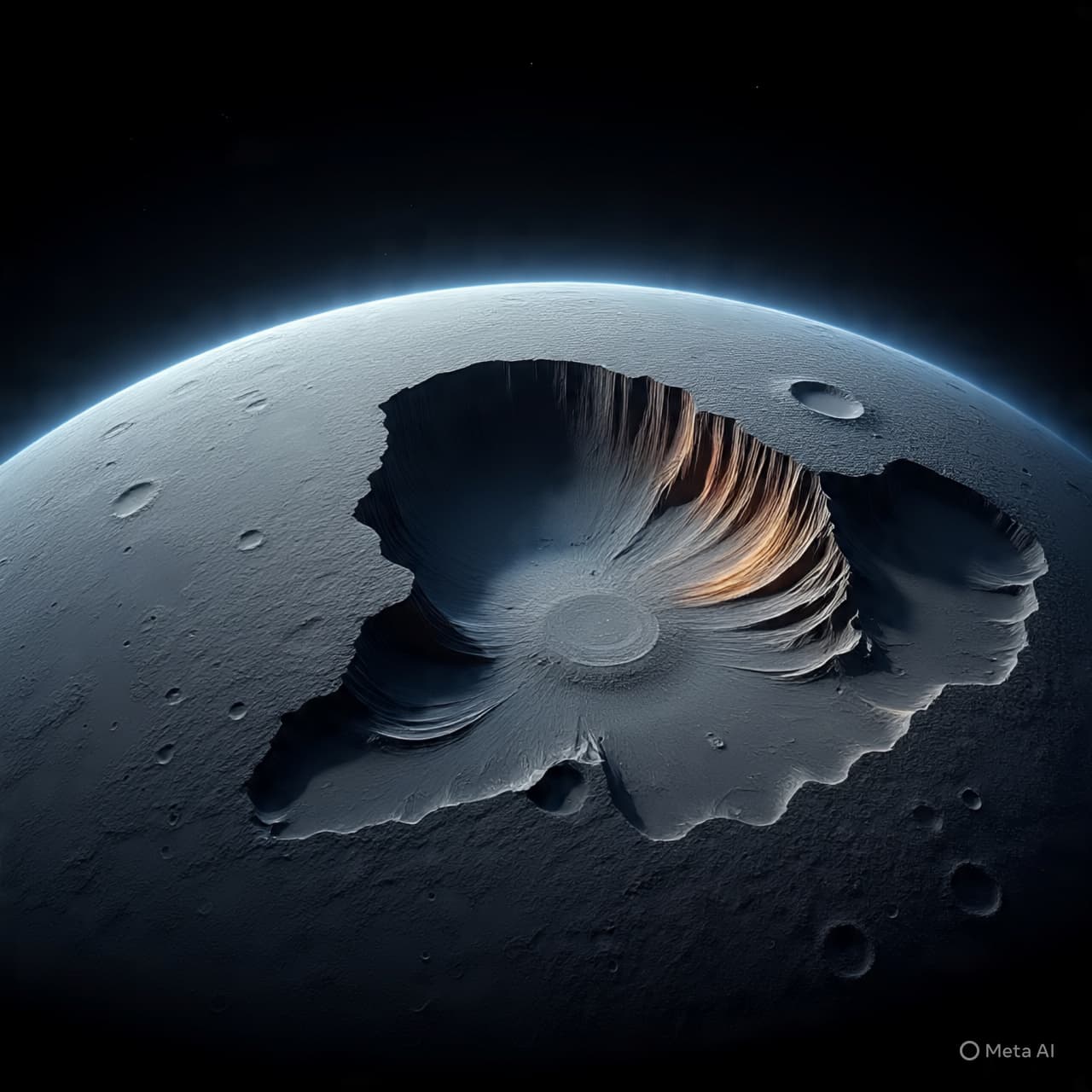
Recent scientific studies suggest exactly that: that a giant impact event the monstrous collision that carved the South Pole-Aitken basin on the Moon’s far side may have done more than leave a scar in rock and dust. It may have, as if exhaling a fiery breath, blown away volatile elements deep within the lunar mantle. Volatiles those elements that easily turn to gas, like potassium, zinc, and sulfur act as the Moon’s internal ‘breathing salts’, lowering melting points and inviting molten rock to rise and flow. But these elements, scientists now believe, were largely lost in the dramatic aftermath of that ancient crash.
This discovery sheds gentle light on a puzzle that has long captivated planetary scientists: why the Moon’s far side perpetually hidden from Earth differs so markedly from the near side. The near side, with its dark basalt plains once flooded by ancient lava, tells a story of prolonged internal activity. The far side, by contrast, wears its rugged highlands and deep craters like a quiet testament to a colder, drier past. What may have caused this divergence? The answer like a quiet whisper beneath lunar dust may be in the chemistry of lost elements carried off into space by that tremendous impact eons ago.
But beyond the elemental choreography, this research offers a broader metaphor: that even the seemingly lifeless Moon carries a hidden autobiography one shaped not just by cosmic chance, but by dramatic turns that reverberate through time. Each rock sample, each isotopic fingerprint, unfolds like a page from a long-buried journal. These clues, now gradually emerging from the silent lunar soils collected by missions such as Chang’e-6, are connecting dots between impact, loss, and the Moon’s evolving internal architecture.
In the soft glow of Earth’s gaze, the Moon reflects predictable phases. Yet beneath that gentle dance lies a story of violence and transformation. Scientists guided by patient analysis and the subtle language of isotopes are now decoding that story. Gentle as moonlight, these discoveries deepen our understanding not just of the Moon’s interior, but of how celestial bodies respond to the great winds of change that once swept through the early solar system.
And so, in the quiet cadence of scientific revelation, we find that every crater, every element depleted or retained, speaks to a dialogue between destruction and creation a lunar history both dramatic and quietly unfolding through human inquiry
AI Image Disclaimer “Visuals are created with AI tools and are not real photographs.”
Sources:
News Sources Used: Xinhua News Agency Global Times China Daily ScienceDaily University College London / related scientific reporting
Published by Banx Network. This article is part of the Banx decentralized media programme, powered by the BXE token on the XRP Ledger.