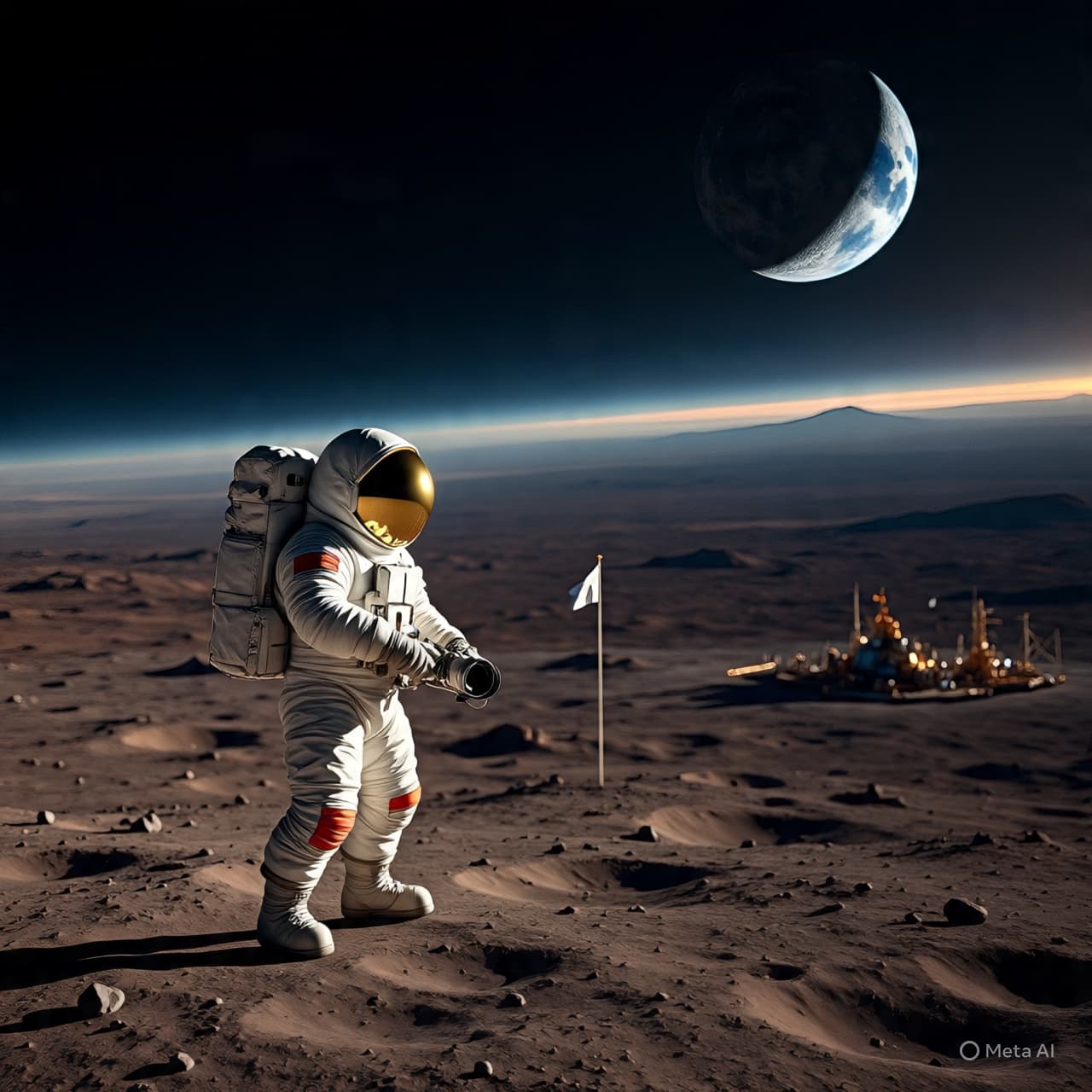
There was a time when the Moon felt like a mirror—reflecting humanity’s highest ambitions back toward Earth. In the glow of the late 1960s, each step upon its surface seemed to carry not just astronauts, but the quiet weight of collective wonder. The journey outward was also a journey inward, asking not only how far we could go, but why we chose to go at all.
Today, that question returns, though its tone feels different.
The United States is once again preparing to send humans back to the Moon through NASA’s Artemis program, an effort that promises to establish a sustained human presence on the lunar surface. Missions involving the aim to land astronauts, build infrastructure, and lay the groundwork for future exploration deeper into space.
Yet alongside this ambition, a quieter debate has begun to take shape—one that does not question the capability, but the intention.
In recent discussions across policy and scientific circles, some observers suggest that the renewed lunar push is being driven less by pure exploration and more by a convergence of strategic interests. These include geopolitical positioning, competition with other nations, and the growing importance of lunar resources such as water ice, which could support fuel production and long-term habitation.
Programs like represent a new phase of space exploration—one where international partnerships coexist with underlying competition. The presence of other spacefaring nations, particularly , has added a dimension that echoes the earlier space race, though in a more complex, interconnected world.
There is also the increasing role of private companies, such as , whose technologies and ambitions are now deeply woven into government-led missions. This partnership reflects a broader shift in how space is approached—not solely as a scientific frontier, but as an ecosystem of economic opportunity.
Within this evolving landscape, the Moon becomes more than a destination. It is a platform—one that could support communications, resource extraction, and even future industries that are still only imagined. To some, this represents progress. To others, it risks reshaping exploration into something more transactional, where the poetry of discovery gives way to the calculus of return.
Still, history rarely moves in straight lines. The motivations behind great endeavors have often been layered, blending curiosity with competition, idealism with pragmatism. The Apollo missions themselves were not untouched by geopolitical tension, even as they inspired generations.
As preparations continue, the question of why remains as relevant as how. It lingers quietly beneath the engineering milestones and mission timelines, inviting reflection rather than judgment.
The Moon, unchanged in its orbit, waits as it always has—neither asking for reasons nor offering answers.
AI Image Disclaimer Graphics are AI-generated and intended for representation, not reality.
Source Check Credible coverage exists from:
The Atlantic The New York Times The Washington Post Ars Technica SpaceNews
Published by Banx Network. This article is part of the Banx decentralized media programme, powered by the BXE token on the XRP Ledger.