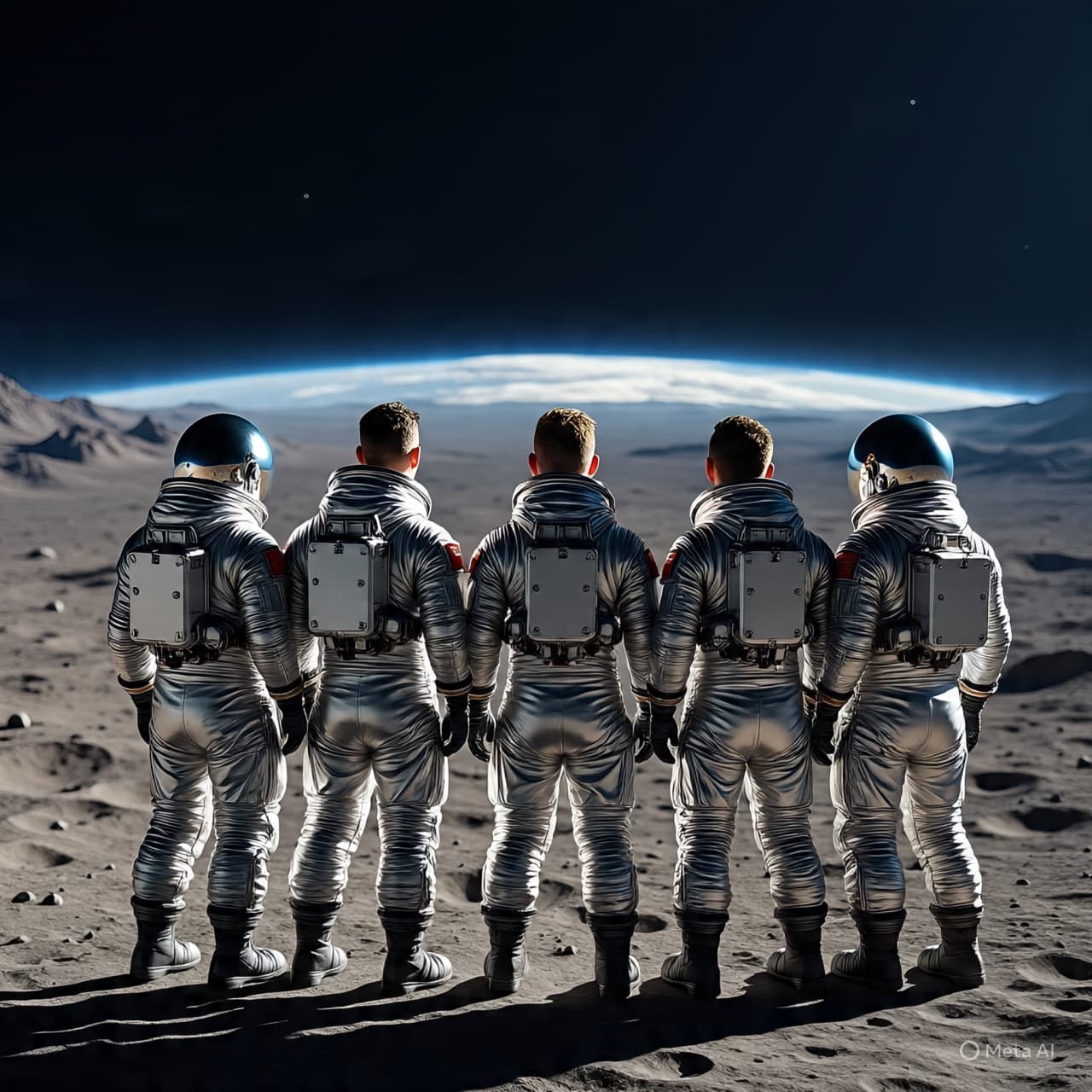
There are moments in exploration when the journey forward also becomes a quiet act of remembering—of looking back at where we began, and who was invited to be part of that beginning. The Moon, long a symbol of distance and wonder, has carried with it not only scientific ambition, but also the imprint of history. For decades, its surface has reflected a narrow chapter of humanity. Now, that reflection is beginning to widen.
With its upcoming Artemis missions, is preparing to send the first woman and the first Black astronaut to the Moon—an intention that feels both long overdue and quietly transformative. It is not simply a milestone of representation, but a shift in the story of exploration itself, where the definition of “who goes” begins to evolve alongside “how we go.”
The Artemis program, named after the twin sister of Apollo in Greek mythology, carries a symbolic weight that extends beyond science. Where the Apollo missions of the 20th century first placed humans on the lunar surface, Artemis seeks to return with a broader vision—one that includes sustained presence, international collaboration, and a more inclusive crew. In this sense, the mission does not erase the past, but gently expands it.
The astronauts selected for these historic roles have yet to complete their journey, but their presence is already reshaping the narrative. For the first time, a woman will step onto the Moon, bringing with her a perspective never before represented in that environment. Alongside her, a Black astronaut will also take part in the mission, marking another first in the history of lunar exploration.
These steps, though symbolic, are grounded in preparation. Years of training, simulation, and technological development continue behind the scenes. New spacecraft, advanced spacesuits, and updated mission architectures are all part of the effort to ensure that this return to the Moon is not only historic, but sustainable. Artemis is designed not as a single event, but as a series of missions—each building toward a longer human presence beyond Earth.
Yet, beyond the engineering and logistics, there is a quieter significance. Space has often been described as a place that belongs to all humanity, but access to it has not always reflected that ideal. By broadening the faces that represent exploration, NASA’s mission begins to align more closely with the universality it has long claimed.
There is also a generational dimension to this moment. For young people watching from Earth—especially those who may not have seen themselves reflected in past missions—the image of who an astronaut can be is beginning to shift. The Moon, once distant in more ways than one, becomes a little more familiar.
At the same time, the mission unfolds within a broader context of renewed global interest in space. Nations and private companies alike are returning their attention to the Moon, seeing it as both a scientific frontier and a stepping stone to deeper exploration, including future missions to Mars. In this landscape, Artemis stands as both a continuation and a redefinition of human ambition.
For now, the timeline continues to take shape. Training progresses, hardware advances, and anticipation builds. The mission has not yet launched, and the moment has not yet arrived—but its meaning is already being felt.
What lies ahead is still a journey, measured in preparation and patience. But when that journey reaches its destination, the footprints left behind may carry more than the weight of those who walked—they may carry the quiet expansion of who we understand ourselves to be.
AI Image Disclaimer Images in this article are AI-generated illustrations, meant for concept only.
Sources Reuters BBC News The New York Times The Guardian Associated Press
Published by Banx Network. This article is part of the Banx decentralized media programme, powered by the BXE token on the XRP Ledger.