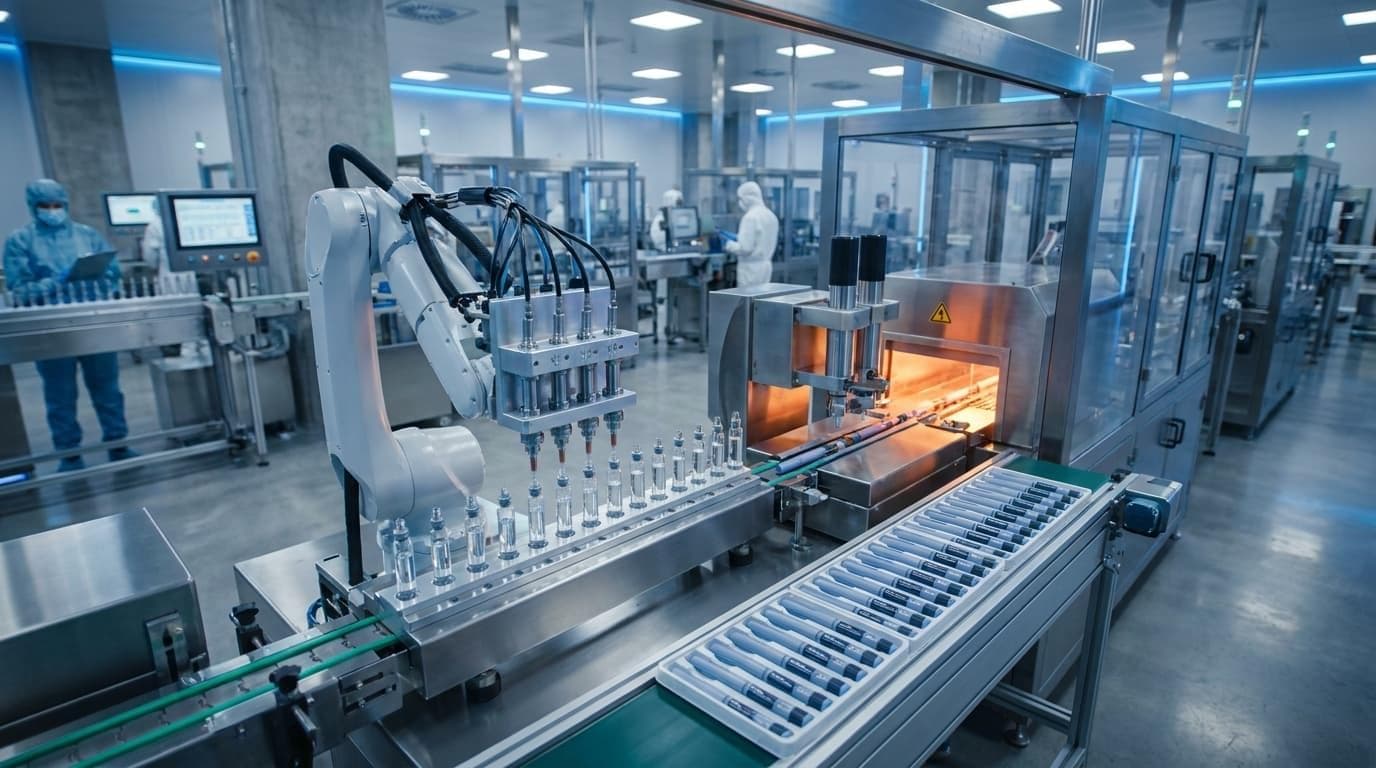
1. A Healthcare System Is Only as Strong as Its Medicine Supply
Modern healthcare depends on something many people rarely think about: the ability to manufacture and deliver medicines reliably.
Hospitals need antibiotics, anaesthetics, painkillers and emergency treatments. Pharmacies need a consistent supply of prescription medicines. Patients with long-term conditions depend on regular access to treatments that cannot always be replaced easily.
Yet the pharmaceutical industry operates through complex international supply chains involving chemical manufacturers, ingredient suppliers, factories, packaging companies, distributors and wholesalers.
A medicine may be developed in one country, manufactured using ingredients from another and packaged somewhere else before reaching a pharmacy thousands of miles away.
This global system has helped pharmaceutical companies reduce costs and expand production. However, it has also created vulnerabilities.
A factory closure, contaminated production batch, shortage of raw materials or unexpected surge in demand can disrupt supplies across several countries.
The problem is not necessarily that the world cannot manufacture enough medicine. It is that production of particular ingredients and products can be concentrated in a relatively small number of facilities.
The OECD's September 2026 report, Strengthening the EU's Medical Supply Chains, identifies recurring shortages, limited supply-chain visibility and manufacturing concentration as important weaknesses in pharmaceutical supply networks.[1]
As healthcare demand increases and geopolitical competition intensifies, medicine supply is becoming an issue of economic resilience and national security.
2. The UK Is Already Experiencing Medicine Supply Disruptions
Britain is not immune to pharmaceutical supply problems.
The Department of Health and Social Care monitors medicine supply issues through its Discontinuations and Shortages reporting system, known as DaSH.
Its August 2026 statistics revealed approximately 1,400 supply issue notifications during 2025, compared with around 1,900 in 2024. From January to June 2026, approximately 700 notifications were recorded.[2]
These figures provide an indication of reported supply problems, but they should not be mistaken for the number of medicines completely unavailable to patients. A notification can relate to a disruption that does not necessarily result in a national shortage.
The government identified manufacturing difficulties as the most frequently reported cause in 2025, accounting for 62% of supply issue notifications. Legal, regulatory, market and demand factors accounted for 37%, while logistics-related factors accounted for 5%.[2]
The statistics demonstrate that medicine shortages are not caused by one single problem.
A manufacturer might experience production difficulties while another supplier faces increased demand. A shortage of packaging materials could delay distribution even when the medicine itself is available.
The House of Commons Library's July 2026 briefing also highlighted supply problems affecting medicines used to treat diabetes, ADHD, epilepsy and other conditions.[3]
However, the UK government has emphasised that the overwhelming majority of its approximately 14,000 licensed medicines remain in good supply.[4]
The concern is not that Britain is running out of all medicines. It is that disruptions affecting specific treatments can create serious consequences for patients who depend on them.
3. The Hidden Ingredient Behind Almost Every Medicine
One of the most important parts of the pharmaceutical supply chain is something most consumers never see: the active pharmaceutical ingredient, commonly known as an API.
An API is the substance responsible for producing a medicine's intended therapeutic effect.
For example, a painkiller contains an active ingredient that produces its pain-relieving effect. Other components, known as inactive ingredients or excipients, help form the tablet, capsule or liquid and support its stability and delivery.
Manufacturing an API can involve complicated chemical processes, specialist equipment, strict quality controls and carefully managed production environments.
A finished medicine may be manufactured in Europe or the United States while relying on an API produced elsewhere.
There are also earlier stages of production involving chemical intermediates and key starting materials. These are the substances used to manufacture the API itself.
This creates multiple potential points of failure.
A pharmaceutical company might have several suppliers of finished medicines but still depend on the same upstream chemical manufacturer. If that manufacturer experiences disruption, several apparently independent suppliers could be affected simultaneously.
The OECD's 2026 analysis illustrates this problem. In its study of injectable corticosteroids supplied to the European Union, only 20 companies were identified as holding certificates to supply the relevant APIs in 2024. Nine were located in China, two in India, six in the EU, two in the United States and one in Malaysia.[1]
This does not establish the precise market share of each country, but it demonstrates how a seemingly diverse pharmaceutical market can depend on a relatively limited number of ingredient suppliers.
Understanding these hidden dependencies is essential to preventing future shortages.
4. China's Growing Influence Over Pharmaceutical Supply Chains
China has become an important part of the global pharmaceutical manufacturing industry.
Its chemical manufacturing capacity, industrial infrastructure and established supplier networks make it a significant source of pharmaceutical ingredients and intermediate materials.
The European Commission's analysis of pharmaceutical supply chains has highlighted Europe's dependence on non-EU manufacturing. Its 2025 assessment found that approximately 75% of the API production sites examined were located outside the EU, particularly in China and India.[5]
The distinction between production sites and actual market supply is important. A percentage of manufacturing facilities does not automatically translate into the same percentage of medicines or ingredients supplied.
Nevertheless, the geographical concentration creates a potential vulnerability.
If production in an important manufacturing region is disrupted, companies elsewhere may struggle to find alternative suppliers quickly.
The risks extend beyond direct imports. A medicine manufactured in India or Europe may still depend on chemical intermediates sourced from China.
This means that simply purchasing finished medicines from different countries does not necessarily eliminate supply-chain dependence.
China's role is also attracting greater geopolitical attention.
Governments are increasingly concerned about whether critical industrial inputs could become vulnerable to export restrictions, international disputes or wider trade disruption.
The Council on Foreign Relations examined these dependencies in its October 2026 report, The China Drug Dependency, highlighting how upstream pharmaceutical ingredients and chemical building blocks can create vulnerabilities for both Europe and the United States.[6]
The issue is not that China will necessarily restrict pharmaceutical exports. Rather, governments want to avoid a situation in which an international dispute or domestic manufacturing disruption leaves their healthcare systems without alternative sources.
5. India's Pharmaceutical Industry: A Major Supplier With Its Own Dependencies
India occupies an important position in the global medicine market.
It is one of the world's leading manufacturers of generic medicines, producing affordable treatments that are supplied to healthcare systems across numerous countries.
Generic medicines contain the same active ingredients as their corresponding branded equivalents and must meet applicable regulatory standards. They are particularly important because they help increase competition and reduce treatment costs.
However, India's pharmaceutical industry also relies on international suppliers for some of its raw materials and active ingredients.
This creates an interesting contradiction.
India can manufacture finished medicines for international markets while depending on China for some of the chemical inputs needed to produce them.
A 2026 report from India's government policy think tank, NITI Aayog, estimated that Indian API imports were worth $7.4 billion in 2025. China was the principal supplier across several major API categories, including antibiotics and other chemical compounds.[7]
This demonstrates why pharmaceutical supply chains cannot be understood simply by looking at the country where a finished medicine is manufactured.
A disruption affecting Chinese chemical production could potentially affect Indian manufacturers and, consequently, countries that import finished medicines from India.
India's position is therefore both a source of global pharmaceutical resilience and an example of the interconnected dependencies within the industry.
Diversifying supply would require investment not only in finished medicine production but also in the upstream chemicals and materials required to manufacture them.
6. Why Cheap Generic Medicines Can Become Difficult to Manufacture
One of the less obvious causes of medicine shortages is the economics of generic pharmaceutical production.
Generic medicines are essential to healthcare systems because they provide alternatives to more expensive branded treatments.
However, intense competition can put significant pressure on manufacturers' profit margins.
When several companies produce the same medicine, suppliers may compete aggressively on price. Hospitals and healthcare procurement organisations also have incentives to purchase medicines at the lowest possible cost.
This can create a situation in which manufacturers have limited financial incentives to maintain additional production capacity or invest in expensive improvements.
The US Food and Drug Administration has identified this problem as an important underlying cause of drug shortages.
Its Drug Shortages Task Force report explained that manufacturers may lack sufficient financial incentives to produce less profitable medicines or invest in stronger manufacturing quality systems.[8]
This is particularly relevant for older generic medicines that generate relatively low revenues.
If a manufacturer decides that producing a particular medicine is no longer commercially attractive, it may reduce production or discontinue the product.
If other manufacturers cannot increase their output quickly enough, shortages can follow.
The challenge is that healthcare systems need medicines to remain available even when the commercial returns are relatively small.
This creates a conflict between the economics of pharmaceutical manufacturing and the need for reliable access to essential treatments.
7. Antibiotics: Why Medicine Shortages Can Become a Public Health Risk
Antibiotics are among the most important medicines in modern healthcare.
They are used to treat bacterial infections and support a wide range of medical procedures, including surgery, cancer treatment and emergency care.
However, antibiotic production can be vulnerable to manufacturing concentration, ingredient shortages and low commercial margins.
The European Commission has repeatedly identified antibiotics among the categories of critical medicines requiring stronger supply-chain resilience.[9]
The consequences of a shortage can extend beyond patients who need a particular prescription.
Hospitals may have to use alternative antibiotics, adjust treatment protocols or manage limited supplies across departments.
Alternative medicines are not always interchangeable. Different antibiotics treat different infections, and switching treatment may require clinical assessment.
There is also a wider concern involving antimicrobial resistance.
Antimicrobial resistance occurs when microorganisms evolve in ways that make infections increasingly difficult to treat with existing medicines.
The World Health Organization identifies antimicrobial resistance as a major global public health threat.[10]
Medicine shortages and antimicrobial resistance are separate problems, but they can interact. When preferred treatments become unavailable, healthcare professionals may have fewer options for managing infections.
This makes reliable antibiotic manufacturing and distribution an important part of healthcare resilience.
8. The Manufacturing Problem: Why One Factory Can Affect Several Countries
Pharmaceutical manufacturing is not as simple as switching on another production line.
Factories must operate under strict quality standards. Production processes require validation, regulatory oversight, specialist equipment and carefully controlled environments.
If a facility fails a quality inspection or discovers contamination, production may need to stop while the problem is investigated.
This can have consequences far beyond the factory itself.
A pharmaceutical manufacturer may supply multiple countries, meaning that one production failure can affect several national healthcare systems.
The UK's Department of Health and Social Care has specifically identified situations in which manufacturing problems affecting a single medicine have caused wider disruption because multiple suppliers depended on the same manufacturer.[4]
This is a particularly important vulnerability.
A medicine may appear to have several suppliers, creating the impression of competition and redundancy. However, if those suppliers rely on the same upstream manufacturer, the system is less diversified than it appears.
Manufacturers also need time to increase production elsewhere.
A replacement facility may require regulatory approval, additional equipment, trained staff and new quality testing before it can supply the market.
Consequently, even a temporary factory shutdown can create a shortage that lasts considerably longer than the original disruption.
9. Geopolitical Tensions Could Make the Problem Worse
Pharmaceutical supply chains operate within an international trading system.
Medicines and their ingredients cross borders, meaning that international trade policies, shipping conditions and political relationships can affect their availability.
Several developments could create additional risks:
Trade restrictions affecting pharmaceutical ingredients.
Export controls on important chemicals or manufacturing equipment.
International sanctions disrupting payments and commercial relationships.
Military conflicts affecting industrial facilities and transport routes.
Political disputes creating uncertainty around long-term supply agreements.
Restrictions on the movement of specialist materials and technologies.
The COVID-19 pandemic demonstrated how quickly international supply chains can become disrupted when countries compete for essential medical products.
The experience encouraged governments to reconsider their dependence on overseas suppliers.
More recently, concerns about strategic competition between major economies have increased attention on pharmaceutical manufacturing.
The Council on Foreign Relations' 2026 analysis highlights the potential implications of concentrated pharmaceutical supply chains and the difficulty of reducing dependencies that have developed over decades.[6]
However, international trade remains important. Attempting to manufacture every medicine domestically would be extremely expensive and could reduce access to the benefits of global specialisation.
The challenge is finding a balance between international cooperation and the ability to maintain essential supplies during geopolitical disruption.
10. Shipping Disruptions Can Delay Medicines Even When Production Is Available
Medicine shortages are not always caused by factories.
Pharmaceutical products require transportation, specialist packaging, storage and distribution. Some medicines also need carefully controlled temperatures throughout their journey.
Disruptions to major shipping routes can increase transport times and costs.
The Red Sea shipping disruption provides an example. Rerouting vessels around the Cape of Good Hope has increased journey times for some shipments between Asia and Europe.
The UK government's 2025 medicines supply resilience paper identified shipping disruption and longer transport routes as factors affecting medicine supply chains. It reported that rerouting could add more than 12 days to some shipping journeys.[11]
For ordinary consumer products, a delay may simply mean that customers wait longer.
For medicines, the consequences can be more serious.
A delayed shipment could affect hospital inventories, pharmacy deliveries or the availability of ingredients required for manufacturing.
Temperature-sensitive products create additional complications because they may require specialist refrigerated transportation.
Pharmaceutical companies therefore need reliable logistics arrangements, appropriate storage facilities and contingency plans.
The industry cannot eliminate every transport disruption, but it can reduce its exposure through alternative routes, diversified suppliers and carefully managed inventories.
11. Demand Surges: When Patients and Businesses Need More Medicine Than Expected
Supply chains can also fail because demand increases faster than manufacturers can respond.
A medicine may experience a sudden rise in demand following new clinical guidance, increased diagnosis rates, changes in prescribing behaviour or wider public awareness.
The popularity of certain weight-management and diabetes treatments has demonstrated how quickly demand can change.
If production capacity is already heavily utilised, manufacturers may struggle to increase output immediately.
This can create a domino effect.
When one supplier experiences a disruption, healthcare providers and wholesalers may turn to alternative manufacturers. Those manufacturers then face additional demand, potentially creating shortages elsewhere.
The UK's 2026 supply disruption statistics identified customer demand surges as one of the recurring causes of reported supply issues.[2]
The problem is particularly difficult when pharmaceutical production requires long manufacturing cycles or specialist equipment.
Companies cannot always respond to rising demand by simply increasing output next week.
This makes accurate forecasting important.
Manufacturers need to understand changing demand patterns, maintain sufficient production flexibility and communicate potential shortages early enough for healthcare systems to respond.
12. Can Artificial Intelligence Help Prevent Medicine Shortages?
Artificial intelligence could become an important tool in pharmaceutical supply-chain management.
Manufacturers and healthcare organisations generate large amounts of information involving production, inventory, demand, distribution and supplier performance.
AI systems could analyse these datasets to identify patterns that indicate a potential disruption.
For example, a forecasting system might detect that demand for a particular medicine is increasing while inventories are declining. It could alert manufacturers and distributors before the shortage becomes critical.
Potential applications include:
Demand forecasting: Predicting changes in medicine requirements using historical sales, prescribing patterns and seasonal trends.
Inventory management: Identifying products at risk of running out and helping organisations manage stock levels.
Supplier monitoring: Detecting warning signs involving production delays, financial instability or logistical disruption.
Manufacturing optimisation: Identifying production inefficiencies and helping facilities improve output.
Quality control: Supporting the detection of manufacturing irregularities through automated inspection and data analysis.
The OECD's September 2026 report on European medical supply chains specifically examines how digital technologies can improve supply-chain monitoring, demand forecasting and early risk detection.[1]
However, AI cannot solve every problem.
A forecasting system cannot manufacture an ingredient that is unavailable, reopen a closed factory or resolve an international trade dispute.
Its value lies in helping organisations identify vulnerabilities earlier and respond more effectively.
Better information could make pharmaceutical supply chains more resilient, but technology must be supported by actual manufacturing capacity and cooperation between suppliers, governments and healthcare providers.
13. Should Countries Bring Pharmaceutical Manufacturing Back Home?
One proposed solution is reshoring: moving more pharmaceutical production back into domestic markets.
The argument is that countries should reduce their dependence on overseas manufacturers by rebuilding local capacity for essential medicines and their ingredients.
This could provide several advantages.
Domestic manufacturing may offer governments greater visibility over production, improve emergency preparedness and reduce exposure to certain international disruptions.
It could also support employment, industrial investment and technological development.
However, reshoring is expensive.
Pharmaceutical manufacturing requires specialist facilities, skilled workers, regulatory approval, energy, raw materials and continuous investment in quality systems.
Building domestic capacity for every medicine would be economically unrealistic for many countries.
It could also make medicines more expensive if domestic production costs significantly exceed those of established international suppliers.
An alternative is diversification.
Rather than moving all manufacturing home, governments could encourage companies to source critical ingredients from multiple countries and maintain alternative production facilities.
This would reduce dependence on individual factories or geographical regions without abandoning the benefits of international trade.
The EU's Critical Medicines Act is designed around this broader challenge.
The European Commission proposed the legislation in March 2025, and the Council and European Parliament reached a provisional agreement in May 2026. Its measures include supporting strategic manufacturing projects, strengthening procurement resilience and encouraging more diversified supply chains.[9]
The direction of policy is clear: governments increasingly want pharmaceutical supply security to carry greater weight in industrial and procurement decisions.
14. The Financial Cost of Building a More Resilient Medicine Industry
A more secure pharmaceutical supply chain will require investment.
Manufacturers may need to build additional production facilities, maintain spare capacity, diversify ingredient suppliers and improve their ability to monitor supply-chain risks.
Governments may also need to reconsider how they purchase medicines.
If procurement decisions focus almost exclusively on the lowest price, manufacturers may have limited incentives to maintain expensive backup capacity.
The EU's Critical Medicines Act reflects an effort to address this issue by giving greater consideration to supply security and resilience in public procurement.[9]
There are several potential funding approaches:
Government grants for strategic pharmaceutical manufacturing.
Long-term purchasing agreements with reliable suppliers.
Financial incentives for domestic API production.
Investment in advanced manufacturing technologies.
Joint procurement arrangements between countries.
Strategic stockpiles of selected essential medicines.
However, maintaining additional capacity is not free.
A factory that operates below its maximum production capacity may appear less efficient financially, but that spare capacity could become extremely valuable during an emergency.
This creates a fundamental economic trade-off.
The cheapest supply chain may not be the most resilient one.
Governments will need to decide how much additional cost they are prepared to accept in exchange for greater security of supply.
15. Could Strategic Medicine Stockpiles Prevent a Crisis?
Stockpiling is another approach to reducing the impact of pharmaceutical disruptions.
Governments and healthcare organisations can maintain reserves of selected medicines so that temporary interruptions do not immediately affect patients.
A stockpile could provide additional time for manufacturers to restore production, arrange alternative suppliers or increase output elsewhere.
However, medicine stockpiling is more complicated than storing ordinary goods.
Medicines have expiry dates, storage requirements and specific handling conditions. Some products require refrigeration, while others may become unsuitable for use after prolonged storage.
A poorly managed stockpile could also create waste if medicines expire before they are needed.
There is another concern: excessive stockpiling can make shortages worse for other countries if governments compete to secure limited supplies during an emergency.
The OECD's 2026 report identifies international cooperation, better information-sharing and coordinated approaches to supply resilience as important policy tools.[1]
The EU's Critical Medicines Act also includes measures to improve information-sharing around contingency stocks and support cooperation between member states.[9]
The objective should not be to stockpile every medicine indefinitely.
Instead, governments need to identify products where a disruption would have serious consequences and determine how much reserve capacity is appropriate.
16. The Global Competition to Secure Essential Medicines
Pharmaceutical manufacturing is becoming an increasingly important part of economic security.
The United States, European Union, China and India all have major interests in the future of the global medicine industry.
The United States has been examining its exposure to overseas pharmaceutical ingredients, particularly those linked to generic medicines.
Europe is attempting to strengthen domestic production and diversify suppliers through the Critical Medicines Act.
India wants to maintain its position as a major manufacturer of affordable medicines while reducing some of its dependence on imported ingredients.
China remains a major player in pharmaceutical chemicals and manufacturing infrastructure.
This competition could encourage new investment and create opportunities for pharmaceutical companies in countries seeking to expand domestic production.
However, there is a risk that aggressive national policies could fragment international supply chains.
If countries prioritise domestic production without maintaining international cooperation, manufacturing costs could rise and access to certain medicines could become more complicated.
A resilient pharmaceutical industry does not necessarily require every country to manufacture everything itself.
It requires multiple reliable sources, transparent supply chains, effective regulation and international cooperation when disruptions occur.
17. Three Possible Futures for the Global Medicine Industry
The future of pharmaceutical supply chains will depend on how governments, manufacturers and healthcare organisations respond to existing vulnerabilities.
Scenario One: Gradual Improvement
Governments introduce better monitoring systems, improve supplier diversification and strengthen stockpiles of essential medicines.
Manufacturers invest in production flexibility, while AI and digital systems help identify potential shortages earlier.
International trade continues to play a central role, but supply chains become more transparent and better prepared for disruption.
Scenario Two: A More Fragmented Pharmaceutical Industry
Geopolitical competition increases pressure on governments to manufacture more medicines domestically.
Countries introduce subsidies, trade restrictions and industrial policies designed to protect national pharmaceutical industries.
Some supply chains become more secure within individual countries, but manufacturing costs increase and international cooperation becomes more complicated.
Scenario Three: A Major Global Supply Disruption
A combination of manufacturing failures, geopolitical tensions, transport disruption and sudden demand increases affects several important pharmaceutical supply chains simultaneously.
Governments compete for limited supplies, manufacturers struggle to increase production and healthcare systems are forced to manage shortages across multiple treatment categories.
This scenario would not necessarily mean that the world runs out of all medicines. However, it could create serious problems for particular essential treatments.
These scenarios are not predictions. They illustrate how different policy decisions and external disruptions could shape the industry's future.
The central issue is whether governments and manufacturers invest in resilience before a major emergency forces them to respond.
18. Conclusion: Medicine Supply Is Becoming a Matter of National Security
The global pharmaceutical industry has achieved something remarkable.
International manufacturing networks have helped produce affordable medicines at enormous scale, making treatments available to millions of people.
But the same system has created dependencies that are not always visible.
A medicine manufactured in one country may rely on ingredients from another, which may depend on chemical intermediates produced somewhere else. A disruption at one facility can therefore affect multiple suppliers and healthcare systems.
Britain's medicine supply statistics demonstrate that manufacturing problems, demand surges and regulatory issues continue to create supply disruptions. International research also shows how concentrated some pharmaceutical supply chains have become.
The solution is unlikely to be complete manufacturing independence. No country can realistically produce every medicine and ingredient it needs at the lowest possible cost.
Instead, governments will need to identify their most critical dependencies, diversify suppliers, maintain appropriate reserves and encourage investment in reliable production capacity.
Artificial intelligence and better data systems may improve forecasting and monitoring, but they cannot replace the physical infrastructure required to manufacture medicines.
The real question is not whether the world can produce enough medicine today. It is whether global healthcare systems can maintain access when the supply chains behind those medicines are disrupted.
In an increasingly interconnected economy, pharmaceutical resilience is no longer simply an industry concern. It is becoming an essential part of national security, economic stability and public health.
Sources
[1] OECD — Strengthening the EU's Medical Supply Chains: International Co-operation and New Technologies for Better Emergency Preparedness (22 September 2026) https://www.oecd.org/en/publications/strengthening-the-eu-s-medical-supply-chains_cc235a9c-en.html
[2] UK Department of Health and Social Care — Medicine Supply Disruption Statistics, UK: Data to June 2026 (5 August 2026) https://www.gov.uk/government/statistics/medicine-supply-disruption-statistics-uk-data-to-june-2026/medicine-supply-disruption-statistics-uk-data-to-june-2026
[3] House of Commons Library — Medicines Shortages (30 July 2026) https://commonslibrary.parliament.uk/research-briefings/cbp-9997/
[4] UK Department of Health and Social Care — Managing a Robust and Resilient Supply of Medicines (11 August 2025) https://www.gov.uk/government/publications/managing-a-robust-and-resilient-supply-of-medicines/managing-a-robust-and-resilient-supply-of-medicines
[5] European Commission — Commission Staff Working Document: Pharmaceutical Supply Chain Dependencies (2025) https://eur-lex.europa.eu/legal-content/EN/TXT/?uri=CELEX:52025SC0263
[6] Council on Foreign Relations — The China Drug Dependency: What the United States and Europe Can — and Can't — Do (October 2026) https://www.cfr.org/reports/the-china-drug-dependency
[7] NITI Aayog — India's Active Pharmaceutical Ingredients (API) Import Dependence (2026) https://www.niti.gov.in/node/2342
[8] US Food and Drug Administration — Drug Shortages: Root Causes and Potential Solutions https://www.fda.gov/drugs/drug-shortages/report-drug-shortages-root-causes-and-potential-solutions
[9] European Commission — Critical Medicines Act https://health.ec.europa.eu/medicinal-products/critical-medicines-act_en
[10] World Health Organization — Antimicrobial Resistance https://www.who.int/news-room/fact-sheets/detail/antimicrobial-resistance
[11] UK Department of Health and Social Care — Managing a Robust and Resilient Supply of Medicines: Policy Paper and Supply Chain Analysis https://www.gov.uk/government/publications/managing-a-robust-and-resilient-supply-of-medicines
Published by Banx Network. This article is part of the Banx decentralized media programme, powered by the BXE token on the XRP Ledger.