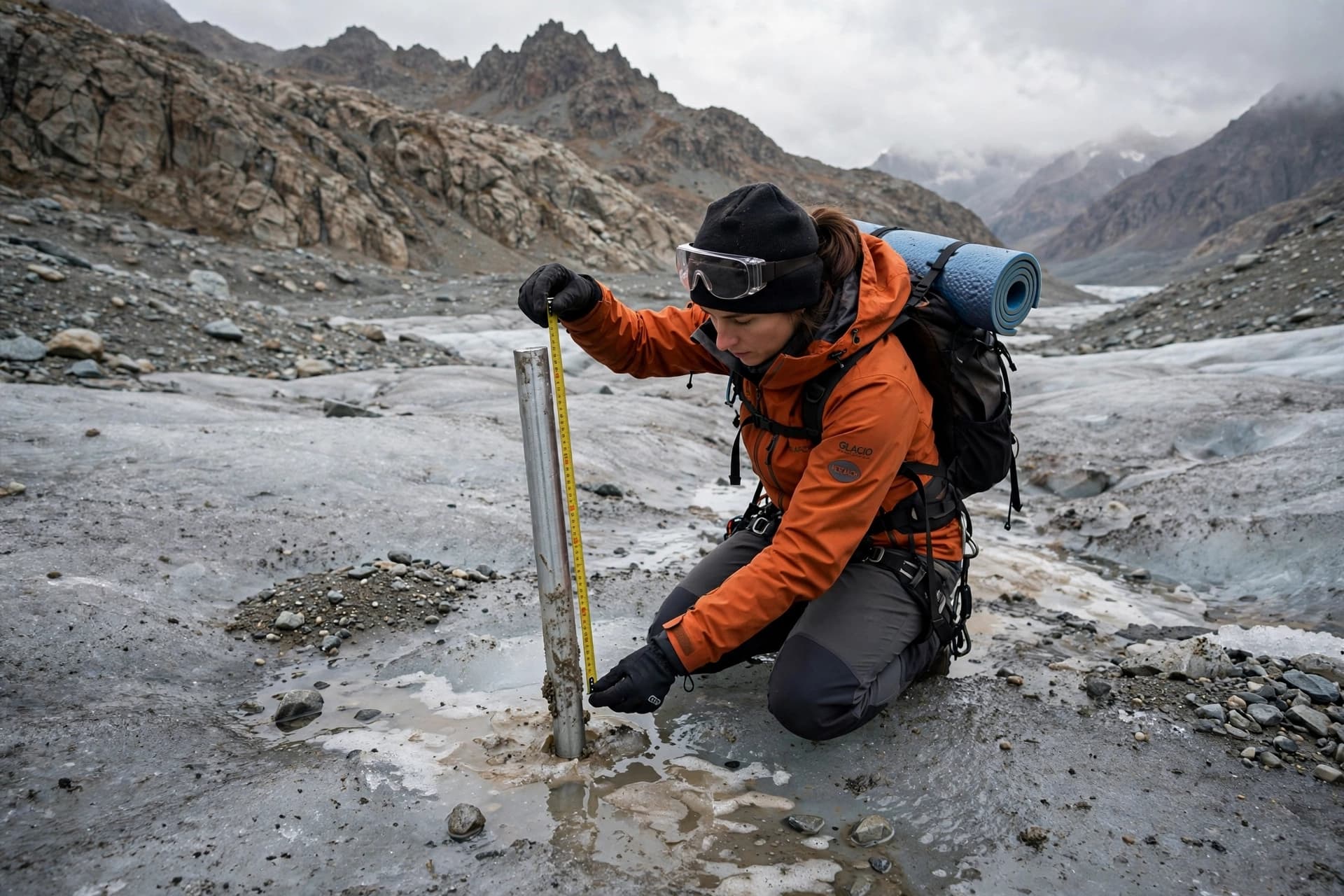
Some losses can be measured and still remain difficult to truly comprehend. High in the Swiss Alps, scientists return each autumn to the same stakes of aluminum they planted months before, and wait for the numbers. This year, when Matthias Huss, who leads the GLAMOS glacier monitoring network, arrived at the Silvretta glacier nearly three thousand meters above sea level, the four-meter stake had emerged from the ice by more than three meters. Last July it had been entirely buried. Now it hung above a grey surface, pointing upward like a warning.
Data released this week by GLAMOS shows that Swiss glaciers lost 5.5 percent of their ice volume in 2026—the second-worst year on record, behind only the 6 percent loss in 2022. More troubling still, nearly one-fifth of Switzerland's total glacier ice has disappeared in the past five years. Huss described the year as "disastrous," adding that "Alpine glaciers have no chance of surviving long-term under these conditions."
The melting was not caused by a single factor. The winter of 2025–2026 brought snow accumulation among the ten lowest on record, leaving glaciers without a protective snow layer as summer began. Then heatwaves in May and June rapidly melted what snow remained, exposing darker, less reflective bare ice. Bare ice absorbs more solar heat, accelerating melting during subsequent heatwaves. This summer, Switzerland recorded 76 days when the freezing level rose above 4,000 meters—the highest count on record. By September, no snow remained even at 3,500 meters.
The consequences extend beyond the landscape. Between July and September, Swiss glaciers released roughly 2.2 trillion liters of meltwater—more than four times the annual water consumption of Swiss households. That water temporarily eased summer drought, keeping the Rhine navigable when it might otherwise have dropped too low for shipping. But Huss noted this is an unsustainable resource. "Every drop of that water flowing away during these heatwaves is old water stored in the ice decades or centuries ago," he said. "It helps us now, but we won't have it available during the next heatwave."
For regions dependent on glacial meltwater, the arithmetic is becoming harsh. More than half of Switzerland's electricity comes from hydropower, and the Rhine, Rhône, and Danube—Europe's most important waterways—all originate in what is often called the continent's water tower. This summer, parts of the Rhine reached record-low levels, shipping costs rose, and some nuclear plants that rely on river water for cooling had to shut down temporarily. As glaciers continue to retreat, that pressure will only increase.
Huss emphasized that the attribution of responsibility is clear. "The warming we're experiencing now can be attributed 100 percent to human-caused climate change. Without human emissions, without fossil fuels, we would not have any warming now." He also noted that drastically cutting carbon emissions could still save most of the world's glacier ice, particularly in the Himalayas and polar regions, where the volumes are large enough to affect global sea levels.
For the Alps themselves, many small glaciers have already disappeared forever. The Belavarda, Griesfiern, and Plattalva glaciers vanished entirely in 2026. The Aletsch, the largest glacier in the Alps, and the Rhône glacier both experienced their worst melting on record. Standing on the Silvretta glacier, Huss said the ice there "will probably be gone in ten to fifteen years." He added: "It's not that we're surprised—we know how fast glaciers are melting. But seeing mountains without snow, the color of the rock and dark glacier ice, relics of the past—it's really unbelievable."
AI Image Disclaimer: The images accompanying this article were generated by artificial intelligence and are intended for conceptual illustration only.
Sources: BBC, AP News, EurekAlert, Washington Post, Bangkok Post, GLAMOS
Published by Banx Network. This article is part of the Banx decentralized media programme, powered by the BXE token on the XRP Ledger.