In the solar system’s family portrait, Venus stands out as the odd sibling without a moon. While Earth has its loyal companion and Mars has two small satellites, Venus remains solitary. A new study offers a compelling explanation for this absence, suggesting that if Venus ever had a moon, it was likely doomed from the start, destined to be consumed by the planet itself due to complex tidal forces.
The hypothesis posits that early in its history, Venus may have formed a moon through a giant impact, similar to how Earth’s moon was created. However, unlike Earth, Venus rotates very slowly and in the opposite direction to most planets. This unique rotation, combined with strong tidal interactions, would have caused any hypothetical moon to spiral inward rather than outward. Over time, the moon would have moved closer to Venus until it crossed the Roche limit, where gravitational forces tore it apart.
Researchers used computer models to simulate the tidal evolution of a potential Venusian moon. Their findings indicate that the moon’s orbit would have decayed rapidly, leading to its destruction within a few billion years. The debris from this catastrophic event may have been absorbed by Venus or scattered into space, leaving no trace behind. This process explains why no natural satellite exists today despite the likelihood of its initial formation.
This theory aligns with recent discoveries about Venus’s past. Evidence suggests that the planet once had a more Earth-like environment, with liquid water and a thinner atmosphere. The presence of a moon could have influenced its axial tilt and climate stability. The loss of the moon may have contributed to the dramatic changes that turned Venus into the hellish world we see today, with its thick carbon dioxide atmosphere and scorching surface temperatures.
The study also highlights the importance of tidal forces in shaping planetary systems. While moons often stabilize their parent planets, as Earth’s moon does for our axis, they can also lead to destructive outcomes under different conditions. Understanding these dynamics helps astronomers interpret the diversity of planetary systems observed in our galaxy, including those around other stars.
For planetary scientists, the case of Venus serves as a cautionary tale about the fragility of celestial relationships. It reminds us that the current configuration of the solar system is the result of billions of years of chaotic interactions and evolutionary processes. Each planet’s history is unique, shaped by a combination of chance events and physical laws.
As we continue to explore Venus with upcoming missions, we may find further clues about its past. Whether through geological evidence or atmospheric analysis, each discovery brings us closer to understanding why Venus is alone. In the silence of its sky, the story of a lost moon echoes, a testament to the dynamic and often violent history of our cosmic neighborhood.
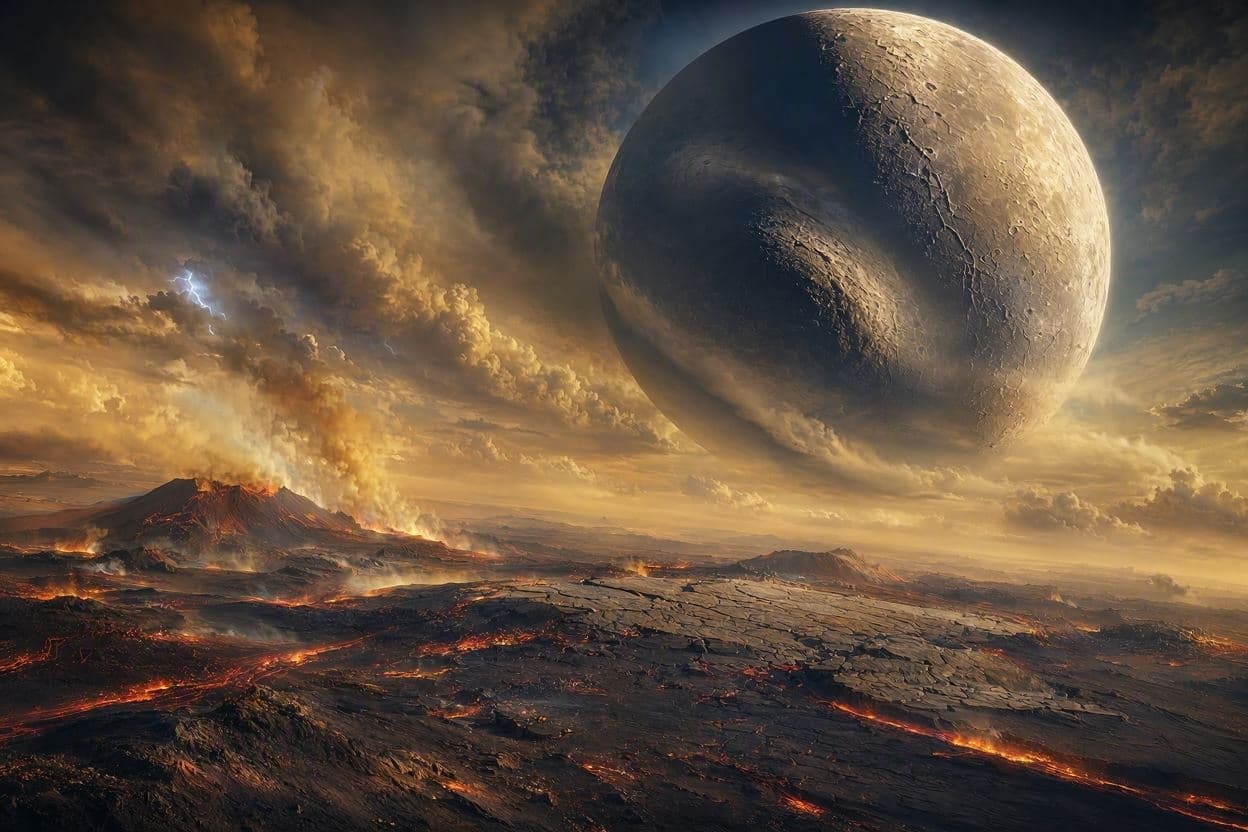
AI Image Disclaimer: The visual content in this article is AI-generated to depict theoretical astronomical scenarios and planetary history.
Sources: Universe Today, Phys.org, ZME Science
Published by Banx Network. This article is part of the Banx decentralized media programme, powered by the BXE token on the XRP Ledger.