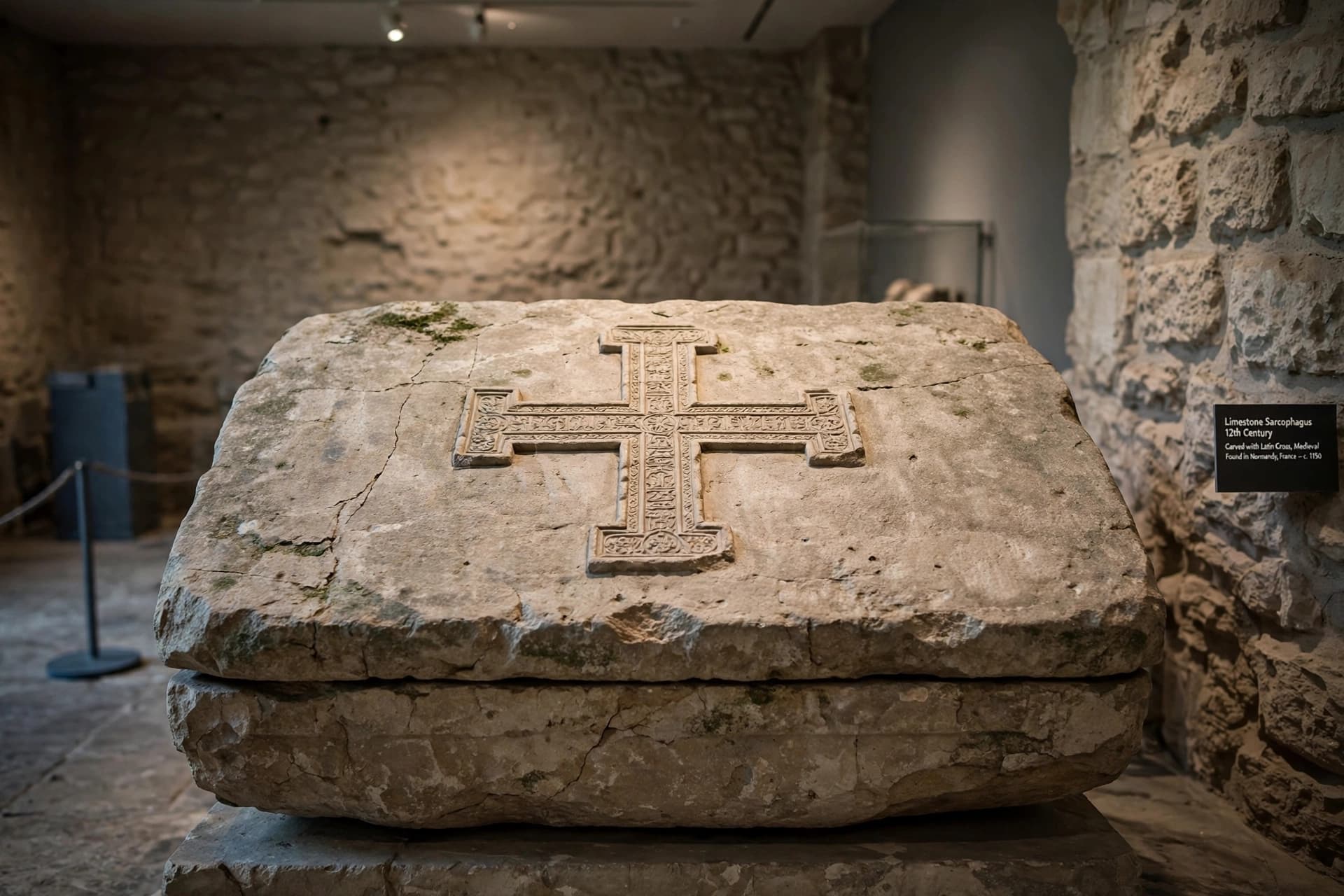
There is a particular satisfaction in a mystery that has waited centuries to be solved, a quiet resolution that arrives not with a dramatic revelation but with a carbon date and a careful reading of stone. In Westminster Abbey, a skeleton found inside a Roman sarcophagus has puzzled historians for more than 150 years. The coffin bore an inscription to a man named Valerius Amandinus, a wealthy Roman who lived in London in the third or fourth century. Yet the lid was carved with a Latin cross, a symbol that belonged to a later age. Who was buried in a Roman's tomb, under a Christian's mark?
The sarcophagus was first unearthed in 1820 by workmen who accidentally smashed its lid into six pieces. It was officially rediscovered and repaired in 1869. In 2016, when the vessel was opened for conservation, a skeleton was found inside . The bones belonged to a man about five-foot-nine, aged between thirty-five and forty-nine, who had suffered from gout, rib injuries, and osteoarthritis . Carbon dating placed his death between 987 and 1052 AD, confirming that the Roman sarcophagus had been repurposed centuries after it was carved .
The question of identity fell to Professor Warwick Rodwell, consultant archaeologist at Westminster Abbey. Writing in the Journal of the British Archaeological Association, he reasoned that the man honored with such a fine sarcophagus and a carved cross of that size could only have been a major ecclesiastic. "Nobody of lower rank would have been buried in anything like that," he said . The cross, a specific late Anglo-Saxon type running the full length and width of the lid, pointed to an abbot.
Rodwell examined the birth and death dates of the abbots of Westminster and narrowed the field to two candidates: Ælfwig, who served from 993 to about 1020, and his successor Wulfnoth, who died around 1049 . Both fit the age profile, assuming an abbot appointed in his early twenties and dying near fifty. Rodwell leans toward Ælfwig, noting that he was already a monk at Westminster when he was chosen, a detail that may have favored him .
The reuse of a Roman sarcophagus for a Christian burial is highly unusual, with no comparable cases documented. Rodwell suggested that the original tomb may have been unearthed during construction work and repurposed out of reverence, or perhaps convenience. The Roman inscription to Valerius Amandinus, a possible early Christian himself, may have made the vessel seem appropriate for a holy man . The lid was recarved, the body placed inside, and the tomb sealed for centuries.
The sarcophagus is now on public display in the Queen's Diamond Jubilee Galleries at Westminster Abbey. It sits not as a relic of Rome but as a document of a layered history, a stone that held one man's memory and then another's, separated by seven hundred years. The mystery is not entirely closed—Rodwell acknowledges that Ælfwig and Wulfnoth cannot be distinguished with certainty—but the shape of the answer is now clear. A Roman tomb became a Saxon abbot's resting place, and a cathedral kept the secret until someone thought to look inside.
---
AI Image Disclaimer: The images in this article are generated by artificial intelligence and are intended for illustrative purposes only.
Sources: The Guardian, London Evening Standard, New York Post, Daily Mail
Published by Banx Network. This article is part of the Banx decentralized media programme, powered by the BXE token on the XRP Ledger.