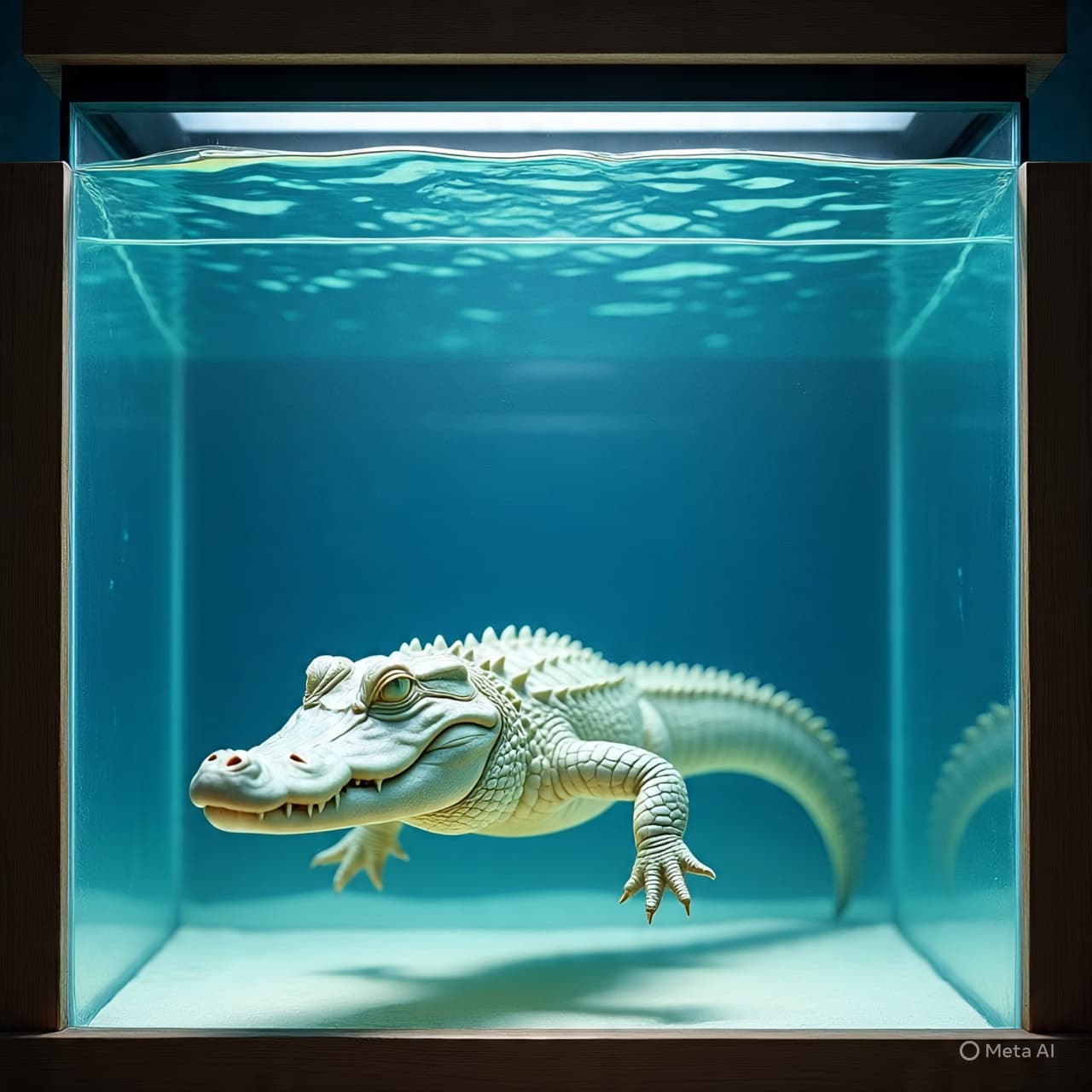
Under the soft glow of aquarium lights, many visitors once gazed quietly at Claude — ghost-white scales gleaming, pale eyes drifting over the water as if inviting wonder. For decades, he was more than an alligator: he was a symbol of curiosity and gentle difference, a bridge between visitors and the wild. Now, after 30 years of captivating hearts, Claude’s story has quietly closed.
Claude, a rare albino alligator housed at California Academy of Sciences in San Francisco, died on December 2, 2025. In his final weeks, aquarium staff had noted something wrong — Claude’s appetite diminished, and he appeared weak. He was moved off display, treated for what was initially thought to be a possible infection.
But despite care and concern, he passed away early Tuesday morning. A full necropsy — conducted at UC Davis School of Veterinary Medicine — revealed the heartbreaking truth: nearly his entire liver had been overtaken by cancerous tumors. In short: Claude’s end came not from neglect or accident, but from a late-stage liver cancer.
“A definite answer,” his care team said, “and nothing we could have done differently.” In those words lies both sorrow and solace: sorrow that this gentle creature’s time ended so early, solace in knowing his caretakers tried everything within their power.
Claude was hatched in 1995 on a farm in Louisiana. Due to his albinism — a rare genetic mutation that deprived him of pigment — his ghostly white skin and pale pink eyes made him stand out for all the right reasons. But those same traits meant that in the wild, survival would have been near impossible. Recognizing this, caretakers welcomed him to the Academy in 2008, where he spent the last 17 years of his life.
Over the years, Claude became more than a specimen or exhibit. He was the museum’s unofficial mascot: a gentle ambassador to nature, beloved by children, families, visitors from around the world. For many, seeing him was their first moment of wonder — a pale alligator that defied expectations.
Claude’s death reminds us of fragility — even in creatures that seem timeless. He didn’t die from a violent end or reckless mistake, but from a quiet decay deep within, a reminder that life — even a long life — can be fragile and unpredictable. And in that fragility, perhaps there’s worth: a gentle creature that taught generations to care, to marvel, and to respect the delicate threads that tie us to nature.
AI Image Disclaimer Visuals are created with AI tools and are intended purely as conceptual depictions — not actual photographs.
Sources San Francisco Chronicle; The Washington Post; AP News; People; The Economic Times.
Published by Banx Network. This article is part of the Banx decentralized media programme, powered by the BXE token on the XRP Ledger.