There are discoveries that arrive not with a roar, but with a whisper—quietly reshaping what we thought we knew. In the fossil record, where time often erases more than it preserves, the rare survival of skin feels almost like a message carried across millions of years. And now, a strange, spiky dinosaur has offered exactly that: a glimpse not just of bones, but of texture, pattern, and presence.
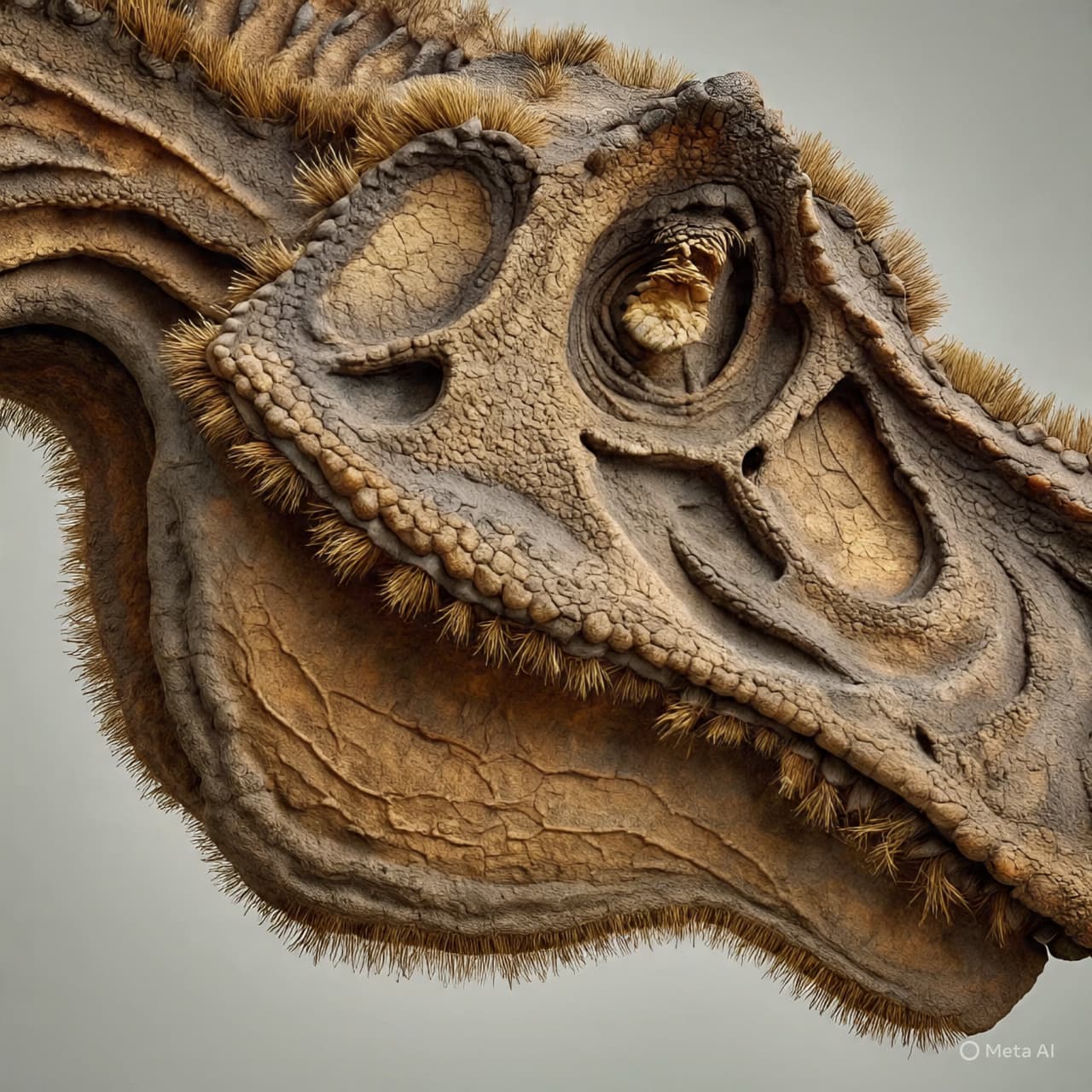
The creature in question is not new to science, yet it has revealed something entirely unexpected. Fossil evidence, exceptionally preserved, shows that this small, early horned dinosaur—often associated with the genus —carried a form of skin unlike anything previously documented. Along its tail, long, stiff bristles extend outward, resembling quills more than scales, suggesting that dinosaur integument was far more diverse than once imagined.
For years, reconstructions of dinosaurs leaned heavily on scales or feathers, two categories that offered a kind of visual certainty. But this discovery gently disrupts that simplicity. The preserved skin of Psittacosaurus shows a mosaic of textures—scaly surfaces across the body, paired with these striking filament-like structures at the tail. It is not entirely feather, nor entirely reptilian in the traditional sense. Instead, it occupies a space in between, reminding us that evolution often resists neat classification.
What makes this finding particularly compelling is not just the presence of these bristles, but what they imply. Scientists suggest they may have played a role in display, communication, or even species recognition—subtle visual signals in a prehistoric landscape. The idea that such a small dinosaur might have carried its own form of ornamentation adds a quiet layer of personality to a world we often imagine as distant and impersonal.
Equally remarkable is the preservation itself. Fossilized skin is rare, and detailed integument even more so. In this case, the specimen provides an almost tactile sense of the animal’s surface—how light might have moved across it, how its body may have appeared in motion. It shifts our understanding from skeletal outlines to something closer to life, bridging the gap between structure and sensation.
Yet, as with many scientific advances, the discovery raises as many questions as it answers. Were these bristles unique to Psittacosaurus, or more widespread among early dinosaurs? Do they represent an evolutionary precursor to feathers, or an entirely separate adaptation? And how many other surprises remain hidden, waiting in stone, overlooked simply because we did not yet know how to see them?
In the end, this spiky dinosaur does not demand a dramatic revision of everything we know—but it gently invites reconsideration. It reminds us that the past is not fixed, but continuously unfolding, shaped by each new fragment brought into the light. And sometimes, it is not the largest or most fearsome creatures that change our understanding, but the quiet, unexpected details etched into their skin.
AI Image Disclaimer Illustrations were produced with AI and serve as conceptual depictions.
Source Check Nature National Geographic BBC Science Smithsonian Magazine Science
Published by Banx Network. This article is part of the Banx decentralized media programme, powered by the BXE token on the XRP Ledger.