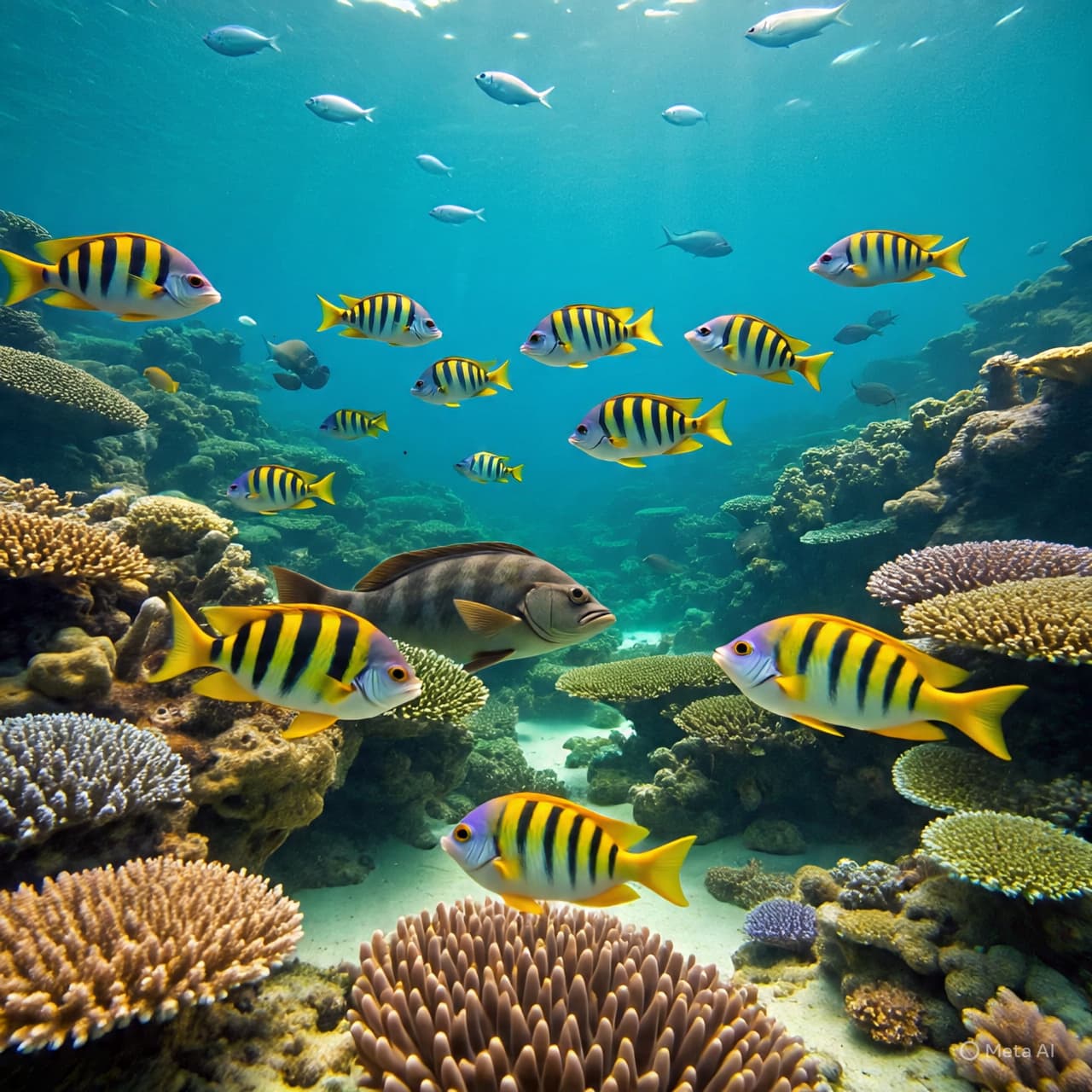
Across the warm waters of tropical oceans, coral reefs glow with color. Schools of fish glide between branching corals, their bodies marked with stripes, spots, bars, and brilliant flashes of yellow, blue, and orange. To the human eye, it can feel almost theatrical — as though evolution itself had taken a painter’s brush and decorated the sea.
But beneath this dazzling display lies a quieter scientific question. Why do coral reef fish display such extraordinary diversity of color and pattern? And why do certain shapes and motifs appear again and again across species that may live thousands of miles apart?
A recent evolutionary study offers new insight into this underwater mosaic, suggesting that the diversity of fish colors is not simply the result of environmental beauty. Instead, it reflects a deeper story of speciation, biological constraints, and the hidden rules that guide how patterns emerge in living organisms.
Researchers examined nearly a thousand species of reef fish drawn from several major families, including angelfish, damselfish, butterflyfish, surgeonfish, goatfish, and snappers. By cataloguing the visual patterns across these species — from stripes and spots to more complex shapes — scientists were able to compare how coloration changes across evolutionary lineages.
One of the study’s most striking observations is that color pattern diversity tends to increase in places where more species live together. In regions rich with fish species, the number of distinct patterns also grows.
This relationship hints at an important evolutionary force. When many closely related species share the same reef, clear visual differences can help individuals recognize members of their own species. In this way, color patterns become a form of biological identity — a visual signal that guides mating and social interaction.
Over time, these visual signals may contribute to the formation of new species. As populations diverge, their patterns shift slightly, creating new combinations of stripes, spots, and color contrasts. Across millions of years, such small differences accumulate, producing the extraordinary palette seen on modern reefs.
Yet the research also uncovered an intriguing limitation. While patterns evolve rapidly, they do not expand infinitely.
Instead, evolution appears to explore a limited set of visual possibilities. Certain motifs — such as horizontal stripes, vertical bars, spots, and eye-like markings — repeatedly appear across unrelated fish families. Even species that evolved in separate oceans can display remarkably similar patterns.
Scientists describe this phenomenon as evolutionary convergence, where different species independently arrive at similar solutions because they share comparable biological constraints.
Those constraints arise from the biology of pigment cells and developmental processes that shape how patterns form on a fish’s body. In other words, the blueprint for color patterns is partly written within the fish itself.
The environment still plays a role, of course. Coral reefs provide a visually complex world filled with shadows, textures, and moving light. Patterns may help fish camouflage among coral branches, confuse predators, or signal dominance during territorial disputes.
But the study suggests that the underlying rules governing color diversity are more internal than previously assumed. The mechanisms that produce pigments and organize them across a body create boundaries — a framework within which evolution can experiment.
The result is a remarkable balance between freedom and constraint. Evolution can generate dazzling variation, yet it often revisits familiar designs.
For scientists, these findings offer a new perspective on biodiversity. The vivid patterns of reef fish are not simply decorative features; they are records of evolutionary history, shaped by millions of years of interaction between genetics, development, and ecological relationships.
As researchers continue mapping the visual diversity of reef life, they are uncovering the deeper mathematics and biology behind nature’s most colorful ecosystems.
The coral reef, it seems, is not just a garden of color. It is also a canvas where evolution continues to refine its designs — generation after generation, pattern after pattern, quietly shaping the living art beneath the waves.
AI Image Disclaimer Visuals are created with AI tools and are not real photographs.
Sources Phys.org ScienceDaily EurekAlert BMC Biology Nature
Published by Banx Network. This article is part of the Banx decentralized media programme, powered by the BXE token on the XRP Ledger.