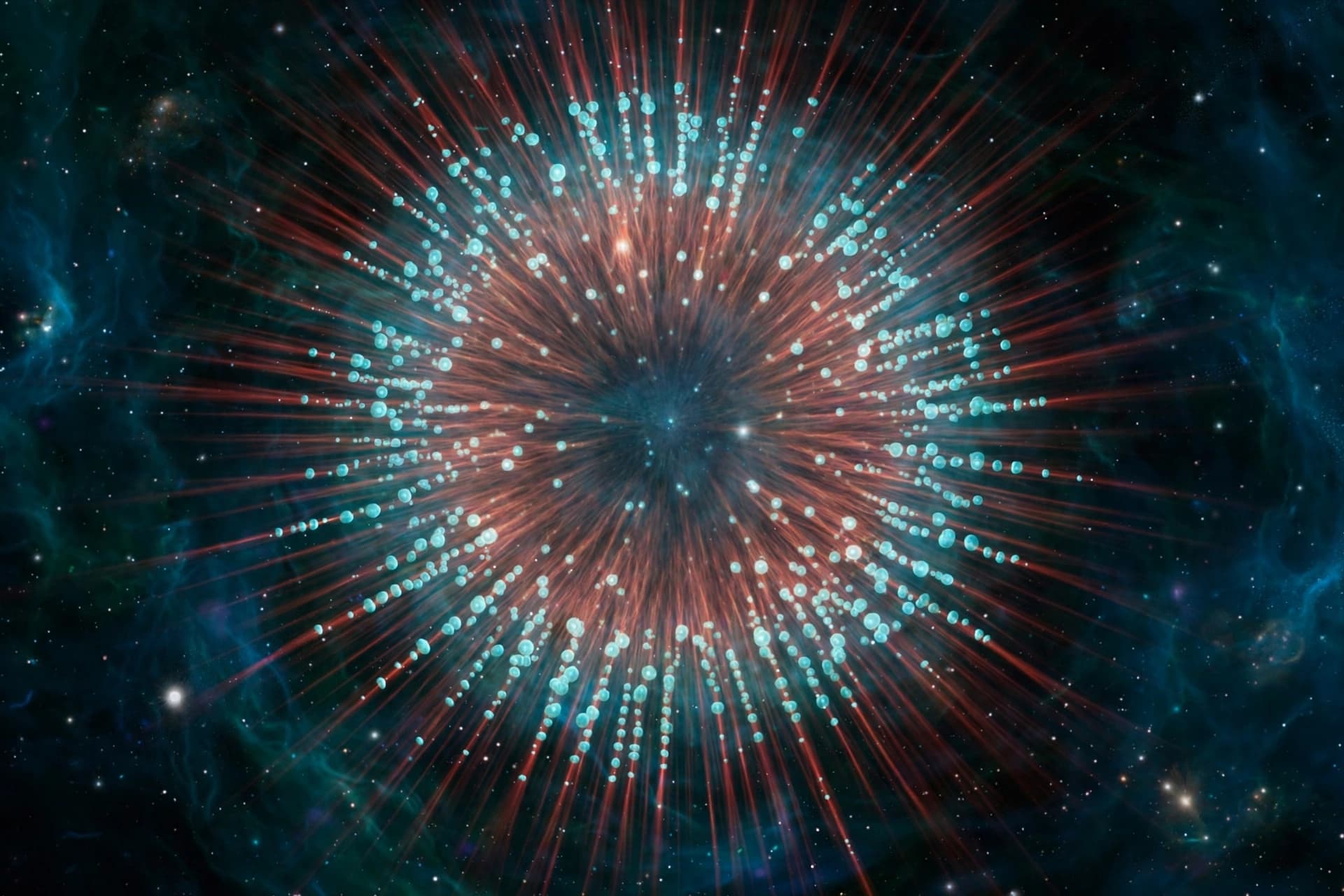
In the dim tunnels beneath the rolling hills of Geneva, where magnets hum and protons race in near silence, scientists recently uncovered something strange — a ghost, not of matter or myth, but of resonance and mathematics. Inside the cavernous ring of the Super Proton Synchrotron (SPS), part of CERN’s collider complex, physicists have identified a subtle but persistent “ghost” — a 3D-shaped waveform that shifts over time, effectively living in four dimensions.
The SPS is no experimental toy. It spans nearly four miles, built decades ago yet still central to CERN’s modern particle research. Over time, as beams have grown more intense and expectations higher, small imperfections — in magnets, in alignments, even in natural fluctuations — accumulated. What researchers now understand as “the ghost” is a resonant structure born of those imperfections: a pattern of distortions and energy amplifications that subtly — but significantly — disturbs the smooth flow of particles.
To catch it, scientists applied a mathematical tool called a Poincaré section: imagine mapping all the intersections of a shifting wave over time, like tracing ripples on a pond across hours. By doing this, they revealed fixed “loci” — predictable spots where particles tend to cluster, lose energy, or drift off course — the ghostly footprints of resonance inside the ring.
Why call it a ghost? Because it’s not a physical object: no hardware part, no stray particle, just a shape in phase-space — a dynamic, four-dimensional pattern that influences behavior invisibly. The effect can degrade beams, cause energy loss, and compromise the precise control required for high-stakes experiments. In essence: when the accelerator vibrates — literally or electromagnetically — the ghost emerges.
But this discovery is not a mere curiosity. It marks a milestone in understanding non-linear dynamics in megastructures like particle accelerators — systems where minute imperfections and resonances can produce complex, emergent behavior. Recognizing and mapping such “ghosts” may lead to better accelerator design, improved beam stability, and fewer losses — especially as future machines aim for ever higher energies.
Beyond technical fixes, the revelation evokes metaphor: even in humanity’s most precise creations — built to peel back nature’s secrets — hidden forces can linger. Systems we think we understand may still carry subtle shadows. And sometimes, the greatest mysteries aren’t what we collide, but what we fail to see.
As the researchers refine their models and engineers contemplate improvements, one question remains: how many other “hauntings” roam inside the world’s accelerators — waiting for the right measurement, the right lens, the right quiet moment to emerge?
In that quiet uncertainty lies hope. Because uncovering the invisible, acknowledging the subtle — that is the essence of science. And a ghost, once seen, stops being a specter, and becomes an opportunity.
AI image disclaimer Visuals are created with AI tools and are not real photographs; they are meant as conceptual illustrations.
Sources Popular Mechanics; RealClearScience; Yahoo summarizing the recent findings.
Published by Banx Network. This article is part of the Banx decentralized media programme, powered by the BXE token on the XRP Ledger.

.jpg&w=3840&q=75 "September 2026 Was the Second-Warmest on Record, With Global Temperatures Above 1.5°C for a Second Month")