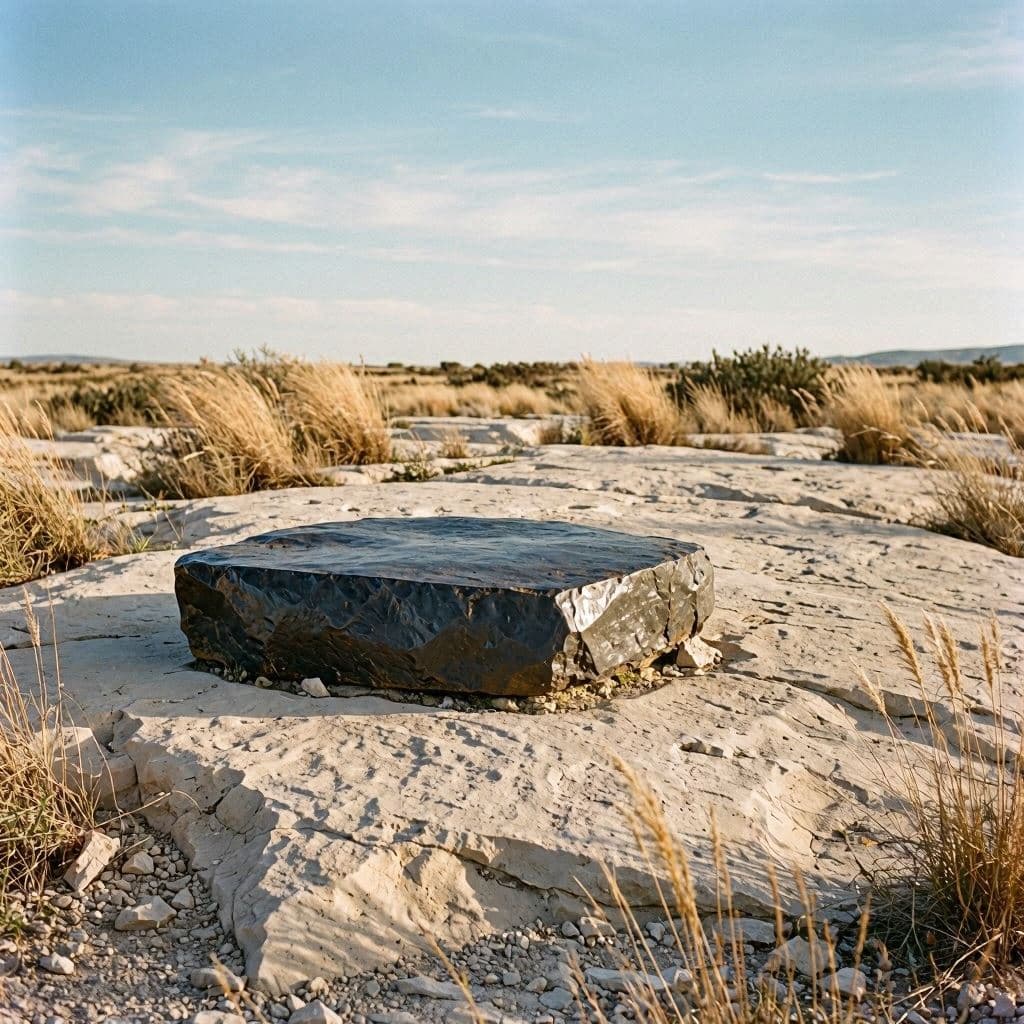
In the vast, arid landscapes of Namibia, there lies a rock that defies the usual expectations of cosmic impacts. The Hoba meteorite, the largest intact meteorite ever found on Earth, rests quietly on the ground where it fell thousands of years ago. Unlike its counterparts that leave behind dramatic craters and scars on the planet’s surface, Hoba arrived with a whisper rather than a bang, posing a gentle puzzle to scientists and visitors alike.
This singular stone, weighing approximately 60 tons, invites us to reconsider the violence often associated with celestial arrivals. Its presence is a testament to the nuanced ways in which space objects interact with our atmosphere and surface, offering a lesson in physics that is as elegant as it is surprising.
Body: Discovered in 1920 by a farmer named Jacobus Hermanus Brits, the Hoba meteorite is composed primarily of iron and nickel. Its flat, tabular shape and massive size make it a unique specimen in the world of meteoritics. Despite its considerable weight, the meteorite did not create a significant impact crater, a fact that has intrigued researchers for decades. The lack of a crater suggests that the meteorite’s entry into the atmosphere was different from the typical high-velocity plunge.
Scientists believe that the Hoba meteorite entered the Earth’s atmosphere at a shallow angle, which allowed air resistance to slow it down significantly before it reached the ground. This deceleration reduced its kinetic energy, enabling it to land with relatively low velocity. Instead of exploding or digging a deep hole, it likely skipped or slid along the surface, coming to a rest with minimal disruption to the surrounding limestone bedrock.
The meteorite’s composition also played a role in its survival. Iron-nickel meteorites are stronger and more durable than stony ones, allowing them to withstand the stresses of atmospheric entry without breaking apart. Hoba’s structural integrity meant that it remained intact throughout its journey, preserving its original form and providing a rare opportunity for study.
Today, the Hoba meteorite is a national monument in Namibia, attracting tourists and scientists from around the world. It remains in its original location, a rarity among large meteorites that are often moved to museums for preservation. The site is protected, ensuring that this natural wonder can be appreciated in its contextual setting, surrounded by the quiet beauty of the African landscape.
The absence of a crater also highlights the importance of local geology in determining the outcome of an impact. The soft limestone beneath Hoba may have absorbed some of the remaining energy, further minimizing the visible effects of the landing. This interplay between the object’s properties and the Earth’s surface features creates a unique signature for each meteorite fall.
Studying Hoba provides valuable insights into the behavior of large metallic bodies in the atmosphere. It helps scientists refine models of meteorite entry and impact, improving our ability to predict the effects of future events. The meteorite serves as a natural laboratory, offering data that cannot be easily replicated in experimental settings.
Closing: As we gaze upon the Hoba meteorite, we are reminded of the gentle possibilities within cosmic chaos. Its silent arrival and enduring presence challenge our assumptions about power and destruction, offering a perspective that is both humbling and inspiring. In its stillness, Hoba speaks volumes about the intricate dance between Earth and the heavens.
AI Image Disclaimer: Please be aware that any visual illustrations accompanying this text are AI-generated interpretations designed to evoke the thematic context of geological wonders and do not depict actual photographs of the Hoba meteorite site.
Sources: Britannica ZME Science IFLScience Mineralogical Society of DC
Published by Banx Network. This article is part of the Banx decentralized media programme, powered by the BXE token on the XRP Ledger.