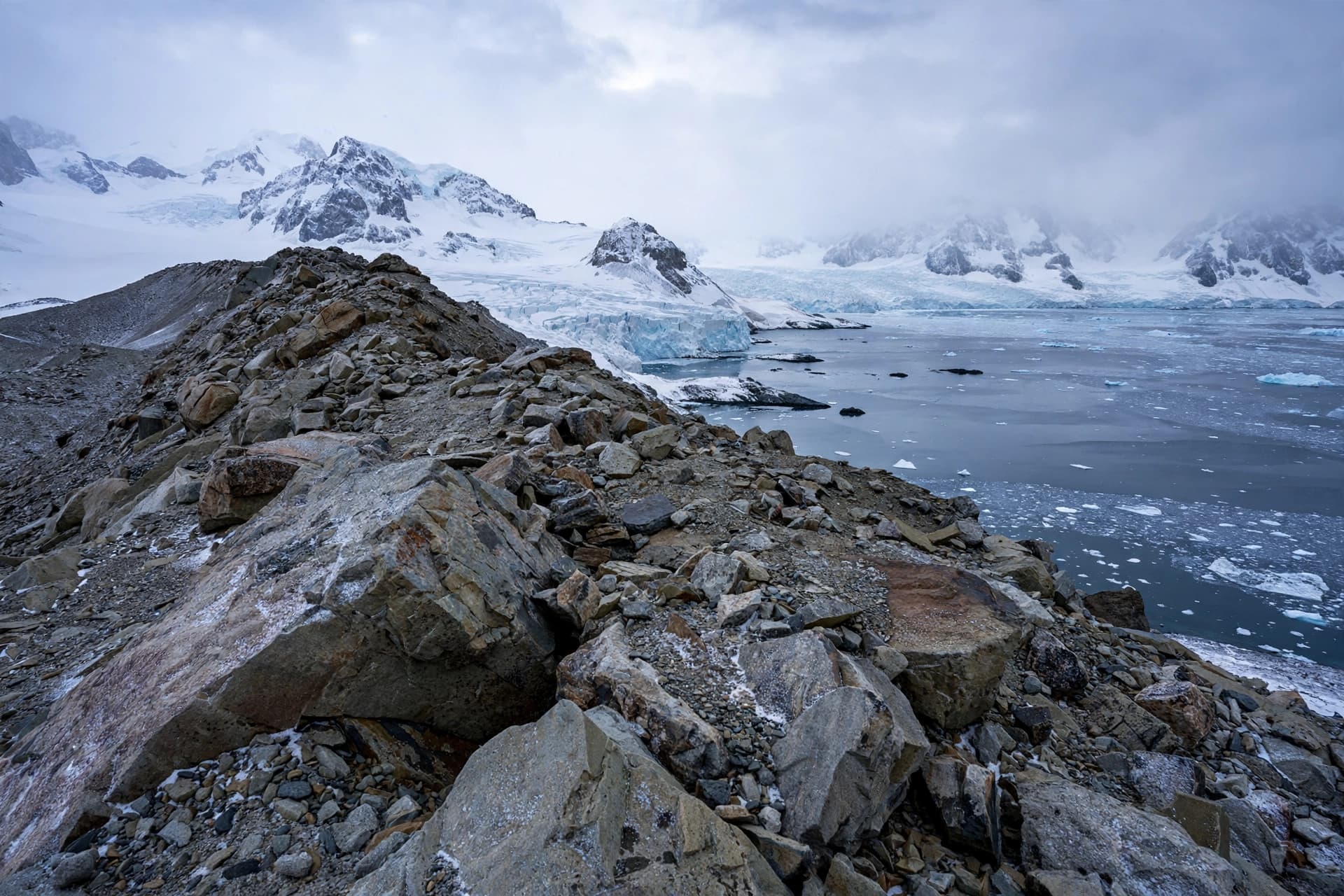
Ice leaves few witnesses. It advances and retreats, scouring the land, depositing ridges of rock and debris at its margins, and then melting away without record. For scientists trying to understand how Antarctica's glaciers behaved before satellites and thermometers, the evidence must be read from what the ice left behind—piles of stone that mark where a glacier once ended, waiting for someone to ask when.
Along Marguerite Bay on the western Antarctic Peninsula, researchers have now dated those piles for the first time. A moraine on Shoesmith Glacier on Horseshoe Island was dated to 496 years ago, plus or minus 79 years, placing its formation during the Little Ice Age . The study, published in Quaternary Science Reviews, provides the first direct surface-exposure ages for late-Neoglacial moraines in Marguerite Bay, the largest bay on the peninsula .
The technique is elegant in its patience. When a glacier retreats, it exposes rocks that have been buried for millennia. Once exposed, those rocks begin to accumulate beryllium-10, an isotope produced by cosmic rays. By measuring how much has accumulated, scientists can calculate how long the rock has been at the surface—a clock that starts the moment the ice lets go . The Shoesmith Moraine offered the clearest record. Two other glaciers, Erinç and Erol, told more complicated stories, with some boulders carrying older exposure signals from previous geological episodes .
The Little Ice Age, roughly 1300 to 1850 CE, is well documented in the Northern Hemisphere but less clearly understood in Antarctica. Previous studies suggested glaciers advanced in parts of the peninsula during that period, but Marguerite Bay had no direct dating. Now it does. The finding aligns with evidence from Rothera Point, less than 50 kilometers away, where a glacier advance occurred around the same time .
"These ridges resemble ancient boundaries formed by ice," said Professor Attila Çiner of Istanbul Technical University. "Determining when the rocks were exposed allows us to map past glacier positions before direct observations. Marguerite Bay was a key missing piece in that historical puzzle" .
What the rocks offer is not a prediction but a baseline. To understand where Antarctica's glaciers are going, scientists need to know where they have been. The moraines at Marguerite Bay are a small piece of that map, a chapter written in stone and ice that is only now being read.
The images in this article are AI-generated and are not photographs of the glaciers or researchers described.
Sources: Istanbul Technical University, Quaternary Science Reviews, EurekAlert
Published by Banx Network. This article is part of the Banx decentralized media programme, powered by the BXE token on the XRP Ledger.