There is something unsettling about the price of deep time. A skeleton that lay in the earth for 67 million years, patient and silent, can be lifted into the light and sold in twelve minutes. The bones do not change. What changes is their meaning—from scientific specimen to commodity, from a chapter in the story of life to a line item in an auction catalog.
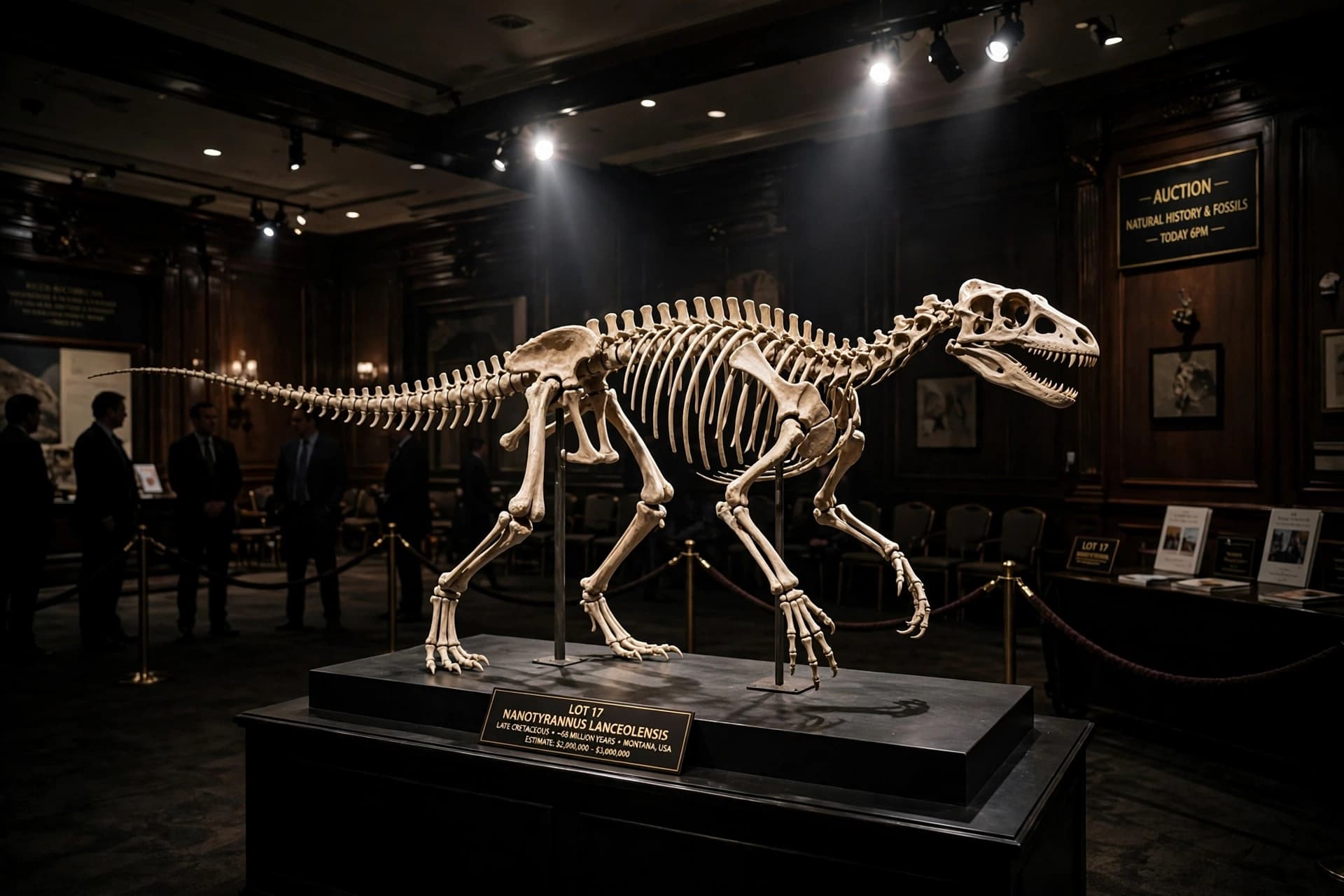
On Tuesday in New York, a Nanotyrannus skeleton nicknamed "Jodi" sold for $47.3 million at Sotheby's, far exceeding the auction house's estimate of $6 million to $9 million . The sale makes it the second-most expensive dinosaur fossil ever auctioned, behind a T. rex named Gus that sold for $50.1 million in July .
Jodi is one of only three Nanotyrannus skeletons known to science. Standing roughly two meters tall and six meters long, the specimen is about 70 percent complete, with a virtually complete skull . It was discovered in 2019 by Montana rancher Jodi Pierson on her land in the Hell Creek Formation, and excavated by commercial paleontologist Clayton Phipps .
For decades, scientists debated whether Nanotyrannus was a distinct genus or merely a juvenile Tyrannosaurus rex. Research published last year concluded that it was, in fact, a separate creature—smaller and more slender than its famous cousin, with longer forelimbs and blade-like teeth suited for slicing through meat . The confirmation transformed Jodi from a curiosity into a rarity, and the auction price reflected that transformation.
Six bidders competed for roughly twelve minutes before the winning offer came in. The buyer remains anonymous .
The sale has renewed a debate that has followed private fossil auctions for years. Some paleontologists argue that significant specimens should be displayed in museums, where they can be studied by researchers and viewed by the public. Steve Brusatte of the University of Edinburgh called it "harrowing" that Jodi could disappear into a private collection. "We've really just found out that Nanotyrannus is real," he said, "and now one of the best skeletons is about to be sold to the highest bidder" .
Others acknowledge the complexity. Megan Jacobs of the University of Portsmouth noted that excavation requires time, money, and expertise. "I don't begrudge the people involved for wanting to sell it for such a large amount of money," she said, though she described the prospect as "scary" .
What remains unresolved is the question of access. A fossil in a museum belongs, in a sense, to everyone who walks through the door. A fossil in a private vault belongs to one person, and to the silence that surrounds it. Jodi's bones will endure for millions of years more. Where they endure, and who will be allowed to see them, is now a matter of private decision.
The images accompanying this article are AI-generated and are not photographs of the fossil or the auction.
Sources: Associated Press, BBC News, ORF, VRT
Published by Banx Network. This article is part of the Banx decentralized media programme, powered by the BXE token on the XRP Ledger.