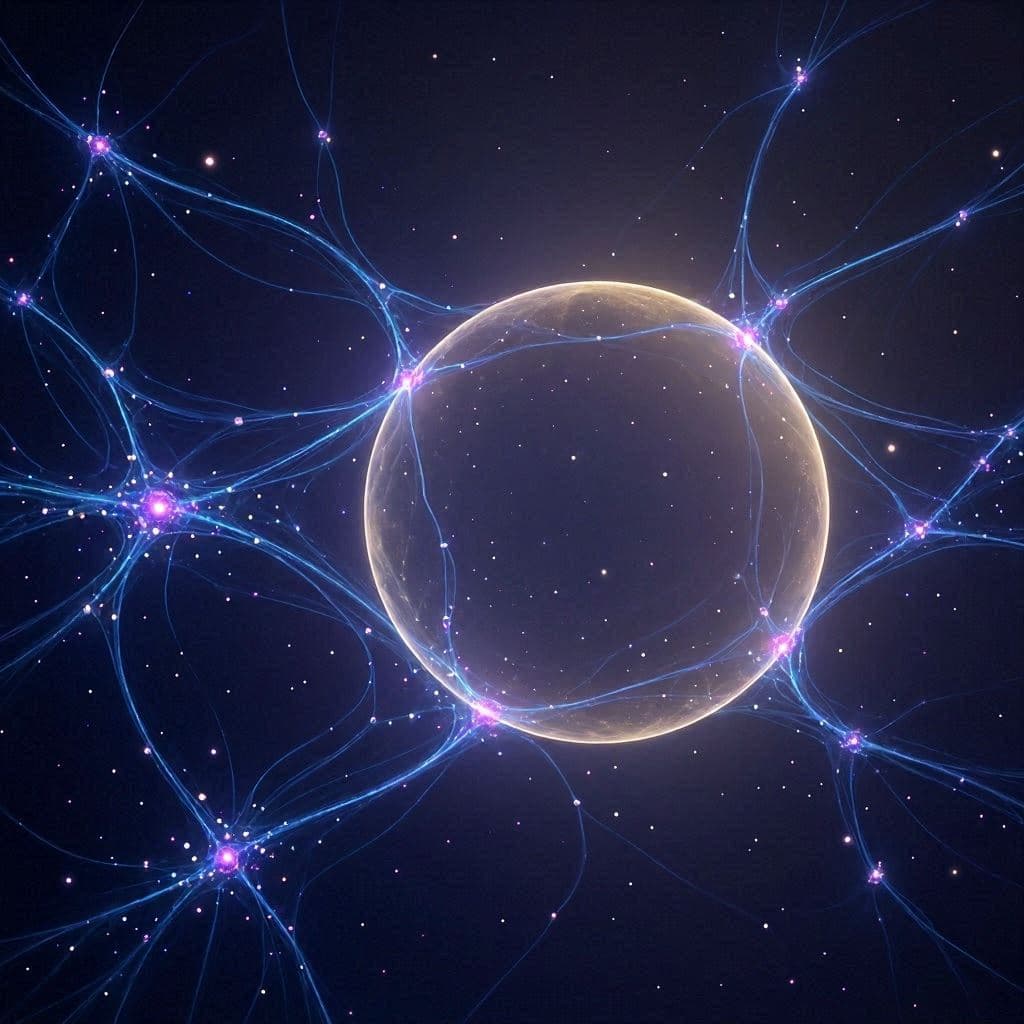
When we gaze into the night sky, we are accustomed to seeing a tapestry woven with stars and galaxies, a dense fabric of light and matter. Yet, amidst this cosmic richness, there exist vast regions of profound silence and darkness. One such anomaly is the Boötes Void, a spherical expanse stretching approximately three hundred million light-years across. In a universe where gravity typically pulls matter into clusters, this void stands as a stark exception, a hollow sphere where thousands of galaxies should reside, but only a sparse few dozen are found. It is a reminder that the cosmos is not just defined by what is present, but also by what is absent.
The Boötes Void, discovered in 1981, remains one of the largest known voids in the observable universe. To comprehend its scale is to challenge the limits of human imagination. If the Milky Way were located at the center of this void, humanity would not have discovered other galaxies until the 1960s. The sheer emptiness defies standard models of cosmic structure formation, which predict a more uniform distribution of matter over such vast distances. This discrepancy has puzzled astronomers for decades, prompting numerous theories to explain its origin.
One leading hypothesis suggests that the void was created by a rare concentration of early-universe energy or a unique fluctuation in the density of matter shortly after the Big Bang. Another theory proposes that smaller voids may have merged over billions of years to create this massive empty space. Regardless of the cause, the result is a region where the gravitational pull is too weak to gather significant amounts of gas and dust into new stars and galaxies. It is a cosmic desert, untouched by the fertile processes that build galactic cities elsewhere.
Studying the Boötes Void offers valuable insights into the nature of dark energy and the expansion of the universe. Because voids expand faster than the surrounding dense regions, they act as natural laboratories for testing cosmological models. By observing the few galaxies that do exist within the void, scientists can study how isolated systems evolve without the influence of neighboring structures. These "lonely" galaxies provide a unique window into the fundamental forces that shape the cosmos.
The psychological impact of such emptiness is profound. For humans, who thrive on connection and community, the idea of a galaxy isolated in a sea of nothingness is both terrifying and fascinating. It challenges our anthropocentric view of the universe, reminding us that life and complexity are not guaranteed outcomes of cosmic evolution. The void serves as a humbling counterpoint to the crowded clusters where we reside.
Recent advancements in telescope technology have allowed astronomers to map the boundaries of the Boötes Void with greater precision. These maps reveal a sharp contrast between the void and the surrounding filamentary structures of the cosmic web. The transition from emptiness to density is abrupt, highlighting the intricate architecture of the universe. Each new observation adds a piece to the puzzle, bringing us closer to understanding why this hole exists.
As we continue to explore the depths of space, the Boötes Void remains a beacon of mystery. It invites us to look beyond the bright lights and consider the shadows. In its silence, there is a story of the universe’s early days, written in the language of absence. It is a testament to the diversity of cosmic environments and the enduring questions that drive scientific inquiry.
The Boötes Void is more than just an empty space; it is a critical component of the universe’s structure. Its existence challenges our understanding of gravity, matter, and energy. As astronomers continue to probe its depths, they uncover not just emptiness, but the subtle fingerprints of the cosmos’s history.
AI Image Disclaimer: The visuals accompanying this article are AI-generated illustrations designed to represent the themes of cosmic voids and astronomical discovery.
Sources: NASA, Smithsonian Magazine, Live Science, University of Arizona News
Published by Banx Network. This article is part of the Banx decentralized media programme, powered by the BXE token on the XRP Ledger.