Neutrinos are the ghosts of the particle world—almost nothing stops them, and almost nothing reveals them. A single neutrino can pass through the entire Earth without leaving a trace, and trillions flow through your body every second, unnoticed. Yet these elusive particles may hold keys to physics beyond the Standard Model, and for that reason, scientists have spent decades trying to catch them in the act of interacting. Now, an international team led by researchers at the National Centre for Nuclear Research in Poland has proposed a way to observe one of the rarest neutrino processes of all, using the most powerful particle accelerator ever built.
The process is called neutrino trident scattering. In typical neutrino interactions, a single charged lepton—an electron or a muon—is produced. In trident scattering, two charged leptons emerge, a rare occurrence that involves both charged and neutral currents simultaneously . This interference between the two types of weak interactions makes trident scattering a sensitive probe for new physics, potentially revealing particles or forces not yet discovered. It has never been conclusively observed; early reports from more than twenty years ago were later undermined by background processes that mimicked the signal .
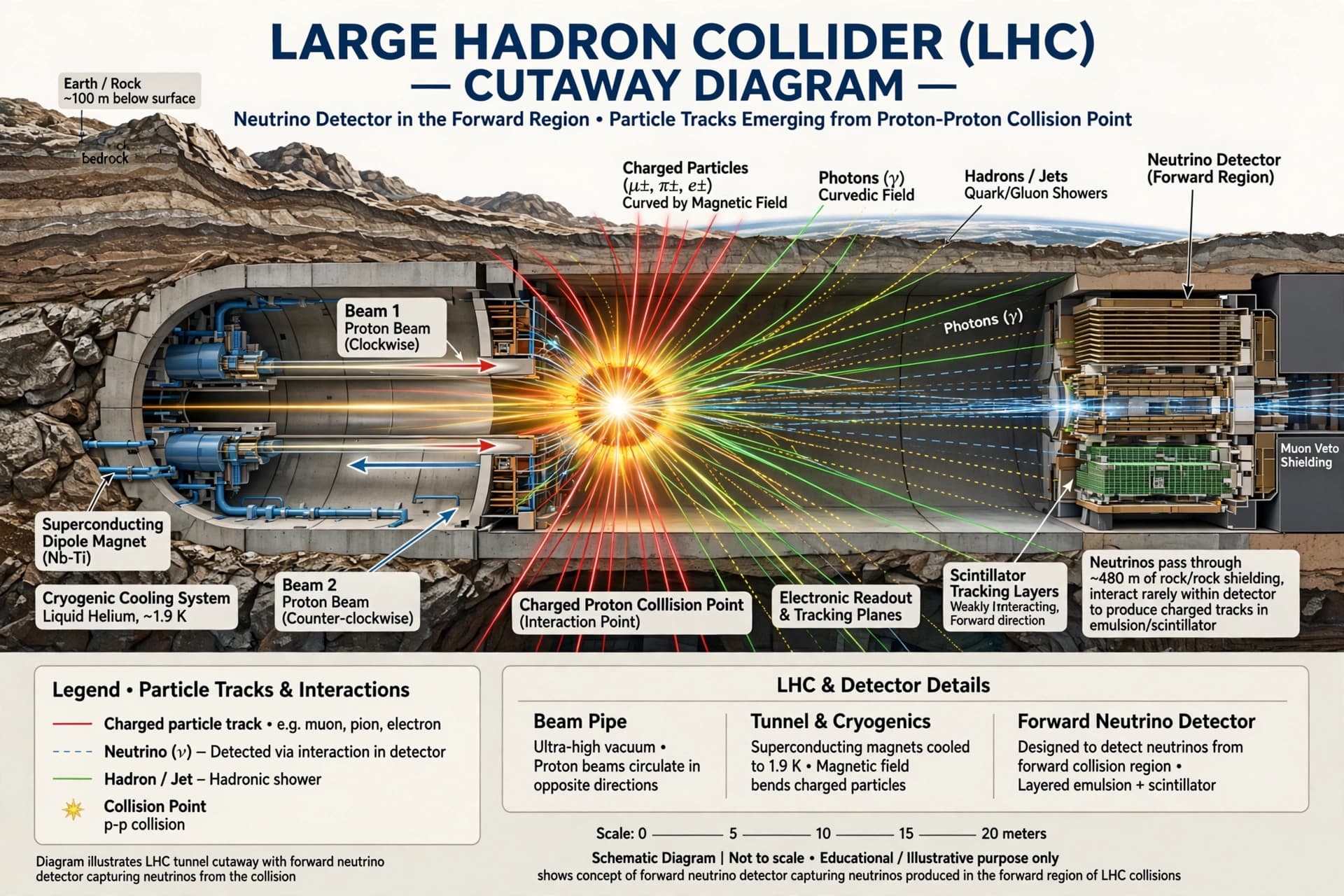
The Large Hadron Collider, designed primarily to collide protons at unprecedented energies, also produces an intense beam of neutrinos as a byproduct. These neutrinos emerge from the collisions in a narrow cone in the forward direction, and a new generation of detectors is being developed to study them. The FASER experiment, which began taking data in 2022, made the first direct observations of collider neutrinos. A proposed upgrade, FASERν2, would increase the detector volume and improve sensitivity .
The NCBJ-led study, published in Physical Review D, presents a measurement strategy for trident scattering using FASERν2. The researchers show that even a detector of about ten tons could observe tens of di-muon trident events, while background processes could be reduced to negligible levels without compromising the signal . The analysis was led by Dr. Sebastian Trojanowski of NCBJ’s Theoretical Physics Division, with contributions from Dr. Toni Mäkelä, who completed a postdoctoral fellowship at NCBJ and now continues his research at the University of California, Irvine .
Observing trident scattering would serve two purposes. First, it would test the Standard Model’s predictions for a process that has never been directly measured, providing a new constraint on the interference between charged and neutral weak currents. Second, it would open a window to new physics. Any deviation from the expected rate could indicate the presence of unknown particles or interactions. The researchers also note that measurements of neutrino production at the LHC can help explain the behavior of cosmic ray collisions in Earth’s atmosphere, connecting collider physics to astrophysics .
The study is part of a broader effort to establish neutrino physics as a permanent program at the LHC. The forward region of the collider, long considered a background for other experiments, is now recognized as a unique source of the most weakly interacting particles known. For a particle that passes through almost everything, the LHC may finally offer a place where it can be caught.
An international team led by NCBJ researchers has proposed a strategy to observe neutrino trident scattering at the Large Hadron Collider using the proposed FASERν2 detector. The rare process, never conclusively observed, could provide a window to physics beyond the Standard Model and help explain cosmic ray interactions.
AI Image Disclaimer: Visuals in this article are produced by artificial intelligence for illustrative purposes only and do not represent actual laboratory setups.
Sources: NCBJ, Physical Review D, University of Pittsburgh, Fermilab
Published by Banx Network. This article is part of the Banx decentralized media programme, powered by the BXE token on the XRP Ledger.