There is a particular image that comes to mind when people think about space debris: a cosmic garbage truck, perhaps, scooping up dead satellites and lost tools and hauling them away. It is a comforting image, and it is almost entirely wrong. The problem of orbital debris is not a problem of collection. It is a problem of control—of who decides what orbits where, who pays for the consequences of neglect, and how the economics of space can be aligned with its long-term sustainability. A new analysis by Dr. Slava Turyshev of NASA's Jet Propulsion Laboratory, available as a preprint and published in Acta Astronautica, makes this case with a clarity that the policy conversation has often lacked.
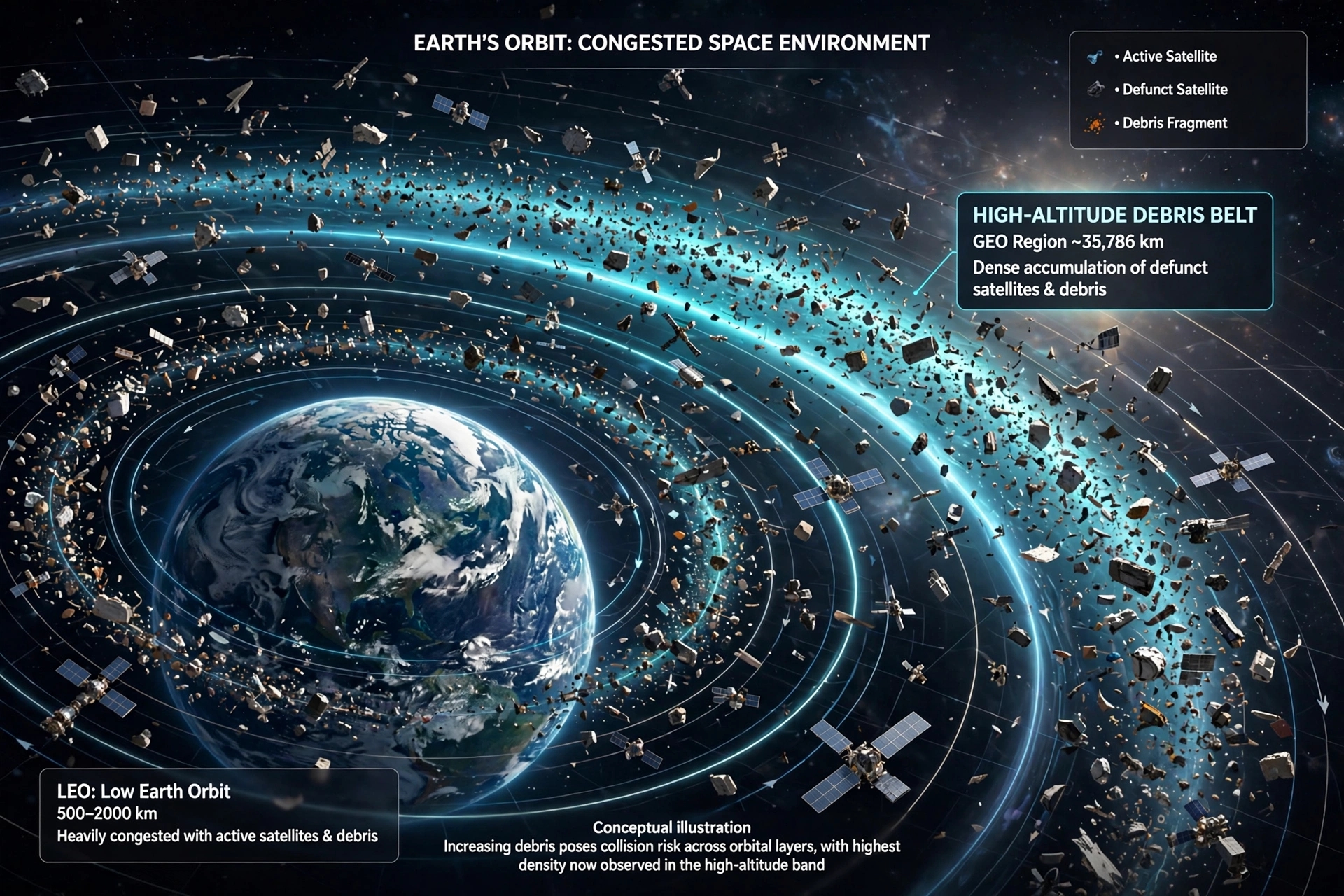
The scale of the challenge is visible in the numbers. According to filings with the Federal Communications Commission, SpaceX's Starlink satellites performed 144,404 collision avoidance maneuvers in the six months from December 2024 through May 2025—an average of one dodge per satellite per week . Those maneuvers consume fuel and shorten mission lifetimes. But Starlink operates at 500 to 600 kilometers, where there is enough residual atmosphere that dead satellites eventually burn up. The real danger lies higher, at around 850 kilometers, where abandoned rocket stages from decades past orbit with no ability to maneuver and no atmospheric drag to bring them down. When they collide, they will spray debris into both higher and lower orbits, threatening the megaconstellations below .
According to European Space Agency data cited in the paper, roughly 96 percent of the long-term collision risk comes from these dead objects . And the situation is self-reinforcing. Even if all launches stopped tomorrow, the debris already in orbit would continue to collide and fragment faster than natural processes can clear it. This is the Kessler syndrome, a cascade that orbital dynamicists have warned about for decades. Turyshev's contribution is not the warning but the framework for what to do about it.
The first lever is regulatory. Satellites must be designed to deorbit quickly once their missions end. The FCC has already moved in this direction, reducing the allowable post-mission lifetime from twenty-five years to five . The paper calculates that if disposal reliability rises from 90 to 99 percent and the afterlife window is cut to five years, the environmental hazard decreases by a factor of fifty. This is not a technological problem. It is a matter of rules and enforcement.
The second lever is vision. Space Situational Awareness systems can track large objects but struggle with small ones, and even for the objects they track, the uncertainty box—the volume of space where an object might be—is often too large. Operators waste fuel dodging threats that never materialize. Turyshev suggests that rather than trying to track every bolt and fragment, the priority should be shrinking the uncertainty zone around high-risk close approaches. This aligns with NOAA's Traffic Coordination System for Space, which is expanding its pilot program to commercial operators .
The third lever is what to do with the debris already up there. Instead of launching expensive missions to deorbit every dead rocket stage, Turyshev proposes "just-in-time collision avoidance"—a concept that acknowledges the impossibility of cleaning the sky entirely and focuses instead on preventing the most dangerous collisions before they happen. The economics matter here. A paper published in Nature Communications found that post-mission disposal bonds, applied at launch and returned upon successful deorbit, can reduce undisposed mass per year by 24 to 65 percent depending on the bond amount, while increasing economic welfare relative to the baseline . The market, properly structured, can be part of the solution.
There is a quiet urgency in all of this. The orbital environment is a shared resource, and like many shared resources, it is vulnerable to the tragedy of the commons. The satellites that provide broadband, navigation, and weather data are real and valuable. The debris that threatens them is also real, and it will not clean itself up. The levers Turyshev identifies are not dramatic. They are regulatory, economic, and technical, the unglamorous machinery of governance. But they are the only levers available, and the time to use them is before the cascade begins.
The images accompanying this article are AI-generated illustrations and are not actual photographs of orbital debris.
Published by Banx Network. This article is part of the Banx decentralized media programme, powered by the BXE token on the XRP Ledger.