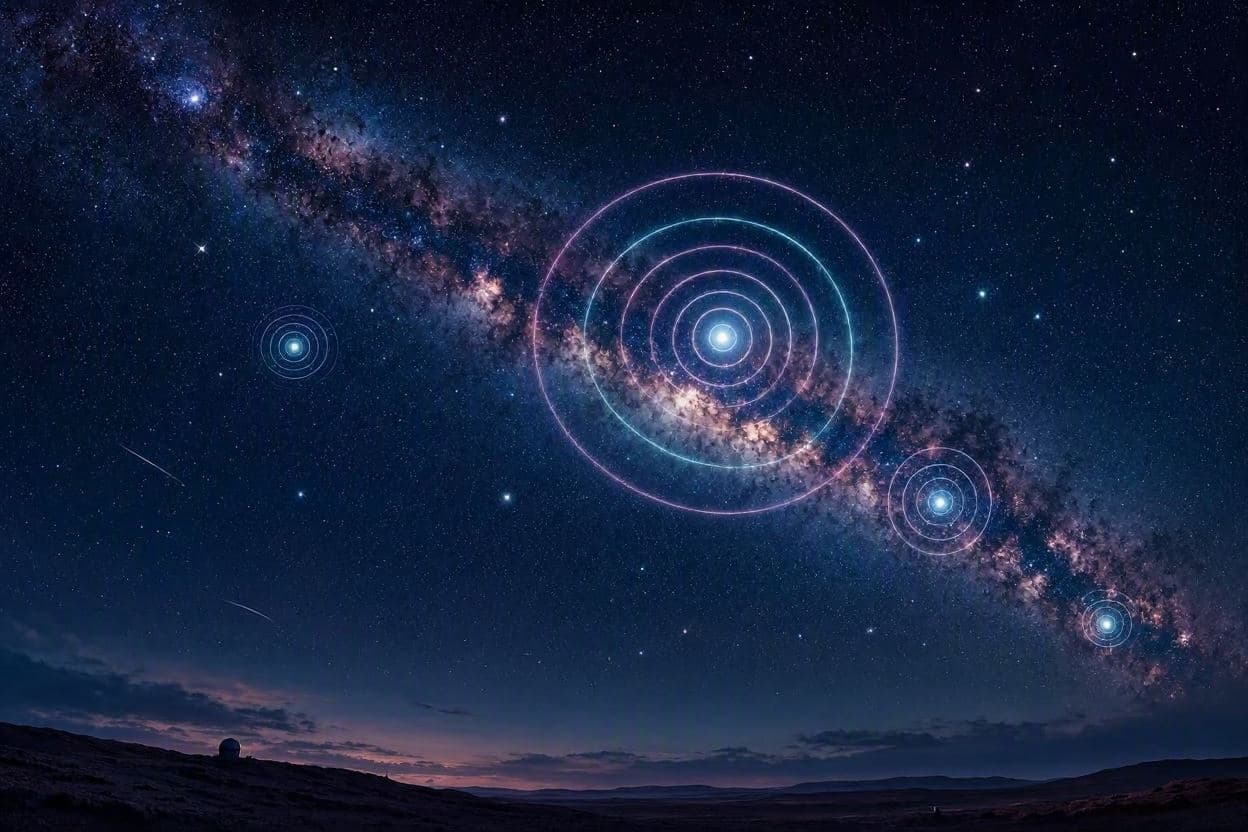
The Milky Way is often described as a river of light, a sprawling band of stars that has guided navigators and dreamers for millennia. Yet, beyond the visible spectrum, our galaxy hums with invisible signals, a chorus of radio waves that tell stories of cosmic violence and stellar evolution. Recently, astronomers have tuned into this hidden frequency to discover twenty-seven new, enigmatic radio beacons. These sources, bright and persistent, stand out against the background noise, inviting us to listen more closely to the secrets of our galactic neighborhood.
These newly identified beacons were detected using advanced radio telescopes capable of capturing faint emissions from deep space. Unlike typical pulsars, which rotate with clockwork precision, or quasars, which shine from billions of light-years away, these sources reside within our own galaxy. Their proximity makes them particularly intriguing, as they offer a clearer window into the physical processes that generate such strong radio signals.
The nature of these beacons remains a subject of careful investigation. They exhibit characteristics that do not fit neatly into existing categories of astronomical objects. Some may be highly magnetized neutron stars, known as magnetars, whose intense magnetic fields drive powerful radio emissions. Others could be interacting binary systems, where two stars orbit each other closely, exchanging material and generating energy in the process.
What sets these twenty-seven sources apart is their consistency and brightness. In a galaxy filled with transient events and fleeting flashes, these beacons maintain a steady presence. This reliability allows astronomers to study them in detail, tracking their behavior over time and searching for patterns that might reveal their underlying mechanisms. It is a patient process, requiring months of observation and analysis.
The discovery also highlights the importance of surveying the sky at different frequencies. Many of these sources were invisible to optical telescopes, hidden behind clouds of dust or simply too faint in visible light. Radio astronomy, therefore, plays a crucial role in completing our picture of the galaxy, revealing objects that would otherwise remain undetected. It reminds us that what we see is only a fraction of what exists.
Furthermore, these findings contribute to our understanding of stellar life cycles. If these beacons are indeed young neutron stars or evolving binary systems, they provide snapshots of critical phases in stellar evolution. Studying them helps scientists refine models of how stars die, how black holes form, and how energy is distributed across the galaxy. Each beacon is a data point in the larger narrative of cosmic history.
The mystery surrounding these sources also sparks the imagination. While natural explanations are the most likely, the unusual nature of their signals invites speculation and curiosity. It is a reminder that the universe still holds surprises, even in our own backyard. For astronomers, this is not a cause for alarm but a call to deeper inquiry, driven by the desire to understand the unknown.
As technology improves, we may find that these twenty-seven beacons are just the beginning. Future surveys could uncover hundreds more, painting a richer and more complex map of the radio sky. Until then, these sources serve as markers of our current limits, challenging us to expand our knowledge and refine our tools.
The identification of twenty-seven mysterious radio beacons in the Milky Way underscores the dynamic nature of our galaxy. It highlights the value of radio astronomy in uncovering hidden celestial phenomena. As researchers continue to study these sources, they bring us closer to understanding the diverse and energetic processes that shape our cosmic home.
AI Image Disclaimer: The images associated with this article are AI-generated interpretations designed to visualize the concept of radio waves emanating from unseen sources in the galaxy.
Sources: The Astrophysical Journal Nature Sky & Telescope
Published by Banx Network. This article is part of the Banx decentralized media programme, powered by the BXE token on the XRP Ledger.