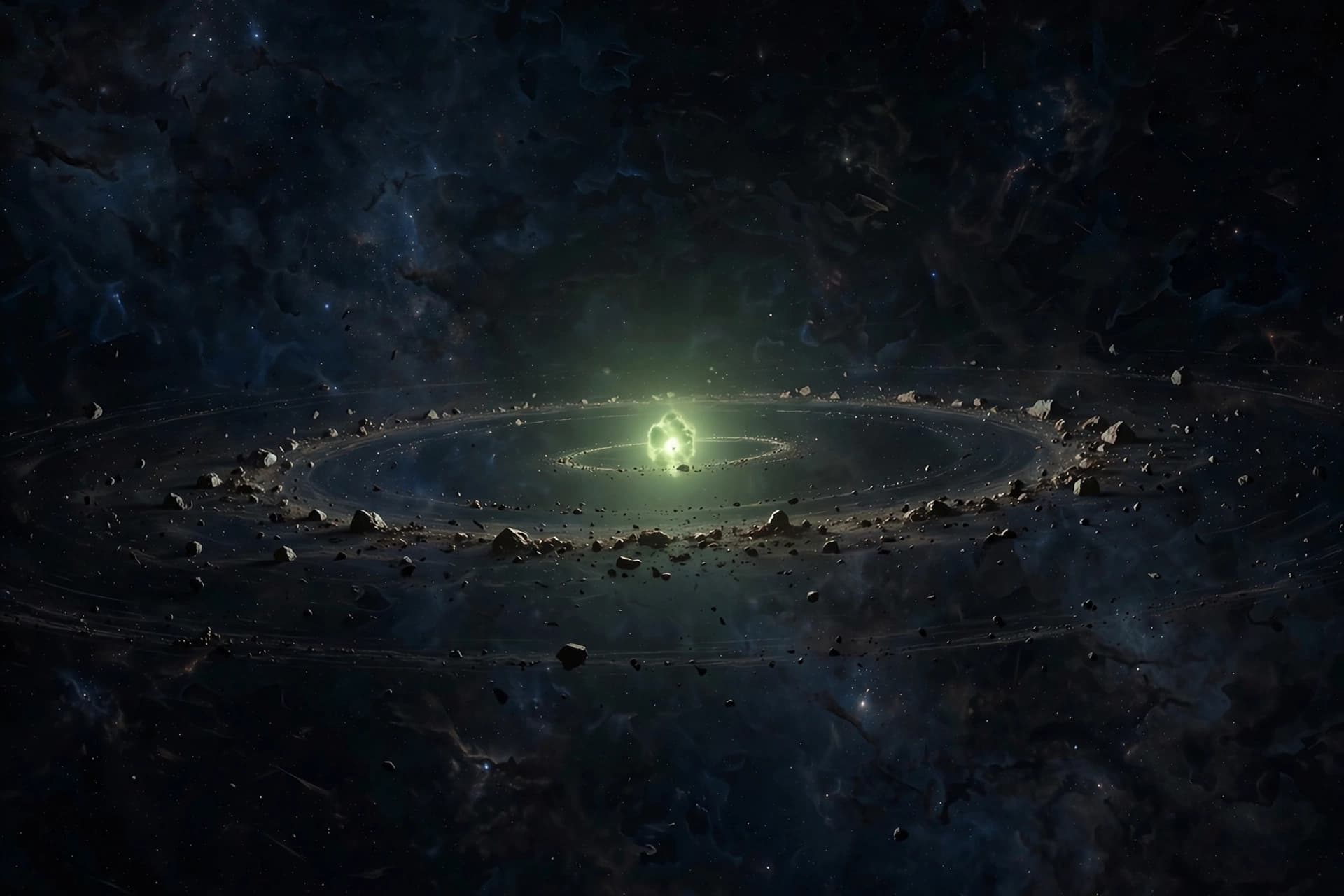
There is a particular wonder that arrives when the universe breaks a rule we did not know it had made. For as long as humans have looked upward, we have understood that a star's color is a simple confession of its temperature—cool stars glow orange, hot stars burn blue-white, and the spectrum between them follows a logic as reliable as the ember of a fire. But somewhere in the constellation Draco, a dead star has been quietly rewriting that logic, one swallowed planet at a time.
Astronomers at the University of Warwick have identified the first known star that would appear green to human eyes—a white dwarf designated WD J1330+6435, located roughly 280 light-years from Earth . The finding, published in the journal RAS Techniques and Instruments, emerged not from a search for strange colors but from a straightforward question: what would these stellar remnants actually look like if we could stand beside them?
White dwarfs are the leftover cores of stars that have exhausted their nuclear fuel and shed their outer layers. They are extraordinarily dense—roughly the size of Earth but containing about 165,000 times Earth's mass . Most behave like "perfect radiators," their color determined almost entirely by temperature. But WD J1330+6435 is not most white dwarfs. It has been consuming rocky debris from a disrupted planetary system, enriching its atmosphere with calcium, lithium, and especially sodium . Under the extreme density of the star's helium-dominated atmosphere, sodium atoms are bombarded by surrounding helium, broadening their absorption from a narrow band of orange into a wide swath of yellow, orange, and red wavelengths. What remains is a ghostly chartreuse green .
The discovery does not stand alone. The Warwick team analyzed 151 nearby white dwarfs and found that while most appear white, a handful display colors that challenge the familiar temperature sequence. One, rich in carbon dredged up from its interior, would appear salmon-pink; another might be the reddest star ever recorded . Cool white dwarfs with mixed hydrogen and helium atmospheres could glow cyan or pale blue, while those enriched by asteroid debris take on a yellow hue . The universe, it seems, has a palette far broader than we assumed.
What makes this finding particularly striking is its intimacy. The researchers were not asking abstract questions about stellar evolution or atmospheric physics. They were asking what a person would see—a question that belongs more to poetry than to spectroscopy. "Imagine standing on a planet and looking up at a green star," said lead author Mark Hollands. "It feels like something out of science fiction" . The answer, it turns out, is that you would see something the universe had never shown us before, because no one had thought to look.
The green will not last. As the white dwarf cools and its gravity pulls the trace elements into its core, the color will fade back toward the ordinary white or orange of stellar old age . The window is temporary, a brief chromatic interlude in a life measured in billions of years. But for now, in the quiet dark of Draco, a dead star is wearing a color that belongs to no other known object in the sky.
AI Image Disclaimer: The images accompanying this article were generated by artificial intelligence and are intended for illustrative purposes only.
Sources: Space.com, CNET, New York Post, Gulf Daily News (citing Reuters), The Economic Times, Yahoo
Published by Banx Network. This article is part of the Banx decentralized media programme, powered by the BXE token on the XRP Ledger.