There is a particular kind of stillness required to study a single particle of antimatter, a stillness that must be maintained for months, in a vacuum so complete that the particle never touches a wall, at a temperature just a fraction of a degree above absolute zero. In that stillness, at Northwestern University, a positron has been coaxed into a quantum state so precisely controlled that it behaves like an artificial atom, its energy levels manipulated with microwave pulses, its magnetic properties measured with a precision that could soon rival that of its ordinary-matter twin. The achievement is the first one-positron quantum cyclotron, and it opens a door that has been closed for decades.
The positron is the electron's antiparticle, identical in mass but opposite in charge. According to the Standard Model, the two should be perfect mirror images, their magnetic moments equal in magnitude and opposite in sign. This symmetry is a consequence of CPT invariance, a cornerstone of quantum field theory. If the symmetry holds, the measured g factors of the electron and positron should match. If it does not, the discrepancy would be a crack in the Standard Model, a clue to why the universe contains so much more matter than antimatter.
The electron's magnetic moment has been measured to a precision of 0.13 parts per trillion, a triumph of decades of Penning trap experiments . The positron's has lagged far behind, with the most precise comparison dating to 1987 and reaching only 2.1 parts per trillion . The new work, led by Gerald Gabrielse and published in Physical Review Letters, closes that gap by applying the techniques developed for electrons to a single positron, captured from radioactive decay and cooled to 300 millikelvins .
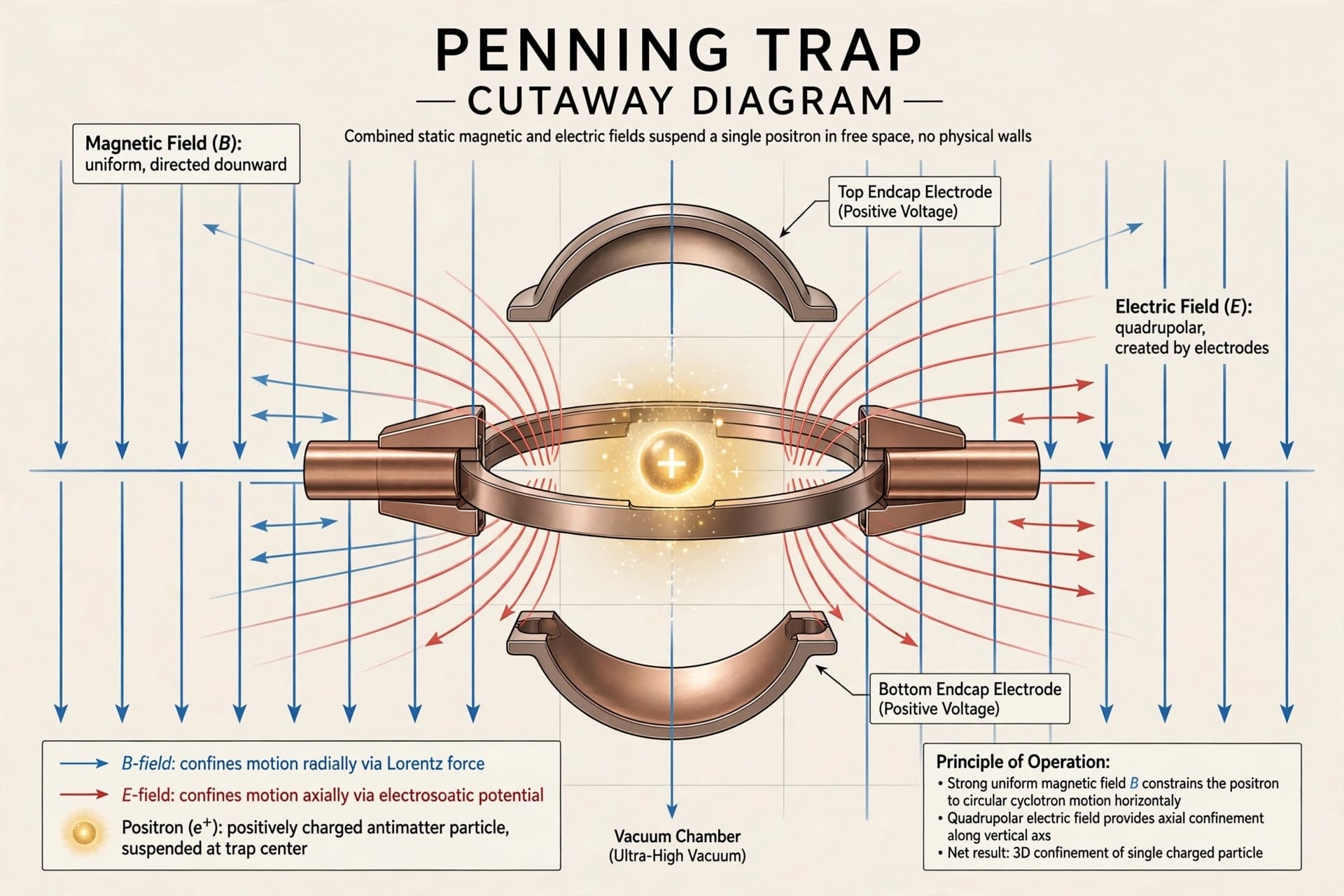
The trap itself is a container with no walls. Specialized electric and magnetic fields suspend the positron in empty space, preventing it from touching ordinary matter, which would cause it to annihilate in a flash of energy. "If we want to study antimatter, we must handle it carefully," Gabrielse said. "To be clear, it's not dangerous. We don't have enough antimatter to make an explosion" . The particle has remained trapped for months, its quantum state preserved and manipulated with precision.
The motivation is not merely to match the electron's precision but to test the foundations of physics. "We know the Standard Model has to be wrong somewhere—or at least incomplete," Gabrielse said. "It cannot predict why the universe exists, so that's a pretty big loophole" . If the positron and electron g factors differ, even slightly, the discovery would be among the most significant in a century. If they match, the symmetry holds, and the mystery of matter's dominance remains unsolved.
For now, the apparatus is working, and the measurements are underway. The team expects to achieve a thirty-fold improvement in precision, reaching a level where the comparison becomes a stringent test of CPT symmetry . The positron sits in its trap, invisible and patient, waiting to answer a question that has haunted physics since the Big Bang.
AI Image Disclaimer: The visuals in this article are generated by artificial intelligence and are intended for illustrative purposes only.
Sources: American Physical Society, Northwestern University, Physical Review Letters, EurekAlert
Published by Banx Network. This article is part of the Banx decentralized media programme, powered by the BXE token on the XRP Ledger.