Stars, we are taught, announce their temperature through color. Cool stars glow orange, hot stars burn blue-white, and the sun sits somewhere in the middle, a patient yellow. It is a rule so reliable that it feels almost like a law of nature. But rules, in astronomy, are often invitations to look closer.
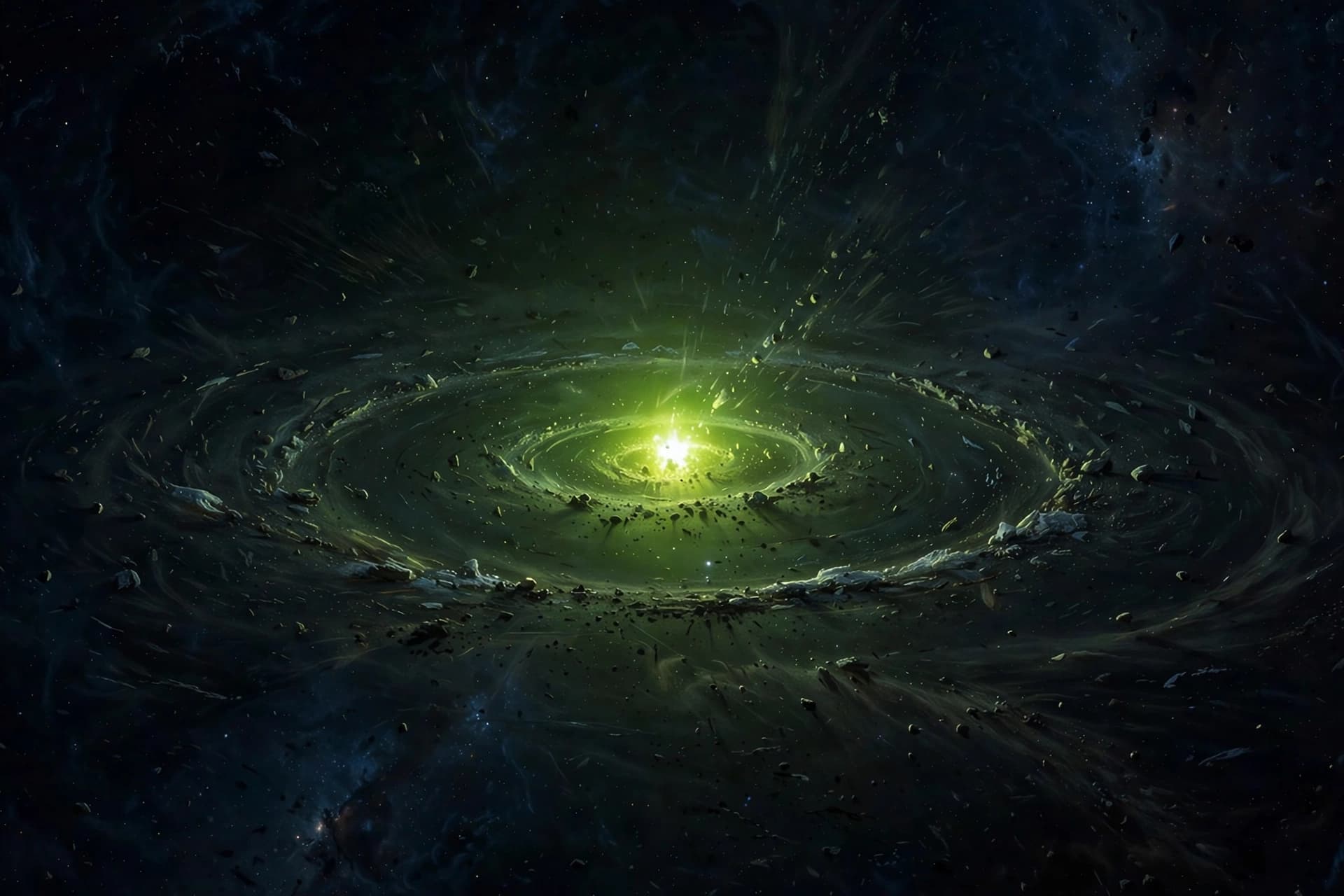
A team led by astrophysicist Mark Hollands at the University of Warwick has found the first star known to shine green—not the faint greenish tinge of a telescope filter, but a true chartreuse, the color of a sour apple or a spectral ghost. The star is WD J1330+6435, a white dwarf about 280 light-years away, and its color is not a trick of temperature. It is a consequence of density, chemistry, and a macabre act of cosmic consumption .
White dwarfs are the cores of dead stars, the remnants left behind when a sun-like star sheds its outer layers and ceases fusion. They are extraordinarily compact, packing up to 1.4 solar masses into a body roughly the size of Earth. Their gravity is so intense that the atmospheres of the coolest white dwarfs reach densities comparable to liquid water, millions of times denser than the sun’s surface .
At such densities, the usual rules of stellar color break down. Elements like sodium and calcium, which absorb light in narrow bands under normal conditions, begin to absorb across broad swaths of the spectrum. In WD J1330+6435, sodium swallows the orange-yellow light, while calcium suppresses violet. What remains, unabsorbed and free to escape, is green .
The elements themselves tell a story. Sodium, calcium, and lithium are the signatures of rocky material—the debris of asteroids, comets, or perhaps entire planets that the white dwarf has devoured. The green glow is, in a sense, the visible stain of its meal, a ghostly patina left by the remains of a planetary system it consumed long after its own death .
The researchers examined dozens of spectrally unusual white dwarfs and found a range of unexpected hues: pinks and purples from carbon-rich atmospheres, yellows from debris-fed stars, cyans from hydrogen-helium mixtures. Roughly one in thirty white dwarfs may display colors significantly different from what temperature alone would predict. But WD J1330+6435 was the most surprising, the only one whose modeled color is genuinely green .
There is no star close enough to see with the naked eye in such detail, so the team calculated the colors by passing each star’s spectrum through a model of human vision. The green is a prediction, not a photograph, but it is a prediction grounded in the physics of dense matter and the chemistry of planetary debris. If one could stand on a planet orbiting WD J1330+6435 and look up, the researchers say, one would see a green star—a sight that belongs more naturally to science fiction than to the known universe.
The finding is not merely a curiosity. The colors of white dwarfs offer a new way to study what these dead stars have eaten, and by extension, what planetary systems were like before their suns died. The green glow is a signature of planetary material, a forensic clue written in light. For a star that has already ended its life, it is a strange and beautiful kind of afterlife.
Image note: This article’s visual is an AI-generated illustration and does not represent an actual photograph of the star.
Sources: Yahoo, Gizmodo, Space.com, New York Post
Published by Banx Network. This article is part of the Banx decentralized media programme, powered by the BXE token on the XRP Ledger.