1. The Physical Reality Behind Artificial Intelligence
AI can feel almost weightless. A person asks a question, generates an image or uses an automated assistant, and the result appears on a screen.
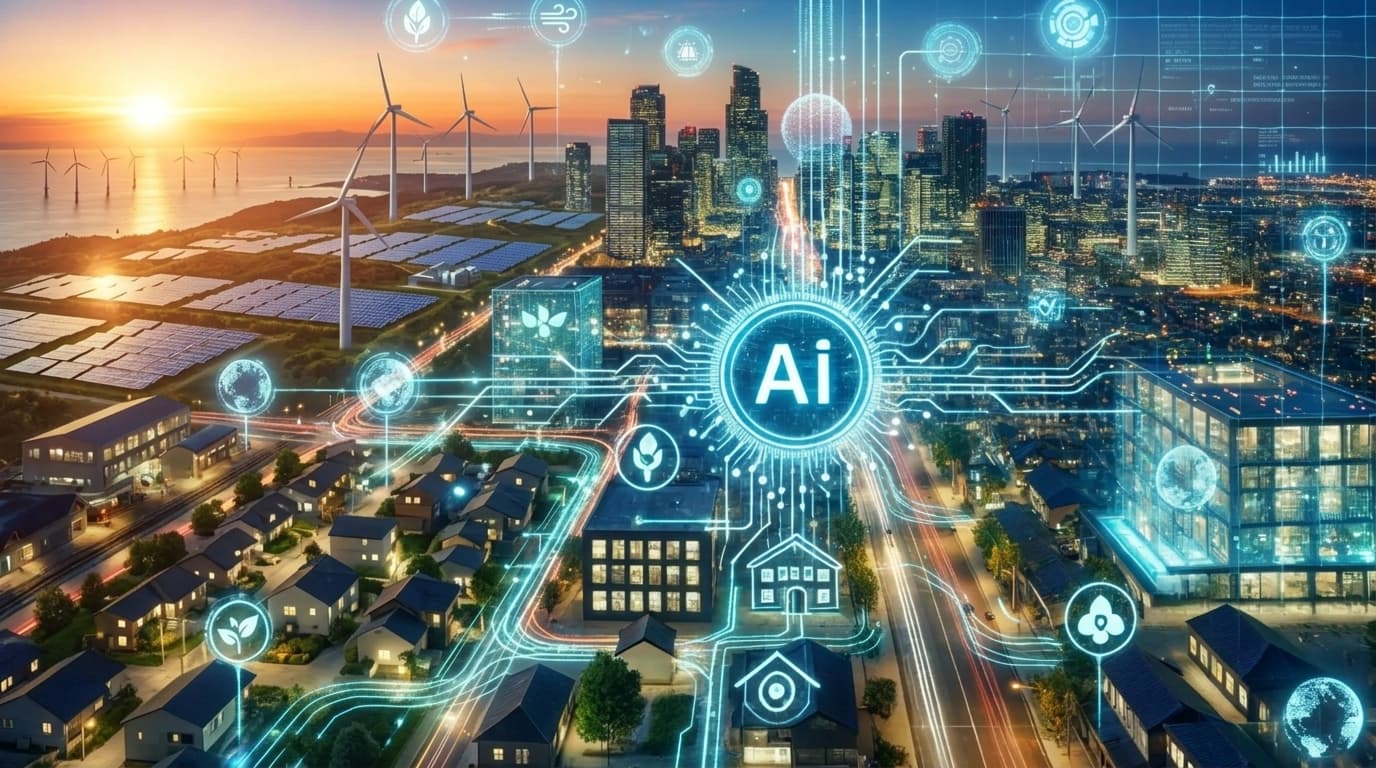
Behind that experience are servers, processors, cooling equipment, networking systems and buildings that require electricity.
Training large AI models can involve intensive computing workloads. Running those models for millions of users creates continuing demand for power. New applications such as video generation, advanced reasoning and autonomous agents can also require significantly more computing per task than simpler applications. [1]
The energy requirements of AI are therefore becoming a strategic concern for technology companies, electricity providers and governments.
2. How Much Electricity Will Data Centres Need?
The International Energy Agency's April 2026 report estimates that global data-centre electricity consumption will rise from approximately 485 terawatt-hours (TWh) in 2025 to 950 TWh in 2030. That is almost a doubling in five years, representing around 3% of global electricity demand by 2030. [1]
A terawatt-hour is a unit of energy equivalent to one billion kilowatt-hours.
These figures cover data centres overall, not AI alone. Data centres also support cloud computing, streaming, online services, enterprise software and other digital activities.
AI is nevertheless becoming an important driver of expansion. The IEA reports that electricity consumption from AI-focused data centres increased by 50% in 2025, compared with 17% growth for data centres overall. [1]
These are estimates and projections, not guarantees. Actual demand will depend on the pace of construction, improvements in computing efficiency, energy availability and the commercial success of AI services.
3. Why Data Centres Are Expanding So Quickly
Several trends are driving the infrastructure boom.
Businesses are integrating AI into software development, research, customer service, marketing and internal operations. Consumers are experimenting with tools that generate text, images, audio and video. Technology companies are investing in larger models and computing infrastructure to compete for customers and enterprise contracts.
The IEA reported that capital expenditure by major technology companies exceeded $400 billion in 2025 and was expected to rise further in 2026. It also warned that not all announced data-centre projects will necessarily be completed. [1]
This is a substantial infrastructure buildout, but investment announcements should not be confused with finished facilities or guaranteed future electricity demand.
4. The Grid Is Becoming a Bottleneck
Building a data centre requires more than land, servers and fibre-optic connections. Large facilities may need a substantial, continuous electricity supply.
Connecting them to the grid can require new substations, transformers, transmission equipment and network upgrades. These projects may take years to plan, approve, manufacture and construct.
The IEA identifies electricity supply, grid connections, equipment manufacturing and advanced-chip availability as important constraints on the expansion of AI infrastructure. [1]
The result is a potential mismatch between the speed of technology investment and the speed of physical infrastructure development.
In some locations, access to dependable electricity may become as important as land prices or proximity to customers.
5. Renewable Energy: A Major Part of the Solution
Solar and wind power could supply a growing share of the electricity needed by data centres.
Long-term power purchase agreements can help technology companies secure electricity and support investment in new renewable projects. In suitable locations, solar and wind can also offer competitive generation costs.
However, their output varies with weather and time of day. A data centre that operates continuously needs reliable electricity even when renewable generation is low.
That does not make renewables unsuitable. It means they must be considered alongside storage, transmission, demand flexibility and other sources of dependable power.
The IEA's 2025 Energy and AI report examined how renewables and other energy sources could contribute to meeting future data-centre demand. Its analysis highlights the importance of regional differences in electricity systems and the pace of infrastructure development. [2]
The key question is not simply how much renewable energy a company purchases over a year, but how its electricity demand is matched with available power across different times and locations.
6. Nuclear Power Returns to the Conversation
Nuclear power is attracting renewed interest because it can provide large quantities of electricity with low operational carbon emissions and relatively consistent output.
Existing nuclear plants may offer a source of dependable electricity for large consumers. New nuclear projects, however, can involve long development periods, complex regulation and significant capital costs.
Small modular reactors are also being explored as a potential future option. Their proposed designs could offer different deployment possibilities, but commercial availability, licensing, construction costs and delivery schedules remain important uncertainties.
Nuclear power should therefore be treated as one potential component of a broader energy strategy rather than an immediate solution to every data centre's needs.
7. Natural Gas and the Short-Term Power Gap
Natural gas can provide dispatchable electricity, helping power systems meet demand when other sources are unavailable or insufficient.
For data-centre operators facing grid constraints, gas-fired generation may appear attractive because it can provide power when required. But combustion releases carbon dioxide, and the overall climate impact also depends on methane emissions across the supply chain.
The IEA's analysis of energy supply for AI examines the roles of natural gas, renewables, coal and nuclear power in meeting growing demand. The mix varies according to local resources, infrastructure and policy choices. [2]
The challenge is to balance reliability, affordability and emissions without assuming that any single energy source can meet every requirement.
8. The Efficiency Race: Better Chips, Less Energy per Task
Energy demand is not determined by the number of AI users alone. It also depends on how much computing each task requires and how efficiently the hardware performs it.
Specialised processors can perform certain AI calculations more efficiently than general-purpose hardware. Advances in model architecture, software, memory and data-centre design can also reduce energy use.
The IEA's 2026 analysis reports that energy use per AI task has declined sharply as hardware and software have improved. Yet newer workloads—including some reasoning, video-generation and agentic tasks—can consume hundreds or thousands of times more energy per query than simple text generation. [1]
This creates a complicated relationship. Efficiency improvements reduce the cost of individual tasks, but lower costs and new capabilities can encourage people to use AI more frequently.
Total electricity demand depends on both effects.
9. Cooling: The Other Side of the Energy Equation
AI processors generate heat. Data centres need cooling systems to keep equipment operating within safe temperatures.
Air cooling remains widely used, while liquid cooling can help manage the heat produced by dense computing hardware. The most appropriate design depends on the processors, building, local climate and workload.
Cooling also has implications for water use. Some systems consume water directly, while others rely more heavily on electricity or alternative cooling methods.
There is no single design that is optimal everywhere. A facility in a hot, dry region may face different constraints from one in a cooler climate with different water resources.
Good planning needs to consider electricity, water availability, local environmental conditions and the efficiency of the entire facility.
10. Where Data Centres Are Built Matters
Electricity demand has geographical consequences.
A data centre located where generation and grid capacity are available may be easier to connect than one in a region with an already constrained network. Proximity to customers and fibre-optic infrastructure also matters.
Some workloads require very low latency, while others can be scheduled or distributed across locations. This may give operators flexibility in deciding where certain tasks are performed.
Energy availability could therefore influence which regions attract new computing investment.
Governments may compete to attract data centres through infrastructure development, planning decisions and energy policy. However, attracting a project is not automatically beneficial if grid upgrades are expensive or electricity costs are unfairly distributed.
Policymakers must consider the effects on households, businesses and the wider economy.
11. Who Pays for the Infrastructure?
Data-centre expansion may require investment in transmission lines, substations, generation and backup systems.
The allocation of these costs matters. If infrastructure is built primarily to serve large new electricity users, regulators must decide how much should be paid by the companies creating the demand and how much should be shared among other electricity customers.
A poorly designed arrangement could leave households and small businesses paying costs that mainly benefit large consumers.
Conversely, well-planned upgrades may increase network capacity and reliability for other users as well.
Transparent connection rules, realistic demand forecasts and fair cost allocation will become increasingly important as data-centre investment grows.
12. Can AI Help Solve the Energy Problem?
AI is not only a source of electricity demand. It may also help improve the energy system.
Potential applications include forecasting renewable generation, detecting equipment faults, analysing grid conditions and improving industrial energy efficiency.
AI tools can help operators examine large quantities of data and identify patterns that would be difficult to detect manually.
But these benefits should be measured rather than assumed. A system that promises efficiency gains needs to demonstrate that it reduces total energy use or improves reliability after accounting for its own computing costs.
AI can contribute to energy optimisation, but it cannot replace physical infrastructure, sound engineering or effective regulation.
13. The Investment Opportunity—and the Risks
Growing electricity demand creates potential opportunities across several industries:
Grid equipment, transformers and transmission infrastructure. Electricity generation and energy storage. Data-centre cooling and electrical systems. Semiconductor design and manufacturing. Energy-management and computing-efficiency technologies.
However, rising demand does not guarantee attractive investment returns.
Projects can face planning delays, financing costs, equipment shortages or difficulties securing grid connections. A data centre may also underperform commercially if customers are unwilling to pay enough for its services.
The IEA has highlighted the sensitivity of data-centre expansion to financing conditions and expected returns from AI deployment. It also notes that not every proposed project will come to fruition. [1]
Investors should distinguish companies with proven demand and sound economics from those whose valuations depend on optimistic assumptions about future growth.
14. The Risk of Building Too Much
The rush to build AI infrastructure raises a familiar economic question: what happens if capacity grows faster than demand?
A company may invest in a facility based on expectations of rapid growth, only to find that customers are unwilling to pay enough to cover its costs.
If multiple companies make similar assumptions, the industry could end up with underused capacity.
That would not necessarily mean AI has failed. It could mean infrastructure was built too quickly, in the wrong locations or for workloads that did not become commercially successful.
The reverse risk also exists. Underinvestment in electricity and grids could constrain genuinely valuable AI applications.
The challenge is to expand capacity at a pace that reflects realistic demand rather than enthusiasm alone.
15. Three Possible Futures
The efficient AI economy: Hardware becomes more efficient, electricity networks expand and data centres increasingly use a diverse mix of low-emissions generation, storage and flexible demand.
The energy-constrained economy: Grid delays, equipment shortages and planning disputes slow the expansion of computing infrastructure. Access to electricity becomes a competitive advantage.
The overbuild scenario: Companies invest too aggressively, some facilities remain underused and the industry faces a period of consolidation.
These scenarios are not mutually exclusive. Different countries and companies may experience different outcomes at the same time.
16. Can the World's Power Grid Keep Up?
The answer depends on more than how much electricity the world produces. It depends on whether power is available in the right locations, whether networks can deliver it reliably, whether projects can be built in time and whether the resulting costs are economically sustainable.
The IEA's April 2026 outlook points to rapidly rising data-centre electricity demand alongside significant uncertainties and infrastructure bottlenecks. [1]
The energy race behind AI is therefore also a race to improve grids, develop more efficient computing and coordinate investment across industries that traditionally operate at different speeds.
AI's future will not be determined by software alone. It will also be shaped by power stations, transmission lines, chips, cooling systems and the decisions that connect them.
Companies and countries that manage this relationship effectively could gain a significant advantage. Those that overlook the physical requirements of digital growth may discover that their ambitions are limited by the electricity needed to make them work.
Sources
[1] International Energy Agency (IEA). Key Questions on Energy and AI. Published 16 April 2026. Updated analysis of data-centre electricity demand, AI workloads, investment, grid constraints and energy supply. The central projection estimates data-centre electricity consumption will rise from approximately 485 TWh in 2025 to 950 TWh in 2030.
[2] International Energy Agency (IEA). Energy and AI. Published April 2025. Analysis of AI-related electricity demand, data-centre infrastructure and the role of different energy sources in meeting future demand.
[3] International Energy Agency (IEA). Energy Supply for AI. Section of the Energy and AI report, 2025. Examines the potential contribution of renewables, natural gas, coal and nuclear power to electricity supply for data centres.
Published by Banx Network. This article is part of the Banx decentralized media programme, powered by the BXE token on the XRP Ledger.