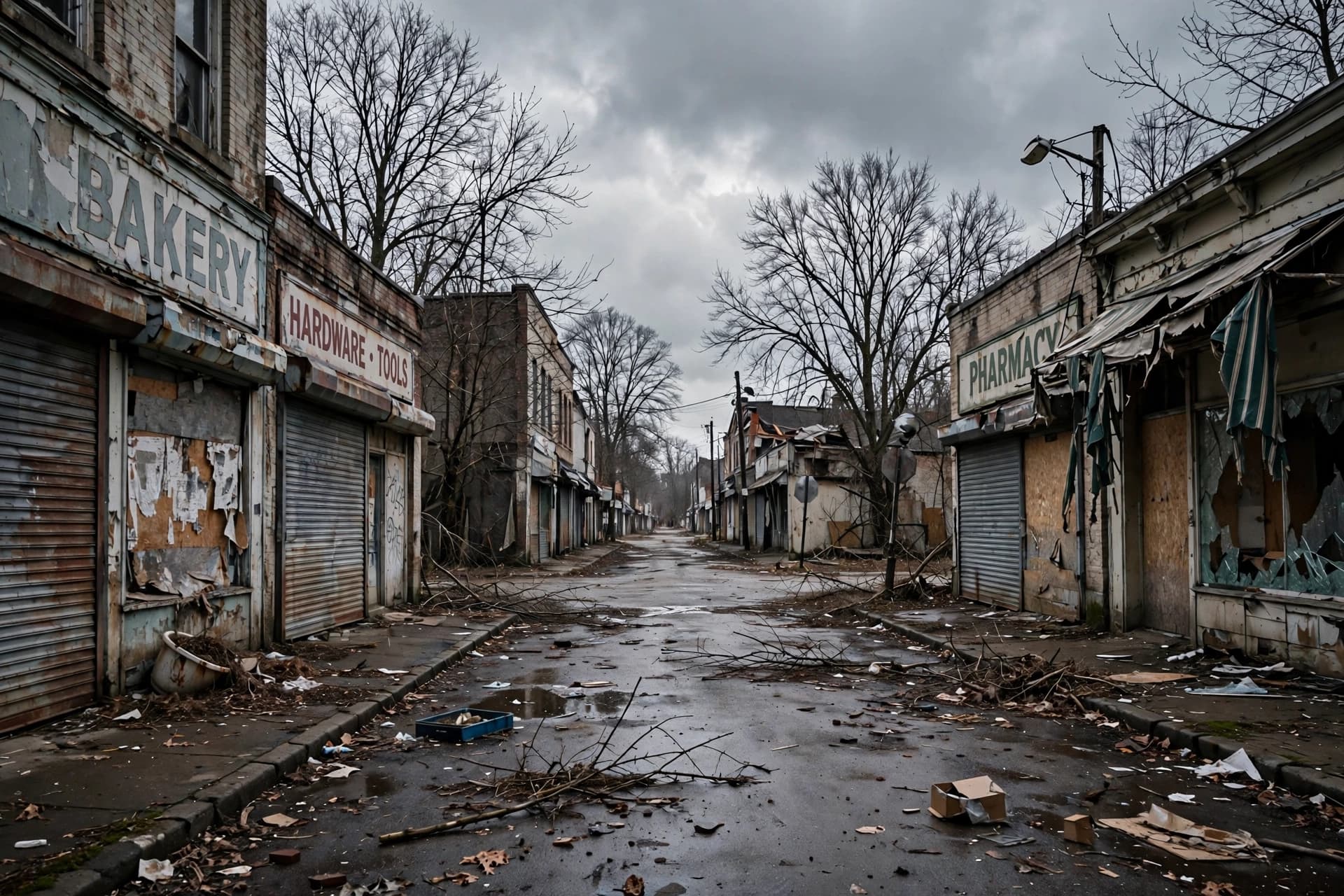
There is a particular silence that settles over a city when its streets no longer carry the sounds of commerce—when the shops are shuttered, the markets empty, the ordinary rituals of daily life reduced to a search for something to eat. In Oleshky, a small city on the left bank of the Dnipro River in Russian-occupied Kherson region, that silence has become something closer to a held breath.
Approximately 2,000 civilians remain in Oleshky, including about 50 children, according to Ukrainian Foreign Minister Andrii Sybiha. Before Russia's full-scale invasion, the city's population exceeded 24,000. The city has no electricity or gas. Food, medicine, and other essentials have been blocked for the past month. Reports indicate that residents are searching for scraps of food and gathering grass to survive.
Sybiha described the situation as a deliberate humanitarian catastrophe. "Russia is deliberately creating a humanitarian catastrophe in the occupied part of the Kherson region," he said. "It is blocking access to food and medicine, obstructing humanitarian access and the evacuation of civilians, while Russian FPV drones hunt people in the streets".
The blockade is not absolute in its enforcement. On Saturday, Ukrainian military units carried out a drone operation that dropped four tonnes of food at 100 different locations across Oleshky, using several waves of drones. Regional authorities said the boxes contained food and cooking oil and would give people the opportunity to live there for up to a month. But Oleksandr Tolokonnikov, deputy head of the Kherson Regional Military Administration, acknowledged that the solution could be short-lived. He also said video from the drones confirmed that Russian troops in some cases forcibly seized supplies from civilians.
The human details that have emerged from the city are fragmentary but harrowing. A woman whose 70-year-old mother-in-law managed to leave Oleshky after walking for six hours described the deterioration of the past six months: "People have been constantly searching for food. What they could obtain was sometimes just two potatoes and two pieces of garlic". Tetiana Hasanenko, the Ukrainian head of the Oleshky military administration working in exile, has shared messages from residents describing how people are exchanging information about how to cook grass and weeds that grow in gardens, because there are no basic food products.
The broader legal and moral framework is being articulated by Ukrainian officials with increasing precision. The deliberate creation of conditions aimed at destroying the Ukrainians of the occupied part of Kherson Oblast may be classified under the Convention on the Prevention and Punishment of the Crime of Genocide, Ukrainian officials argue, noting that the Kremlin has repeatedly used hunger as an instrument of war. The International Committee of the Red Cross has confirmed its readiness to participate in an evacuation, while international humanitarian organizations are ready to provide vital assistance. "The only obstacle is Russia," Sybiha said.
The aid drops are a temporary measure, a bridge across a river that has become a front line. The question that remains, as winter approaches and temperatures drop, is how long a bridge can hold when the other side refuses to let it stand. For the approximately 2,000 people still in Oleshky, the answer is measured not in policy but in days.
AI Image Disclaimer: The images in this article are AI-generated and are for illustrative purposes only.
Sources: Ukrinform, CBC News, Center for Strategic Communications (Spravdi)
Published by Banx Network. This article is part of the Banx decentralized media programme, powered by the BXE token on the XRP Ledger.