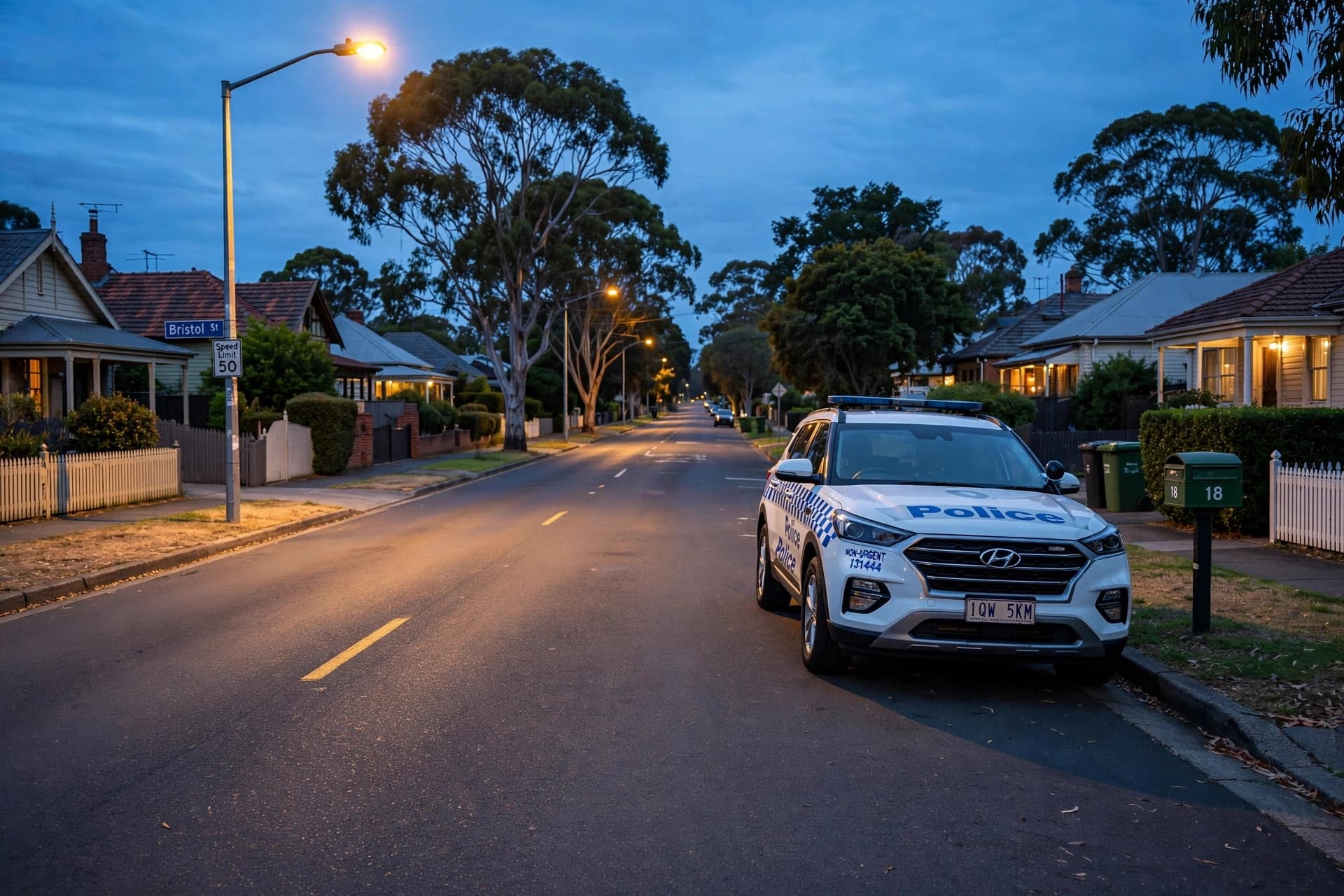
A suburban road at dusk, the ordinary choreography of cars and commuters winding toward home. For a 58-year-old man in Glenroy, a simple drive on Saturday evening became something far different—an encounter that left him hospitalized and police searching for four people on two mopeds. The details, as reported by authorities, sketch a scene that feels both random and deeply unsettling: a sideswipe, a confrontation, and a knife.
According to Victoria Police, the man was driving south on Pascoe Vale Road near Glenroy Road around 7:15 p.m. when a moped carrying two people collided with or sideswiped his vehicle. The moped, along with a second moped also carrying two riders, stopped. The riders approached the man and his passenger after both had exited the car. A brief verbal exchange followed—the kind of tense back-and-forth that might, in another moment, have ended with insurance details exchanged and tempers cooled.
Instead, police allege one of the riders produced a knife. The 58-year-old was punched in the head and struck with the blade, suffering a significant hand injury that required surgery. The four riders fled south on Pascoe Vale Road, leaving the injured man behind. Paramedics treated him at the scene before he was taken to hospital with serious injuries. As of the latest reports, he remained in hospital recovering from wounds that, while not life-threatening, carry the weight of an act that police describe as a standalone incident not believed to be linked to other Saturday night violence.
What makes such incidents linger in the public consciousness is not their frequency—road rage attacks involving weapons remain relatively rare—but their proximity to the ordinary. Most drivers have felt the flash of irritation when another vehicle cuts too close. Most have experienced the moment when adrenaline rises and judgment flickers. The vast majority of those moments end without violence. But when they do not, the consequences can be severe, and the question of what tips a confrontation toward injury becomes difficult to answer.
Detectives have appealed for witnesses and for motorists with dashcam footage to come forward. "They may have inadvertently captured the incident and exchange on camera which would assist the investigation," police said. The request is practical, but it also speaks to a broader reality: in an era when many vehicles carry cameras, the truth of what happened in those few minutes may already be recorded, waiting to be found.
For the victim, the physical recovery will take time. For the community in Glenroy, the incident adds another layer to the quiet calculus of safety that shapes daily routines—where to drive, when to stop, how to respond when a stranger approaches with anger in his posture. There are no easy prescriptions for preventing such moments. Road rage is not a policy problem in the conventional sense; it is a human one, shaped by stress, anonymity, and the fragile boundary between frustration and aggression.
Police have not suggested any broader pattern, and it would be speculative to draw conclusions about motive or context beyond what authorities have released. What remains is a straightforward case: a man injured, four people sought, and an appeal to the public for information that could bring clarity. Anyone with information is urged to contact Crime Stoppers.
---
AI Image Disclaimer: All visual content in this article is artificially generated and does not depict real persons or events.
Sources: 7NEWS, News24 Australia, Victoria Police statements
Published by Banx Network. This article is part of the Banx decentralized media programme, powered by the BXE token on the XRP Ledger.