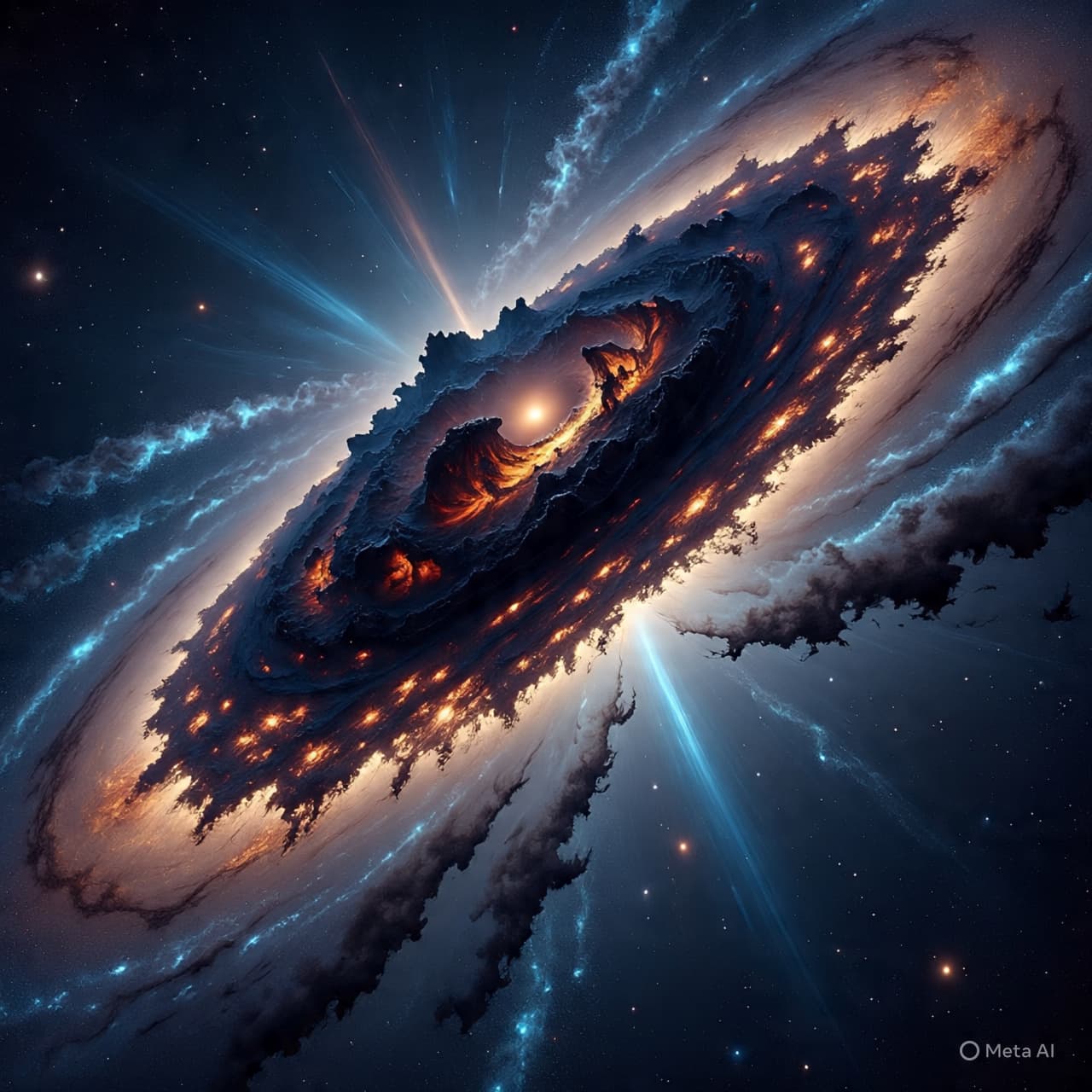
In the gentle play of night and memory, there are moments when the universe seems to whisper hidden truths rather than shout them. We often imagine stars as brilliant lanterns that brighten in dramatic final acts; yet, sometimes a star’s farewell is a quiet unraveling, a fading lull rather than a roaring curtain call. That soft disappearance — humble in cosmic terms — can nevertheless illuminate some of the most profound mysteries of how stars live and die.
Astronomers recently found themselves retracing such a whisper from the nearby Andromeda Galaxy, where a massive star named M31‑2014‑DS1 once shone with steady light. Instead of ending its life in a spectacular supernova explosion, this star dimmed slowly over years and eventually vanished from view — only to be revealed later as having collapsed directly into a black hole, a scenario long predicted by theory but seldom seen in such clear detail.
In 2014, instruments recorded a slow rise in the star’s infrared glow — a signal that faded only gradually, nearly unnoticed among astronomical data. It lingered there in public archives, waiting quietly for researchers to spot it. When a team led by astrophysicist Kishalay De of Columbia University revisited these observations with modern analysis, they found the clearest evidence yet of a star dying without a bang — a “failed supernova” that simply collapsed in on itself.
The process unfolded not with a flash of exploding gas and light, but with the star shedding its outer layers over time, leaving behind a shell of dust and gas that breathed its last in the faint warmth of infrared emissions. By the time visible light faded to nothing, only the dense core remained, bending space around itself and forming a black hole some five times the mass of our Sun.
This discovery gently nudges astronomers to rethink how many stars might end their lives quietly. For years, scientists assumed that stars of this size — roughly thirteen times the Sun’s mass in youth — should always detonate as supernovae. But the evidence from Andromeda suggests that direct collapse into a black hole can happen without fireworks, and may be more common than once thought.
That lesson also serves as a quiet reminder of how much cosmic history lies hidden in data that have already been collected. Overlooked signals, faint and subtle, may contain clues about star death, black hole formation, and the unseen processes that shape the universe. In revisiting this archival light, scientists not only uncovered a rare event but also reaffirmed the value of patient, careful observation.
Tonight, as telescopes peer into the depths of distant galaxies, they do so knowing that not every ending shines brilliantly. Sometimes a star’s last words are whispered, not spoken — and that whisper can reveal the universe’s most intimate transitions.
In straight scientific terms, the star M31‑2014‑DS1 in the Andromeda Galaxy exhibited a slow increase in infrared brightness before fading and disappearing, indicating a direct gravitational collapse rather than a classical supernova. This event provides the clearest observational evidence to date of a star forming a black hole without prior explosive detonation. The findings were published in Science and may influence models of stellar evolution and black hole demographics.
AI Image Disclaimer Graphics are AI‑generated and intended for representation, not reality.
Sources (just media names) BBC Sky at Night Magazine Reuters Sci.News EurekAlert! Space.com
Published by Banx Network. This article is part of the Banx decentralized media programme, powered by the BXE token on the XRP Ledger.