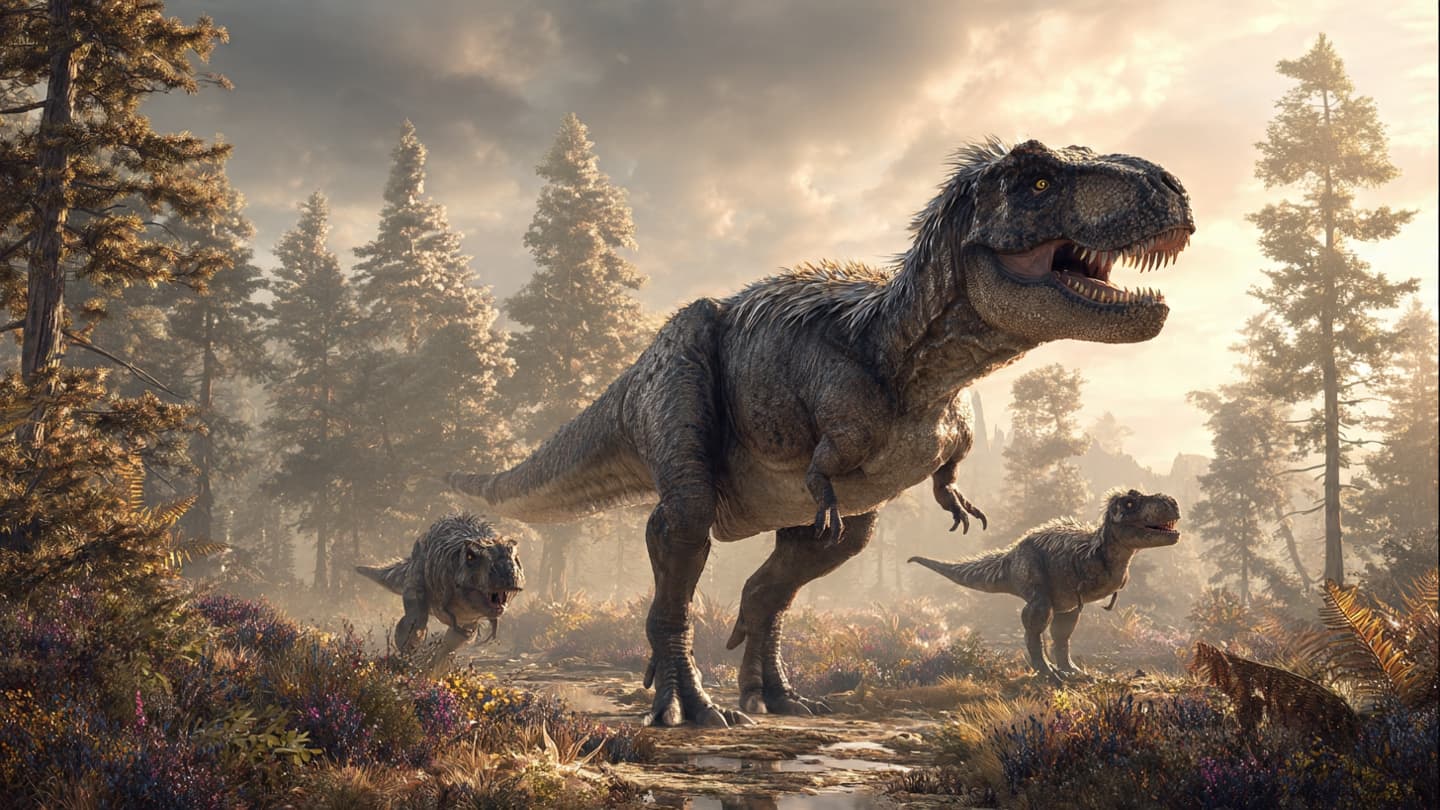
The image of Tyrannosaurus rex often arrives fully formed in the imagination: immense, powerful, and dominant. Yet new research suggests that this prehistoric giant may have reached its legendary stature not through rapid growth, but through patience measured across decades.
Scientists examining fossilized bones have concluded that T. rex may have required as many as 40 years to attain its full adult size of roughly eight tons, substantially longer than earlier estimates suggested.
Researchers analyzed microscopic growth structures preserved within leg bones from multiple Tyrannosaurus specimens. Advanced imaging techniques revealed previously overlooked growth markers, allowing scientists to reconstruct a more complete developmental timeline.
Earlier studies had suggested that T. rex reached adult size in approximately 20 to 30 years. The revised estimate indicates a slower and more flexible growth pattern influenced by food availability and environmental conditions.
Rather than growing at a constant rate, the dinosaurs appear to have experienced periods of accelerated growth interspersed with slower years, much like fluctuations observed in some modern animals.
Paleontologists suggest this prolonged development may have provided ecological advantages. Juvenile, subadult, and mature Tyrannosaurus individuals likely occupied different ecological niches, reducing competition among members of the same species.
The findings also imply that some famous specimens, including exceptionally large individuals, may have still been growing when they died. Researchers now believe T. rex may have lived longer than previously assumed, potentially reaching ages approaching 50 years.
Beyond refining growth estimates, the study demonstrates how evolving analytical techniques continue reshaping scientific understanding of even the world's most extensively studied dinosaurs.
More than a century after its discovery, Tyrannosaurus rex continues to reveal new details about its life history, reminding scientists that ancient bones still hold untold stories.
AI Image Disclaimer: Images featured alongside this article are AI-generated artistic representations based on current scientific understanding.
Sources: Reuters, PeerJ, Scientific American, Oklahoma State University researchers
Published by Banx Network. This article is part of the Banx decentralized media programme, powered by the BXE token on the XRP Ledger.