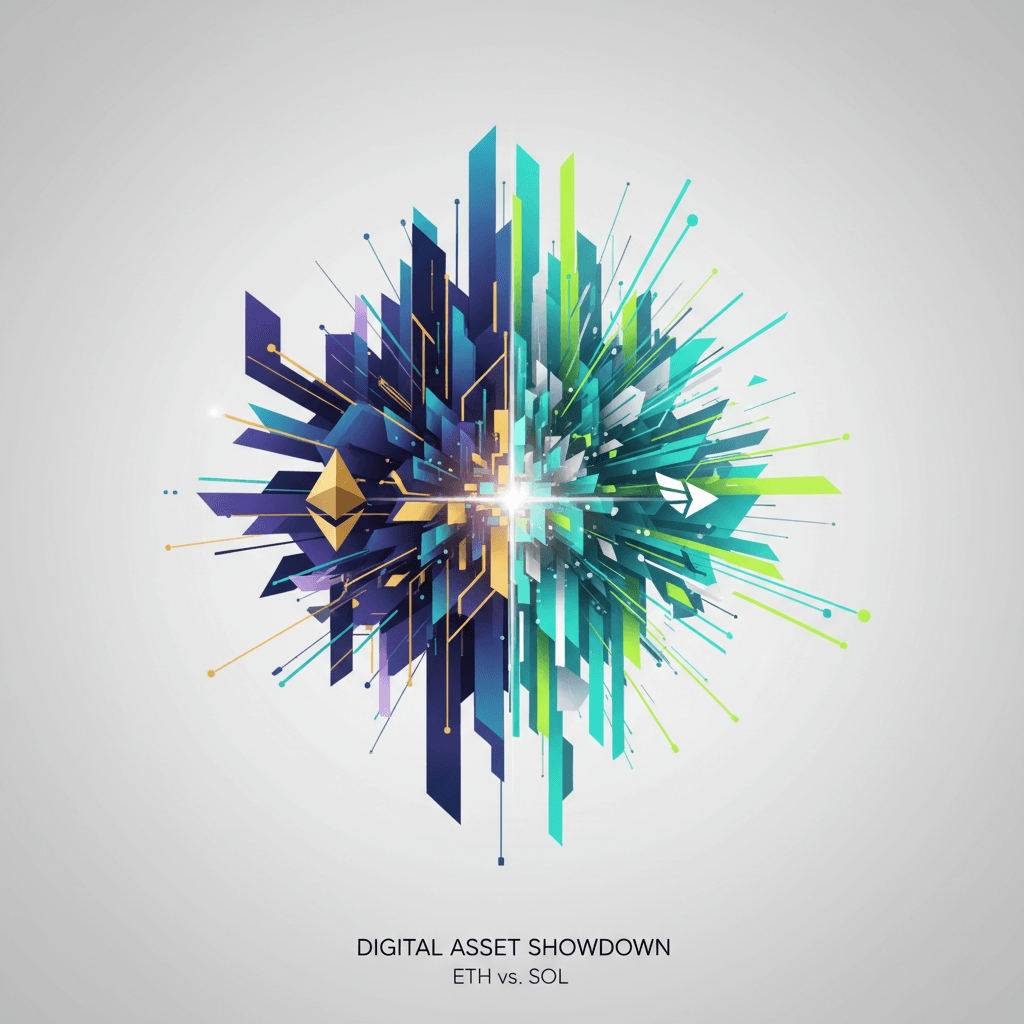
A quiet hum, almost imperceptible at first, often precedes the most profound shifts in financial landscapes. It’s the sound of capital re-evaluating its loyalties, of narratives being subtly rewritten. Right now, that hum is particularly resonant around two titans of the decentralized world: Ethereum and Solana. The question isn't just about which offers a better return on a hypothetical $2,000 investment; it’s about understanding the very different philosophies they embody, the divergent paths they trace through the digital agora.
For years, Ethereum has been the undisputed sovereign, its network a bustling metropolis of innovation. Developers flocked to its robust, battle-tested infrastructure, building everything from DeFi protocols to NFT marketplaces. What strikes me about this enduring dominance isn't just its first-mover advantage, but the sheer gravitational pull of its ecosystem. JPMorgan analysts, in their February 2024 report, highlighted Ethereum's unparalleled developer activity and the depth of its liquidity pools as key strengths, suggesting its network effect remains formidable. It’s the established empire, with all the security and inertia that implies. Look, the numbers don't lie: Ethereum's total value locked (TVL) consistently dwarfs all other chains, a testament to its foundational role.
Then there's Solana, the brash challenger, often framed as the sleek, high-speed rail to Ethereum’s more traditional, albeit reliable, locomotive. Its promise of lightning-fast transactions and significantly lower fees has drawn a different kind of energy, attracting projects and users frustrated by Ethereum's occasional congestion and gas costs. Messari's Q4 2023 State of Solana report noted a staggering 300% increase in active addresses year-over-year, alongside a surge in decentralized exchange (DEX) volumes. This isn't some sudden, impulsive leap; it feels more like a slow, deliberate migration of certain use-cases, particularly those demanding high throughput and micro-transactions. As any Tokyo trader will tell you, speed can be everything in a liquid market.
But here's what nobody's talking about: the very strengths that define these networks also carve out their vulnerabilities. Ethereum’s decentralization and security, while paramount, come at the cost of scalability. Its move to proof-of-stake, while a monumental engineering feat, hasn't entirely resolved the fee issue for everyday users, relying instead on a burgeoning ecosystem of Layer 2 solutions. It’s a multi-layered city, complex and sometimes confusing to navigate. Solana, for all its speed, has grappled with network stability issues, experiencing several outages that, frankly, shake investor confidence. The view from Singapore, a hub for high-frequency trading, often emphasizes reliability above all else. A fast network that occasionally stops isn't fast at all, is it?
The real twist, perhaps, lies not in a direct competition, but in a subtle, almost unnoticed convergence. Both networks are, in their own ways, becoming more modular. Ethereum's Layer 2s are essentially externalizing execution, while Solana is exploring Firedancer and other scaling solutions that could enhance its resilience. It's less a zero-sum game and more a specialization of roles. One might consider it akin to the evolution of global shipping: some ports are deep-water behemoths for massive cargo, others are nimble hubs for rapid distribution. Each serves a distinct, yet interconnected, purpose.
I've watched these cycles unfold for nearly two decades, from the dot-com boom to the early days of Bitcoin. What strikes me about this moment isn't just the technological innovation, but the evolving investor psychology. The Motley Fool's recent query about a $2,000 allocation highlights a retail interest that often overlooks the deeper architectural debates. It's a question of perceived value versus intrinsic utility, of speculative fervor versus long-term vision. The market has a fever for speed, yes, but does it truly understand the cost of that velocity?
Ultimately, the choice between Ethereum and Solana isn't just a technical one; it's a bet on different futures. Is the future a highly secure, deeply decentralized, albeit slower, foundational layer, augmented by a constellation of scaling solutions? Or is it a lightning-fast, integrated chain that prioritizes user experience, even if it means a slightly different compromise on decentralization? Perhaps the real question isn't which crypto is the better buy, but whether we’ve been asking the right questions about the digital infrastructure we're building.
AI Image Disclaimer
Visuals are created with AI tools and are not real photographs.
Source Check Credible sources exist for this article:
Bloomberg Reuters CoinDesk Messari JPMorgan The Motley Fool
Published by Banx Network. This article is part of the Banx decentralized media programme, powered by the BXE token on the XRP Ledger.