1. When Seeing Is No Longer Believing
For years, online scams often contained clues that made them easier to recognise: suspicious spelling, poor-quality images, implausible promises or messages from unfamiliar accounts. Generative artificial intelligence is weakening some of those warning signs.
Deepfakes are digitally generated or manipulated videos, images and audio recordings designed to imitate real people or create convincing fictional identities. Criminals can use these tools to make a celebrity appear to endorse an investment, imitate a relative asking for emergency assistance or impersonate an executive instructing an employee to transfer money.
The technology does not need to be perfect. It only needs to appear convincing long enough for a victim to act.
The UK Government's Office for Science reported in February 2026 that approximately eight million deepfakes were shared in 2025, compared with around half a million in 2023. The figures illustrate the rapid expansion of synthetic media, although they do not mean that every deepfake is fraudulent or harmful. [1]
The concern is that increasingly accessible AI tools are allowing criminals to make familiar scams more persuasive, personalised and scalable.
2. UK Fraud Reports Reveal a Growing AI Threat
The UK's latest fraud intelligence provides a clearer picture of how the technology is being used.
In September 2026, City of London Police reported that cases in which victims identified AI as a factor increased by 395% between the 2024–25 and 2025–26 financial years. The number of reports rose from 193 to 956, while reported losses associated with AI-enabled crime increased from £1.2 million to £9.6 million. [2]
These figures should be interpreted carefully. They represent reports in which victims identified AI as a factor, not a complete count of all deepfake scams or all fraud involving AI. Some victims may not realise that synthetic content was used, meaning the true scale is difficult to establish.
Nevertheless, the figures highlight a serious challenge for law enforcement.
Criminals can combine AI-generated videos, cloned voices, manipulated images and fake websites to create a convincing story around a fraudulent investment or payment request. Each element reinforces the others, making it harder for a victim to recognise the deception.
Investment fraud was the largest category among the AI-enabled reports highlighted by City of London Police. Victims described seeing AI-generated videos in which trusted public figures appeared to endorse investment opportunities. [2]
This is particularly concerning because financial scams often exploit trust before they exploit money.
3. The Fake Celebrity Investment Trap
One of the most visible uses of deepfake technology is the fraudulent investment endorsement.
A victim may encounter a video on social media showing a well-known entrepreneur, financial commentator or public figure promoting an investment platform. The person appears to explain how the opportunity works, describe impressive returns and encourage viewers to sign up.
The video may look like a genuine television interview or news report. The linked website may contain professional graphics, fabricated testimonials and an account dashboard displaying apparent profits.
Yet the endorsement, platform and displayed returns may all be fake.
In February 2026, the Bank of Italy warned about fabricated articles, images and videos featuring its governor, Fabio Panetta, apparently appearing in media programmes or endorsing investment products. The central bank said the material was fabricated and, in several cases, created using deepfake techniques. It also lodged a complaint with judicial authorities. [3]
The broader lesson extends beyond cryptocurrency. Fraudsters can use the same approach to promote fake trading services, questionable financial products or fraudulent schemes involving shares and other assets.
Crypto can be especially attractive to scammers because some transfers are difficult or impossible to reverse once confirmed. However, the presence of cryptocurrency does not automatically indicate fraud, just as a celebrity endorsement does not establish that an investment is legitimate.
The key warning sign is not simply an unrealistic video. It is an investment offer that relies on borrowed credibility, pressure to act quickly or promises of exceptional returns without independently verifiable evidence.
4. Voice Cloning: When a Familiar Voice Becomes a Weapon
Video is only part of the problem. In some situations, a cloned voice may be even more effective because people are accustomed to trusting familiar voices over the telephone.
A criminal can use recorded speech to create an AI-generated imitation of someone's voice. That imitation may then be used in a call, voice message or other communication intended to persuade a victim to disclose information, authorise a payment or believe that an emergency has occurred.
In February 2026, National Trading Standards warned about an operation in which criminals allegedly used information gathered through supposed lifestyle-survey calls to support voice cloning. The cloned voices were then used to simulate consent for unauthorised direct debits, according to the organisation. [4]
The case demonstrates that voice-cloning fraud is not limited to the familiar scenario of a fake emergency call from a relative.
It can also target the systems businesses use to confirm identities and authorise payments.
A convincing voice should therefore no longer be treated as sufficient proof of identity. Even details such as a person's accent, tone or speaking style may be imitated.
For families, a practical defence is to agree on a private verification phrase or another method of confirming urgent requests. For businesses, payment approvals should rely on established verification procedures rather than voice recognition or a single phone call.
5. Businesses Face a New Kind of Executive Fraud
Companies are also vulnerable to criminals who impersonate senior managers, suppliers, lawyers or finance professionals.
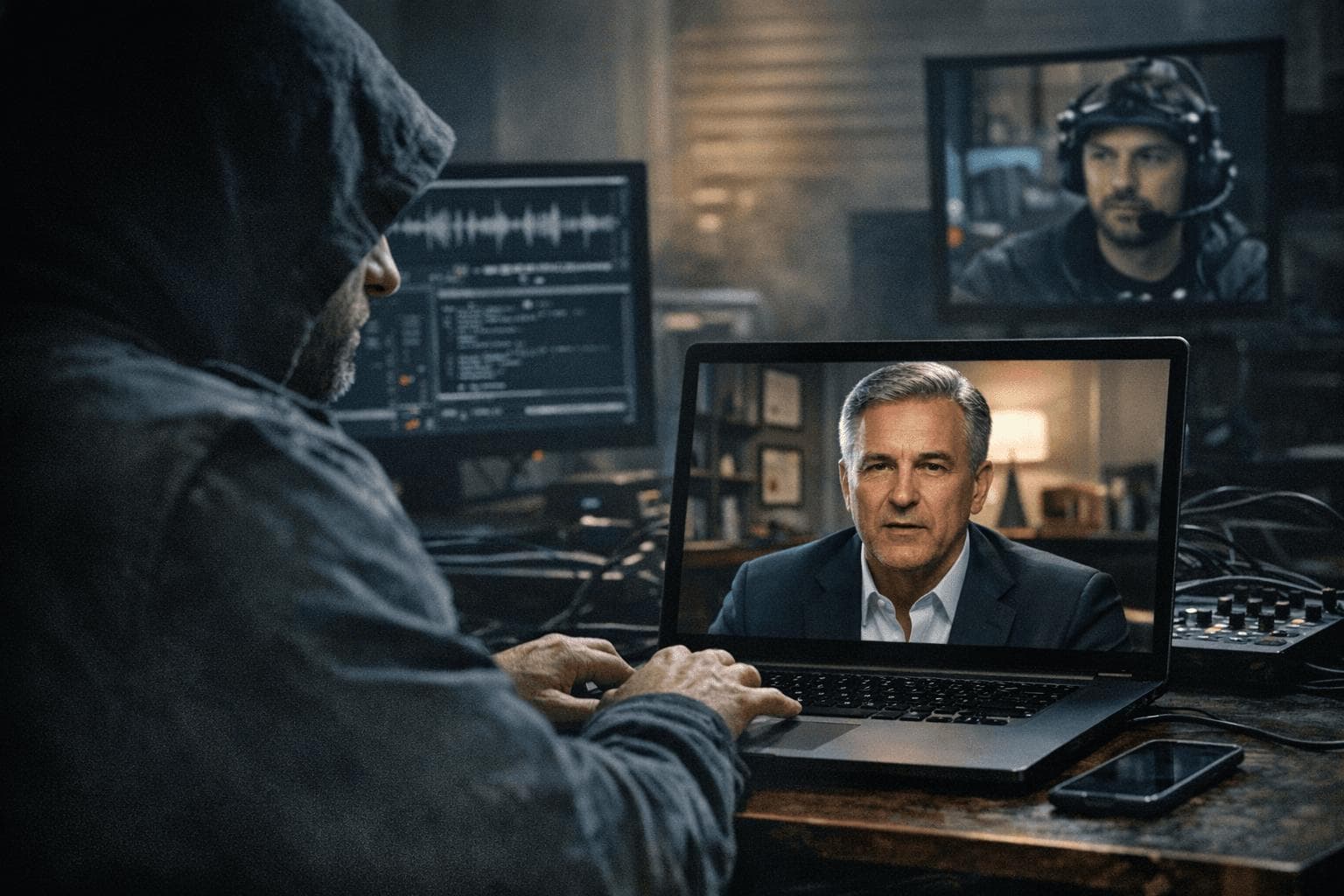
Imagine an employee receives a video call that appears to involve the chief executive. The caller requests an urgent transfer, claims a confidential acquisition is underway or explains that a supplier's bank details have changed.
The employee may recognise the person's face and voice, see a familiar name on the meeting invitation and believe the request is genuine.
But visual familiarity is not the same as authentication.
This type of attack can exploit business hierarchies and workplace pressure. Employees may feel uncomfortable challenging a senior executive, particularly when a request is described as confidential or time-sensitive.
The potential consequences include fraudulent bank transfers, compromised business accounts, exposure of confidential information and damage to supplier relationships.
Businesses can reduce the risk by requiring independent confirmation of payment changes, using multi-person approval for substantial transfers and establishing clear procedures for unusual requests. These controls should apply regardless of whether a request arrives through email, telephone or video conference.
Crucially, staff should be encouraged to question suspicious instructions without fear of being criticised for delaying a transaction.
A company that relies on employees recognising familiar faces is building its security around a signal that criminals can increasingly reproduce.
6. Why Deepfakes Are Becoming Harder to Detect
Early synthetic videos sometimes contained obvious imperfections, such as unnatural facial movements, inconsistent lighting or unusual audio synchronisation. Those clues can still be useful, but they are not dependable enough to serve as a complete defence.
The technology is developing, and the quality of generated content varies. Some fakes remain easy to identify, while others may appear convincing to ordinary viewers.
The UK Government's March 2026 research into deepfake-detection technology described the sector as being at an early stage, despite progress in research and evaluation. [5]
Detection tools can analyse signals that may be difficult for a human viewer to notice. Depending on the system, these may include inconsistencies in an image, audio characteristics or information about how content was created.
However, no single detection approach should be treated as infallible. Performance can vary depending on the media, the manipulation technique and the quality of the original material. A tool that works well on one type of fake may perform less reliably on another.
There is also a practical problem: a person receiving a suspicious message may not have access to specialist detection software, and even an automated result may not settle the question.
The safest approach is to combine technical analysis with independent verification of the person, organisation and claim involved.
7. Can Governments and Technology Companies Stop the Scams?
Governments, law enforcement agencies, banks and technology companies all have a role in reducing deepfake-related fraud, but no single intervention is likely to eliminate it.
In February 2026, the UK Government's Office for Science described a cross-government initiative to evaluate deepfake-detection tools against real-world problems, including impersonation and fraud. The aim is to better understand how effectively these systems identify harmful synthetic media. [1]
Such testing matters because a detection tool needs to work outside a controlled demonstration. It must be assessed against varied content and realistic threats.
Technology companies can also help by improving reporting systems, identifying coordinated scam campaigns, adding provenance information to generated media and disrupting fraudulent accounts and advertisements.
Content provenance is particularly promising. Systems that record where a piece of media came from and how it has been altered can help establish its history. However, provenance information may be absent, stripped away or unavailable for content created using other tools. Its absence does not automatically prove that a file is fake.
Banks and payment providers have a separate responsibility to assess suspicious transactions, strengthen identity verification and make it easier for customers to report potential fraud.
Ultimately, prevention requires several layers of protection. Detection technology can assist, but it cannot replace sound payment controls, effective enforcement and informed users.
8. What Individuals Can Do to Protect Themselves
Ordinary users do not need to become experts in AI to reduce their exposure to deepfake scams. The most effective habits focus on verifying requests and resisting pressure.
Pause when a message creates urgency. A request to transfer money immediately, keep a transaction secret or act before an offer expires deserves extra scrutiny. Fraudsters often use urgency to prevent independent checks.
Verify through a separate channel. If a relative calls requesting emergency funds, contact them using a number you already know. If a manager requests a payment, confirm the instruction through an established internal process rather than replying to the same message.
Investigate investment claims independently. Do not rely on a video, testimonial or social media account. Check the relevant financial firm's regulatory status through official sources and be wary of websites that imitate legitimate organisations.
Treat unusual requests for personal information cautiously. A voice or face that appears familiar is not a reason to disclose passwords, security codes or banking details.
Do not rely solely on visual clues. Strange movements or poor audio may raise suspicion, but a polished video is not proof of authenticity either.
Be selective about personal information shared publicly. Recordings and publicly available details can potentially help criminals construct more convincing impersonations. Reducing unnecessary exposure may make targeted scams more difficult, although it cannot prevent every attempt.
The UK Government's Stop! Think Fraud guidance highlights trusted voices, false urgency and emotional pressure as common tactics criminals use to manipulate victims. [6]
The principle is simple: verify the request independently, not merely the appearance of the person making it.
9. The Wider Problem: Trust in Digital Evidence
The impact of deepfakes extends beyond direct financial losses.
If people become accustomed to seeing fabricated videos and hearing cloned voices, they may become more sceptical of genuine recordings. Authentic evidence could be dismissed as fake, while fabricated material could be accepted as real.
This creates a problem for journalism, businesses, public institutions and the justice system.
A video may appear to show a public figure making a controversial statement, but its authenticity may be disputed. A recording used in a workplace investigation could require independent examination. An apparently genuine message from a business leader might need to be verified before it can justify a major financial decision.
The answer is not to assume that all digital evidence is unreliable. Instead, organisations may need stronger procedures for establishing where evidence originated, whether it has been altered and whether independent information supports its contents.
That could increase costs and slow some decisions. But the alternative — treating every convincing recording as genuine — carries its own risks.
The challenge is to preserve the value of digital evidence while recognising that appearance alone is becoming less conclusive.
10. The Business of Deepfake Detection
The rise of synthetic media is also creating demand for tools that can identify manipulated content and strengthen digital identity verification.
Potential applications include fraud monitoring for banks, identity checks for financial services, media verification for news organisations and security systems for businesses handling sensitive transactions.
However, the commercial opportunity should not be confused with a guaranteed investment outcome.
The UK Government's 2026 research describes the deepfake-detection market as nascent, with barriers to adoption and scaling still present. [5] Buyers will need to determine whether tools work reliably in their specific environments and whether their benefits justify the cost.
Detection providers also face an evolving threat. As generative systems improve, detection methods may need frequent updates, testing and retraining. Businesses may therefore require a combination of tools rather than a single permanent solution.
For investors, the sector may offer opportunities across cybersecurity, identity verification, fraud analytics and content provenance. But the most credible businesses will need to demonstrate measurable performance, clear customer demand and a sustainable business model.
The strongest defence may not come from detecting every fake after it appears. It may come from designing financial and digital systems that do not rely on trusting a face, voice or video in the first place.
Conclusion: Trust Must Be Verified, Not Assumed
Deepfake technology is creating a new challenge for a digital economy that has traditionally relied on familiar voices, recognisable faces and convincing documents as signals of trust.
The latest UK fraud figures suggest that AI-enabled deception is becoming a more visible concern, while investment scams and voice-cloning attacks show how the technology can be used to exploit established weaknesses.
Yet the solution is not to abandon digital communication or assume every video is fraudulent. It is to change how trust is established.
Individuals need to verify urgent requests independently. Businesses need stronger payment controls and identity checks. Financial institutions must continue improving fraud detection, while technology companies and governments need to test and refine safeguards.
Deepfake detection will be part of the response, but it is unlikely to provide a universal solution on its own.
In an age when a face can be fabricated and a voice can be cloned, the most important security measure may be a simple one: never let a convincing appearance replace independent verification.
Sources
[1] UK Government, Office for Science — Science-led collaboration against deepfakes https://www.gov.uk/government/case-studies/science-led-collaboration-against-deepfakes
[2] Report Fraud / City of London Police — City of London Police intelligence assessment highlights emerging fraud trends and evolving threats https://www.reportfraud.police.uk/news/city-of-london-police-intelligence-assessment/
[3] Reuters — Bank of Italy warns over deepfake video scams using Governor Panetta https://www.reuters.com/business/finance/bank-italy-warns-over-deepfake-video-scams-using-governor-panetta-2026-02-26/
[4] National Trading Standards — Phone scams take sinister twist as victims’ voices cloned https://www.nationaltradingstandards.uk/news/phone-scams-take-sinister-twist-as-victims-voices-cloned/
[5] UK Government, Department for Science, Innovation and Technology — Deepfake detection technology https://www.gov.uk/government/publications/deepfake-detection-technology/deepfake-detection-technology
[6] Stop! Think Fraud — Recognise the tactics https://stopthinkfraud.campaign.gov.uk/how-to-spot-fraud/recognise-the-tactics/
Published by Banx Network. This article is part of the Banx decentralized media programme, powered by the BXE token on the XRP Ledger.